The secrets of the most frightening army in history. How did he manage to dominate their opponents without giving them any chance of defense


In the 13th century, on Europe, one of the worst invasions in its history. The Mongols managed everything in the way and quickly swallows the armies of European kings and princes. The specialists identified a number of secrets of these steppe warriors.
The Mongolian photo of the Wikipedia photo
At the beginning of the 13th century, a huge threat started from the steppes of Central Asia and will pour to the East and West at a lightning speed. It was about the Mongolian hordes, Ghenghis Han's steppe riders, one of the most important leaders in the history of the world. After managing to unite under his scepter all the tribes gathered from all corners of the steppes beaten by winds, Ghenghis Han set up an army that had no rival in history. Although perceived at the broad or film level as a unleashed horde, Ghenghis Han's army was, in fact, one of the most disciplined, well organized and equipped history. The specialists identified some secrets of the incredible success of the Mongols.
The warriors who kneeling the world
In 1223, the power of Ghenghis Han was at the peak. With a strong, flexible and very effective army, the Great Han managed to establish a strong empire to the detriment of great Asian economic and political forces, such as the Persians or the Chinese. After submitting much of the East, Ghenghis Han turned west. His armies led by General Subotai crossed the north-pontic steppes and attacked the Russian states. In the battle of Kalka, the armies of the Russian cnes were crushed by the Mongol forces. Entire areas of Ukraine were destroyed and robbed by his sub -tales armies. The Mongolian hosts, after this crushing victory, returned to Asia. In 1227, at the death of Ghenghis Han, the Mongol Empire stretched from the Caspian Sea to the Sea of Japan, on 33 million square kilometers. After a brief dynastic struggle, the empire is taken over by Ogodai, the son of Ghenghis Han.
He resumed his father's expansion policy. After securing peace in the East, Ogodai turned his attention to the west. This time it was no longer about an adventure but about a war of conquest in all the rule. Ogoda ordered Batu Han to go on an expedition against Russian cnesters. A huge horde led by Mongke Han and Guyuk Han was heading for Ryazan in 1237. Ryazan was attacked, defeated and robbed. The hordes repeated the scenario in Suzdal and in other areas. The cns fell one after the other in front of the Mongols. The great prince was defeated in the battle of the Sit River in 1238 and the biggest cities fell into the hands of Mongols. The Mongolian hosts advanced like a roller to the Dniester. The warriors of Batu Han went to Crimea, plundering the whole area and subjusing the tribes of the Alan and the Gentiles of the Cumans.
In 1239, it was the turn of Kieven Russia to endure the Mongolian hurricane. The big cities fell after each other. Finally, Kiev fell under the strokes of the steppe riders. In December 1240, Kiev was a terrible plunder by Batu Han's hordes. Followed Galicia and Voliia. Europe trembled with the fear and strength of the new invaders. They seemed unstoppable. Subotai, the general strategist of the campaign in Europe, sent spies to Poland, Germany, Austria and Hungary. Then he developed an attack plan and the one who executed was the same Batu Han, along with Guyuk and Kadan.
The Mongols invaded Central Europe with three armies. One of them crushed the Polish and German forces led by Henry II, the Duke of Silesia to Legnica. Poland was passed through fire and sword. A second army passed the Carpathians in Transylvania and the third on the Danube line. In 1241 they made the junction and destroyed the Hungarian army in the battle of Mohi. In turn, the Hungarian kingdom was devastated by the Tatar hordes. A column arrived and plundered even in the Czech Republic. Violent invasions in today's Croatia, Austria and Bulgaria followed. Central and Eastern Europe was burning under the blows of Mongols. The plans of Ogodai aimed to advance to the west. But his death stopped the invasion. The hordes withdrew to the North Pontic steppes continuing to control the significant territories. What was the secret of the invicibility of these warriors? The specialists found a series of answers.
A system of military organization that would have made them envious and the Romans
First of all, the Mongolian hordes were extremely well organized. They had an iron discipline, similar to the Roman armies. No one was accidentally moving and no commander or soldier was acting by his head, but after a well -established organizational structure. Ghenghis Han introduced the decimal system into his armies. He kept the organization on the clans and ordered the army on small, interdependent units that would move perfectly, at a sign.
“Ginghis Han's army was divided according to the decimal system: there were units composed of ten warriors (” Harban “), units composed of one hundred people (” dzhaun “) and units composed of one thousand soldiers (” Mingan “). After another series of military successes, especially after the conquest of the city of Naiman, the number of warriors increased again, and the army exceeded 100,000 people. As a result, another type of unit was introduced, composed of 10,000 people, called Tlimen. The introduction of the decimal system in the organization of the troops has led to the emergence of a simple hierarchy system. A Harbanu Noyan ordered a unit of ten people, a centurion (“Dzhaunu Noyan”) was responsible for a hundred people, the commander of a Bingan was responsible for a thousand warriors, and the commander of a Tümen was leading ten thousand soldiers. “said Witold Swietoslawski in “The Organization of the Mongols War Expections in the 12-Th and 13-Th Century.
The army was perfectly divided into three large parts. It was the center, where the elite fighters and the supreme commander were, but also the two flanks. During the attack, each unit knew its place and had its own specificity. They could change the places at any time to a perfect discipline, with specific signals, depending on the enemy found. In addition, the armies of the inn did not haunt. They had specialized units of experienced warriors called Bolgaul. They were traveling for long distances before the army, to examine the land and not to be caught unprepared. “While the army was march, the main forces were preceded by the front units, called” foreheads “(Mongol” Manglay “). The best and most experienced warriors (Mongol “Bolgaul”) belonging to the front units were sent to recognize the enemy position. Patrol positions were also occupied with soldiers of the front units, called guards (“karaul”). They were responsible for the advance armed warning of an approaching danger ”adds Witold Swietoslawski
According to Marco Polo, the troops sent to recognize an area were often quite large, made up of 200 people. The purpose of this technique was to avoid the unexpected attacks launched by the enemy. The scouts started two days before the main army left and operated in front, behind the main force wings. Carpini supports this hypothesis and says that these warriors select “were sent away, to the right and left. “
They only took with them the yurts, horses and weapons. These warriors do not plunder or set fire to houses. They never kill animals. They just hurt and kill people and, if they can't do something else, they force them to run away. But he prefers to kill people than to make them escape. They are followed by the army, and the soldiers take everything they can find. If I meet people, I take them captives or kill them ”add Carpini.
In addition, the Mongolian army had specialized troops in identifying food resources and subsequent desolation of the territory to see the enemy army and to establish terror. No less important were the mongoles sent, in very small groups, weeks or even months before, to inflict and map the territory on which the great Mongolian army was to come. Thus, the Mongol commander knew very well what rivers, mountains or cities were in his way. They were far beyond what the European armies of the time could logistically and computerally.
A quick army and with very effective weapons
In addition to this organization, the Mongolian warriors were extremely well -awaited. Raised in the harsh steppes of Asia, with hot summers and cold winters, they were accustomed to riding from an infant baby. As a child they were taken to hunt and learned to kill with the bow, spear, but also other weapons. They knew how to attack perfectly from the horse's chase. We are not talking about the games of teenagers and young people who made the masters of the war. They were able to cross huge distances on the horse and survive in the hardest conditions. Each Mongol was able to carry out small infrastructure works. They all wore a small ax for cutting wood, a pile for sharpening the arrow tips, a lasome (usually made of horse hair), rope, needle and thread, sewing slope, leather bottles, a small cook pot and a waterproof bag. A group of ten men (known as Arban) carry a tent. The warriors were specialized.
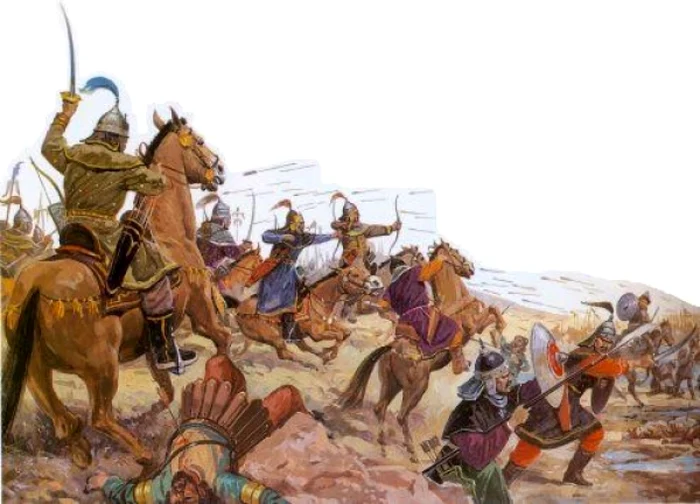
Some were part of the light tribal cavalry and attacked quickly, in the flanks, others formed the heavy, shock, dressed in heavy armor, handling lanes, sometimes with hooks and traps, for attack. There were no missing from the arsenal of the Mongolian warriors, the coat for the cavalry and the curved swords. The most legendary weapon of Mongols was the composite arch. It was made of a mixture of materials glued to each other. More precisely, Iac's horn, tendons and bamboo. With this weapon they could shoot at over 230 meters. The same Carpini confessed that the Mongols used two types of arrows, the lightest used for long distance and wider and heaviest firing for short distance rocket attacks. To this end, the arrowheads were manufactured and treated with a special technique in which they were heated to incandescent temperatures and then immediately submerged in salt water. This instilled in them a higher quality of armor perforation.