The days seem getting shorter – and it's not just an impression. According to scientists, in the summer of 2025, the Earth had several days shorter than the 24 -hour standard. On July 9, July 22 and August 5, the duration of a day was between 1.3 and 1.51 milliseconds less than normal.
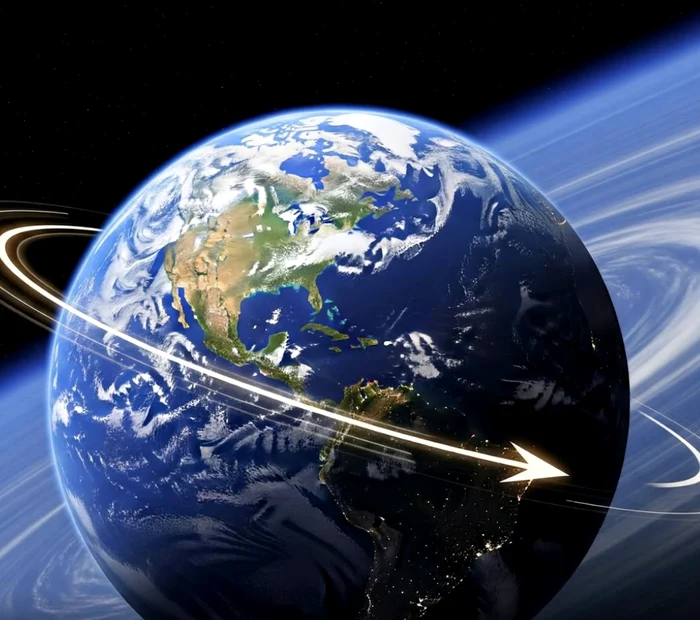
If the earth's rotation speed would increase, a pronounced centrifugal effect would appear/Photo: Archive
Although the differences are small, the researchers warn that behind these variations could be important geophysical phenomena, such as changes in the planet's atmosphere, accelerated glaciers, earth nucleus movements and weakening the magnetic field, writes the Daily Mail.
In a new science-fiction novel entitled Circular Motion, the author Alex Foster imagines an extreme scenario: an acceleration of the terra rotation to the point where one day takes only two hours. Although such a hypothesis remains in the field of fiction, the experts analyzed what real effects could have a significant increase in the rotation speed of the planet.
Physical effects: deformation of the planet and migration of the oceans
If the speed of rotation of the Earth would increase, a pronounced centrifugal effect would appear. Similar to the way in which the suspended chairs are removed from the axis of a carousel, the table of the planet would begin to redistribute to the equator. The result would be an equatorial “bombing”, and the earth would gain a form closer to a diamond, with slightly inclined northern and southern hemispheres.
This redistribution would significantly affect oceans. Polar waters would be pushed to the equator, which would decrease the level of the Arctic Ocean and, at the same time, to severe floods in the equatorial regions. Even the lands not covered by the waters would become much more vulnerable to frequent tsunamies and floods.
Impact on sea, climate and tectonic plates
Professor Duncan Agnew, a geophysicist at the University of California, San Diego, explains that the biggest changes would be recorded in the tides. Currently, the rotation of the Earth, together with the gravitational attraction exercised by the Moon and the Sun, generates two flows and two reflux every day. A change of only 10% of the duration of the day could significantly alter the amplitude of the tides, with areas where they would become much more intense, and in others, considerably lower.
At the same time, the acceleration of rotation would influence and the dynamics of tectonic plates. Increased speed would amplify geological tensions, increasing the risk of global earthquakes.
Effects on gravity and climate
At the equator, the current rotation speed is about 1,650 km/h, while in the poles it is almost zero. If the rotation were to accelerate significantly, the centrifugal force could counteract gravity, determining objects-and even people-to be pushed outward. Under extreme conditions, gravity could be partially canceled.
Moreover, the Coriolis phenomenon, which influences the direction of air currents and gives rise to the rotation of tropical cyclones, would become much more intense. Dr. Sten Odenwald, astronomer at NASA, warns that hurricanes could form faster, become stronger and more destructive.
The circadian rhythm, satellites and time systems
Another consequence of shortening the days would be the disturbance of the Circadian rhythm of the people – the internal biological clock of each, adapted to a 24 -hour cycle. One day, say, 10 or 8 hours, could cause sleep disorders, reduce productivity and mental health effects.
In addition, time systems should be rethought. The watches would require constant adjustments or, possibly, the implementation of a new time measurement system.
The acceleration of the ground rotation would disrupt and position the satellites. They could get out of their trajectories, affecting communications, TV broadcasts and internet access.
How realistic is such a scenario?
Professor Agnew believes that a scenario like the one described in Foster's novel is “particularly unlikely” from a scientific point of view. “There is no evidence that this could take place – and nothing similar has been observed in other planets or stars,” he says.
In reality, the rotation of the earth slows down very slowly, in a natural process. A billion years ago, a day lasted about 19 hours. Even during the dinosaurs, the duration of the day was only about 30 minutes shorter than today.
Dr. Judah Levine, a researcher at the National Institute of Standards and Technology (NIST), argues that a substantial acceleration of rotation would require the loss of the kinetic moment by another heavenly body – possibly the moon. Such a change would change the position of the Moon, approaching it from the ground and considerably amplify the effects of tides.
What determines the current variation variations?
Although the days are not always identical in duration, the variations recorded so far are of the order of milliseconds. The fastest days documented so far have been recorded in July and August 2025, but the absolute record remains July 5, 2024, when the duration of the day was 1.66 milliseconds shorter than the standard.
These changes are monitored with the help of atomic watches, which use the vibrations of atoms to measure time with extreme precision.
Researchers are currently analyzing a number of factors that could contribute to these changes, including climatic variations (such as El Niño phenomenon), accelerated melting of glaciers and the internal dynamics of the Earth – especially the movements of the molten metal in the planet's nucleus.
It is possible that all these combined processes will affect the balance of the planet and influence, even imperceptibly, its rotation.