The greatest fear of parents related to the start of the school is by no means related to money. How much does the beginning of the school year start for a Romanian, a Bulgarian or a Hungarian


With the beginning of the school, parents in Romania have the same fears with parents in neighboring countries. The first fear is common, but then the hierarchies change.
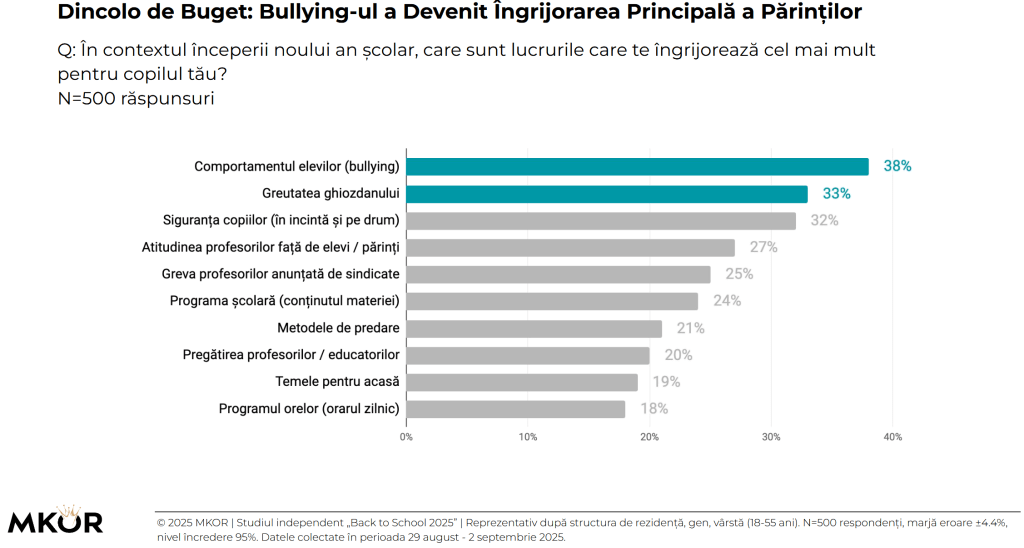
A study transmitted on Friday Hotnews- Back to School 2025- conducted by Research Mkor shows that the fear of bullying (38%) is out of the weight of the backpack (33%) or the child's physical safety (32%).
The average budget allocated for the start of the school is on average 450 RON, but hides parallel worlds: parents in the private system allocate 660 RON, over 50% more than those in the public system (430 RON).
The parallel market for meditations has been normalized: 44% of parents invest in additional training, with an average cost of 100 RON/meeting, to compensate for system deficiencies.
The shopping cart is dominated by clothes: although 83% of parents buy and supplies, the clothing budget (570 RON) is almost double compared to the one for the stationery (300 RON).
“In 2025, returning to school is no longer just about shopping cart. Parents clearly tell us: the emotional safety of children weighs more than the payment note for the backpack. Bullying is the theme that can no longer be postponed-for schools, communities and for us all.” – Cori Cimpoca, the founder of Mkor
Bullying, new anxiety no. 1 of parents
Before worries about notebooks and uniforms, parents talk about the emotional safety of their children. The fear of aggressive behaviors and conflicts between the students is felt more acute by mothers (46%) than by fathers (31%) and reaches a peak among pre -school parents, where 1 in 2 signals this problem (51%). Other practical worries, such as the weight of the backpack, become central in the secondary school (47%).
Bullying is the main concern especially in Bucharest and Ilfov, where the concern for safety climbs to 44%. Parents with higher education add on the agenda and school program (31%), a sign that pressure is not only measured in money, but also in the quality of the educational environment.
Real costs: a polarized market, beyond the average of 450 ron
Although the average budget for a child is 450 RON, it hides striking differences. In the private system, parents allocate 660 RON, over 50% more than in the public (430 RON). The regional disappearances are as sharp: in the west of the country the average budget goes up to 590 RON, while in the south it descends to 330 RON – a difference of 78%.
As children grow up, the payment notes grow: the clothing budget climbs by 36% (from 470 RON to kindergarten to 640 RON to high school), and the investment in IT products increases by 48% (from 850 RON in the primary cycle to 1260 RON).
Most parents sail with pragmatism between retail channels: 51% remain loyal to physical stores, while 41% combine online with offline in a hybrid strategy, which reaches the peak in Bucharest (52%). The final decision on the shelf is a tense negotiation between quality (50%), price (48%) and child preference (42%).
In Digital, the marketplace dominates (62%), followed by specialized online stores (45%). Bucharest leads to hybrid adoption, with 52% of parents alternating the channels to optimize the quality-price ratio and stocks available.
Meditations, a norm that deepens the inequalities
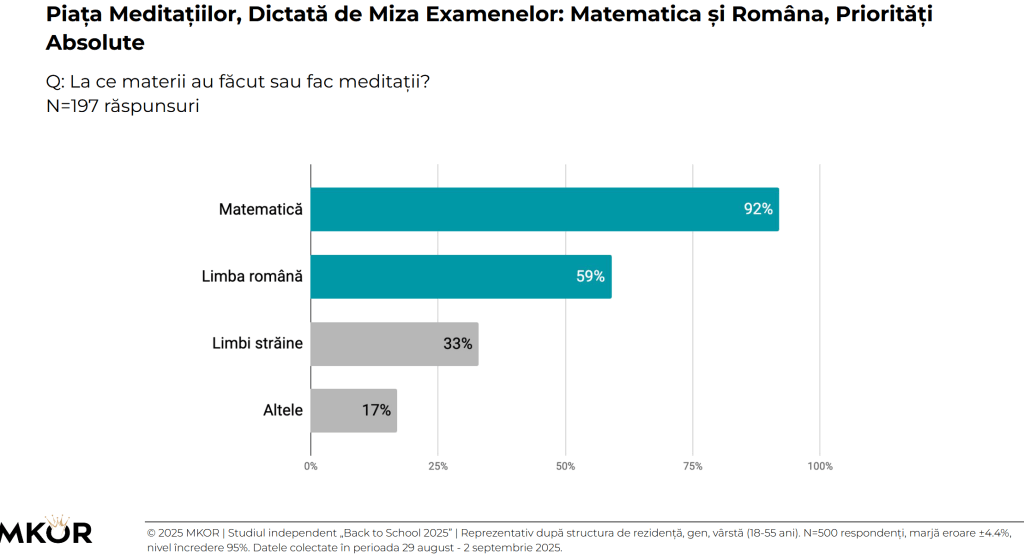
The study confirms that additional training has become a structural component of expenses. 44% of parents pay additional training, with an average cost of 100 RON/meeting.
Mathematics dominate the requests (92%of those who do meditations), followed by the Romanian language (59%) and foreign languages (33%). The pressure of the exams pushes the phenomenon in the high school (67%) compared to the mayor (21%), and the access is strongly stratified: 58% of families with high incomes and 51% of parents with higher education resort to meditations for their children, compared to 34% to low incomes and 13% to general studies – a systemic and inequity signal.
A broken vision of reality: What the Romanians from school are waiting for
The data in conjunction with the study of MKOR “Education from the perspective of Romanians” (May 2025) show that the anxieties of parents are symptoms of systemic problems. Romanians want a school that form informed and cultured people (70%), but identify as major brakes the lack of a coherent national vision (48%) and chronic underfunding (48%). This rupture between ideal and reality fuels distrust and pushes parents towards parallel solutions, such as meditations.
How much does school start in Bulgaria and Hungary
In Bulgaria, the start of public school is free for children (mandatory schooling between 5 and 16 years), but parents spend, on average, between 80 and 150 € For school supplies at the beginning of the year, depending on the region and level. Real costs grow in private or international schools: Annual tax may exceed 1 500–3 000 €without including additional supplies and services.
OCDe and UNICEF report that school harassment is common in Bulgaria and affects the psychological well -being; Parents mainly indicate this fear.
Safety issues (beats, accidents at school) are mentioned as fears, but with a lower intensity than that of harassment.
The burden of the backpack or the supplies is signaled among the material worries of the Bulgarians, but remains second in comparison with the social relations and the prevention of harassment
In Hungary, the state schooling is free, but a parent must provide between 100 and 200 € For materials and school supplies for a student, depending on the city and the school. To private or for Budapest international schools, the annual tax is usually between 4 500 and 5,500 €.
About 30% of Hungarian students said they were victims of intimidation or school harassment, according to a report by the European Commission and UNESCO.
Harassment acts especially affect LGBTIQ students, of which 82% say they were victims of verbal harassment, but the phenomenon also concerns the violence between students in general.
Physical safety is also an increasing concern: Hungarian legislation has introduced from 2020 “school guards” to prevent violence, which shows the importance of the subject for families.
The weight of the backpack is mentioned in Hungarians only as a logistical problem, much less worrying than harassment or risks of violence.