

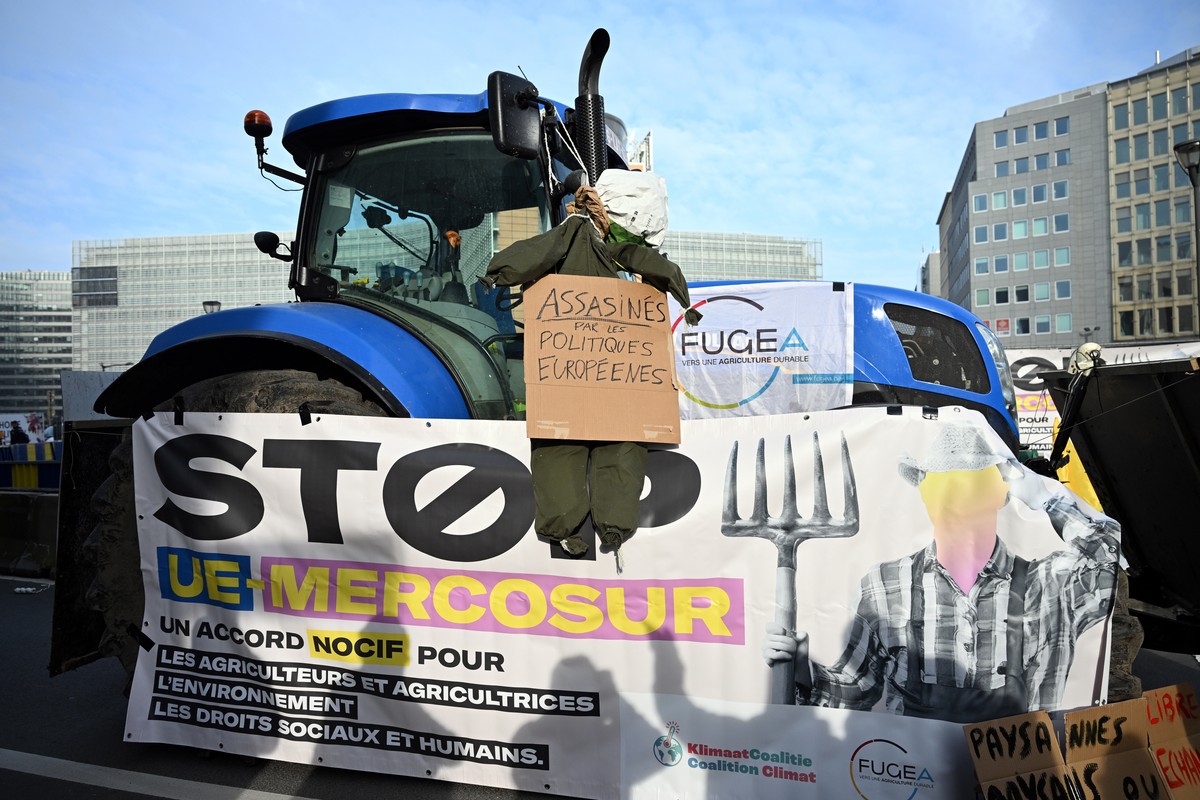
The acceptance of the contract will require the consent of the European Parliament and member states in the EU Council. The EU Council will make a decision by a qualified majority, which means that a minimum of 15 countries constituting 65 percent must be followed. EU population. To block the contract, it is enough to support, among others Italy or France.
Deputy Prime Minister Kosiniak-Kamysz spoke about building the blocking minority, President Nawrocki, after visiting the USA, goes to the Vatican, so maybe he will talk about this topic with the Prime Minister of Italy Giorgia Meloni. For now, however, it is likely that the contract will be approved.
Disadvantages of the contract with Mercosur from the Polish point of view
Freedom of international trade has always been a motor growth motor on both sides. In the case of a contract with Mercosur, it should not be otherwise, but it is not that everyone will benefit.
1. The first thing is the quality of food from South America. Food itself will probably be cheaper, even despite transport costs, so theoretically consumers should enjoy. But the lower price does not come out of anything. Our food is so expensive, because in addition to carrots for farmers in the form of subsidies for agriculture, there is also a stick in the form of strict standards and the possibility of using a limited list of chemicals. In other words, we will have cheaper, but we will get food less healthy.
2. Second thing How farmers cope with the lagoon of cheap competition. They did not win a photo of restrictive standards in their production in the European Commission, so they are in a bad competitive position. The same claims as in the Mercosur case were directed by farmers regarding food from Ukraine. The effects of the influx of cheap, but less quality food from the East can already be seen, among others after data on the number of working in Polish agriculture. During the year it fell by as much as 4 percent, which means a loss of 49 thousand. working on the land.
The contract may hit, among others We are a leader in Europe in Europe, and e.g. in poultry production and we provide it as much as 20 percent. on European tables.
“They are not specified in their quality, their production standards are not as high as in the European Union. It is simply unacceptable. We are against” -Władysław Kosiniak-Kamysz thundered a few months ago.
The European Commission has announced a safety brake in the case of a surplus of products from Mercosuru countries and It is possible to pay compensation for farmers up to EUR 6.3 billion. However, is this enough to compensate for losses and prevent the closing of farms in Poland? We will be able to observe the scale of consistency only after the fact when trading starts, it is speculation for now.
3. Third In this context, the country's food safety is also mentioned. When limiting part of its own agriculture, which could no longer provide the whole country with food, possible sea blockages, a breakdown of transport chains or transporting transport, and in the most drastic scenario war would cause a crisis on our market, perhaps even malnutrition.
In addition, in the case of Poland The most important industry is the food industry. That is why it developed so well with us because it has direct access to agricultural goods. When this is missing, we can experience sudden moves of plants to other countries where the delivery of these goods will be shorter and cheaper, i.e. to Spain or France, when it comes to imports with Mercosur. Just as we have experienced the transfer of production in connection with more expensive energy.
“They will gain on it [na umowie] Countries that are net food importers and will usually lose its net exporters. Poland may feel the negative effects of the contract in the case of poultry, beef, sugar, honey and cheese markets.” – Credit Agricole economists pointed out.
Advantages outweigh the disadvantages?
Mercosur consists of: Argentina, Brazil, Paraguay, Bolivia and Uruguay. This is a market with 260 million consumers. The opening of the market is not only a threat to EU farmers by the influx of cheaper food from South America and for consumers a decrease in its quality and the transfer of the Polish food industry. It is too A chance for a new market for European factories.
1. First case The fact that these 260 million new consumers can buy, for example, cars produced in the Union. And this is a product with a higher value added than food products, i.e. giving employees a chance for greater earnings working for their implementation.
In the case of Polish car production, and specifically mainly parts for cars for German, French and Italian factories, is the second most important industrial industry.
The production of batteries for electric cars has also become very important in Poland, and this also depends on the demand in the world on European cars. Last year The largest producer of such batteries in Poland, i.e. the Korean LG Energy Solution in Wrocław, had almost PLN 200 million loss by a decrease in demand and revenues by as much as 42 percent. year to year to PLN 23 billion. Average earnings at the company last year amounted to over 8,000 PLN per hand for 6.2 thousand employees, i.e. much above the national average. If markets for European cars do not open, their workplaces may be threatened. The factory owner did not invested to add to business.
The automotive industry in July accounted for 9.3 percent. production of the Polish industry sold. The only question is whether the food industry, which gave as much as 19.6 percent, will benefit from a cheaper raw material. production and will it not be a greater threat for her to roll their activities by Polish farmers? A free trade agreement may mean a risk for its activities.
2. Second thing that shift a part of the workforce from work on a role to work in sectors that create more added valuesmay be beneficial for the Polish economy. The end of the war in Ukraine will mean a trip to thousands of Ukrainians to their country, and Our economy will experience employment gaps. If farmers start working in production or service sectors, the monetary value of this work may be higher. For years, for example, the transport industry, the pillar of the Polish economy, informs about the shortcomings of employees. She would gladly accept former farmers, of course, the question of driving trucks.
3. Finally. There is talk about the losses of farmers and competition of cheap food of lower quality, and yet some farmers may not lose as much as they use. The benefits will be related to access to cheaper feed raw materials. In addition, organic food, closer to the consumer, will be included in the price, the non -industrial part of the market does not have to lose the recipient.
The possibilities of exporting processed food to Mercosur countries will also increasein particular alcoholic beverages and sweets, as Credit Agricole analysts indicate, which may compensate for the decline in the revenues of some farmers, and will give many Polish industry companies a chance.
The opening of markets to international trade is always a benefit for both parties from the point of view of the entire economy, vice versa than imposing mutual customs restrictions. The benefits are bilateral, of course, if the conditions give equal opportunities to compete for both sides. Hence, negotiations and determination of import amounts duty -free trade from Mercosur.
Some groups of population – in Poland, more than a million people still work on the farm – but they will be partly forced to change their profession. And this is not a positive circumstance for them. Nobody would take a good pressure on moving from a family home and changing the profession that you like.


