
Putin, my secret meeting in the “city of the Soviet atomic bomb.” What is known about the “Flying Chernobyl”, a rocket announced by the Russian leader since 2018


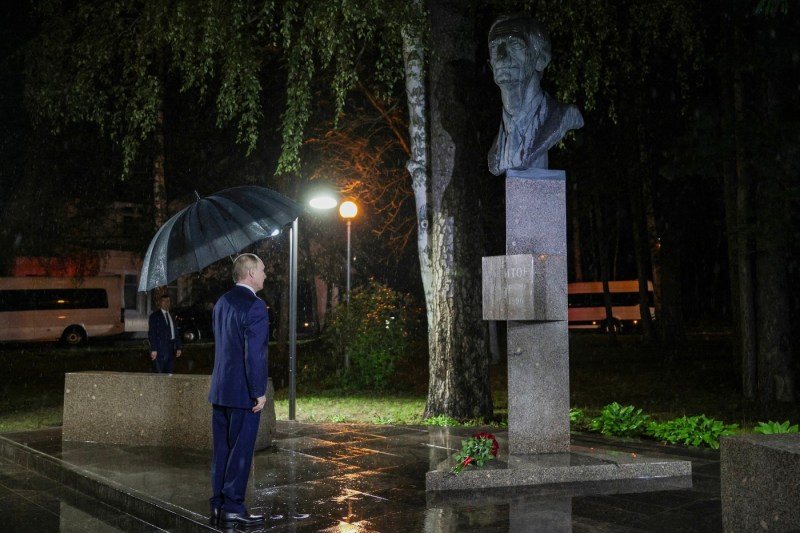
In this photo distributed by the Russian State Agency Sputnik, Russia's President Vladimir Putin, deposits flowers at the physicist Yulii Khariton, the first scientific director of the Russian nuclear federal center, near the House of Scientists in Sarov, on August 22, 2025.
Russian President Vladimir Putin made a discreet visit to Sarov on Friday, the center of the Russian nuclear industry and the place where the first Soviet atomic bomb was created. There was a secret meeting, which did not appear on the official Kremlin's official agenda, journalist Andrei Kolesnikov reported in Kommersant, in the Presidential Delegation, writes The Moscow Times.
According to the reports on the Russian Telegram channels in the area, the meeting targeted discussions about the nuclear propulsion “Burevestnik”, a project announced by the Kremlin leader since 2018. In mainly, the possibility of introducing the weapon was discussed in the Arsenal of the Russian Army in 2025.
warnings
The meeting took place just days after, on the Arctic Island Novaia Zemlea, rocket tests were scheduled. Western experts in nuclear weapons, such as Decker Eveleth (CNA) and Hans Kristensen (Nuclear Information Project), warned previously, based on satellite images, that a new test is imminent. The information was also confirmed by Reuters, which also quoted a source from a western information service.
The most powerful nuclear device that has ever exploded, the “Tsar's bomb”, was detonated in 1961, in Arctic, according to the BBC. This was about 3,000 times stronger than the atomic bomb from Hiroshima. Sarov, a closed city dedicated to nuclear research, located 465 km east of the Russian capital, is considered the place where the bomb was made, a reply being exhibited in the locality museum.
According to the sources quoted by Reuters, Russia seemed to be preparing to test its new cruise missile with nuclear propulsion and nuclear load just before the Alaska summit between Vladimir Putin and Donald Trump.
Reuters has found a series of ads on the website of the Notem of the US Aviation Administration, issued by Russia, which indicates a possible launch window between August 9 and 22. The warnings asked the pilots to avoid the area.
“A privileged location for Russian missile tests”
The Norwegian army has transmitted to Reuters, by an e-mail, that the Barents Sea is “a privileged location for Russian rocket tests” and that it has indications from ads and maritime warnings on “preparations for test activities”. But he said that “he will not confirm any information about the type of ammunition to be tested.”
It is not clear for now if the launch has taken place and what result. “It is possible that the rocket has been tested, you may have failed or simply have given up,” commented Jeffrey Lewis, a researcher at Middlebury Institute of International Studies, who monitors the project. The expert observed on August 19 that the movements for the alleged test had ended in the Novaia Zemlea area, an archipelago that separates the Barents from the Kara Sea.
Putin said, just before the 2018 presidential election, that the weapon, called SSC-X-9 Skyfall by NATO-is “invincible”, sub-line that the projectile can hit almost any point in the globe and can avoid the missile shield built by the US, according to Reuters.
Designed as an unlimited rocket, “Burevestnik” had at least 13 launch attempts, according to Western secret services. Only two were partially successful, and one ended with a tragedy: in 2019, a rocket collapsed in the Barents, and during the recovery operation, killing seven people, including researchers from Sarov. The incident produced a radioactive cloud detected in both Severodvinsk and Scandinavian countries.
Another test is assumed that it took place in October 2023, which Putin declared “successful”, stating that the development of the rocket is “almost completed”.
Western critics call it “flying cherries”. In 2020, the Special Army Special Submit, Marshall Billingslea, warned that the project is extremely dangerous: the rocket not only transports a nuclear ogiv, but also nuclear fuel on board, risking a radioactive cloud behind, and any collapse could contaminate vast territories.


