CJEU and the theory of two condition. Key questions of the court in Warsaw


There was no doubt until June 2025. After annulment of the contract, the parties settled in accordance with the theory of two condition. The situation changed after the last judgment of the Court of Justice of the European Union (CJEU). Tomasz Niewiadomski from the District Court in Warsaw, seeing that various rulings regarding settlements between banks and borrowers began again, he doubted whether that was the purpose of the CJEU.
See also: This judgment of the CJEU in the case of franchisees divided lawyers. This is the voice of one of them [OPINIA]
Two important new questions to the CJEU
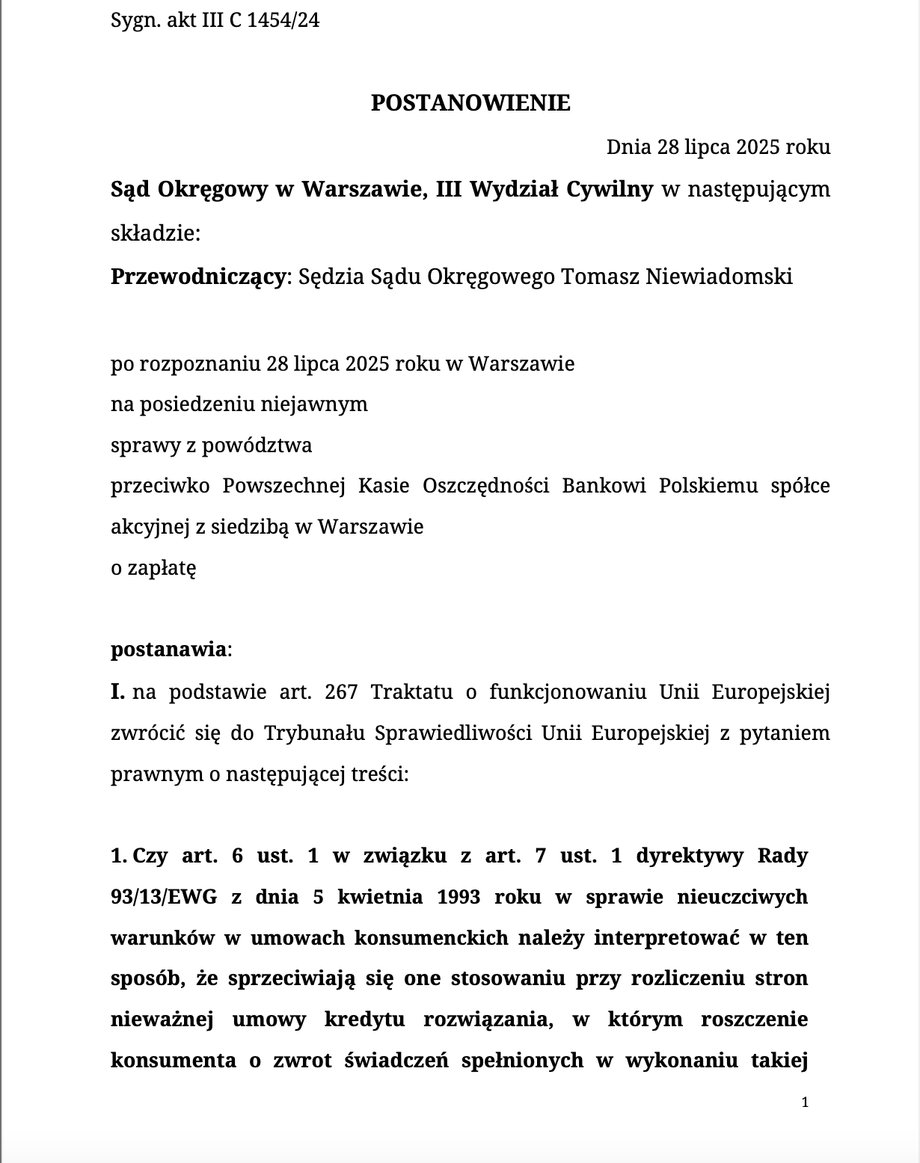
For this reason, on Monday, July 28, 2025, he sent two key questions to the CJEU:
- Or art. 6 para. 1 and art. 7 para. 1 Directive 93/13/EEC oppose the so -called balance theory? It is about a solution in which The consumer's claim for reimbursement of installments arises only when the sum of his payments exceeds the capital paid by the bankbecause the court ex officio compensates for both claims.
- Do the same provisions oppose the restriction of consumer right to interest for delay from all benefits fulfilled in the performance of an invalid contract? In other words – can the consumer be deprived of interest for the time from calling the bank to payment until the money is paid?
– I would like to know what the intention of the CJEU was – says judge Tomasz Niewiadomski. In his opinion, which he presents in justifications, there is no legal basis to return to the theory of the balance, and the thesis indicating at the end of the theory of two condition is too far -reaching. And as the judge informed us, the CJEU has already registered questions under the C-510/25 reference number.
Read also at Business Insider
– The questions concern a fundamental issue regarding settlements after annulment of loan agreements related to foreign currencies and affect about 200,000. Court cases regarding loans related to foreign currencies, which are currently taking place before courts in Poland – says legal advisor Radosław Górski, who represents borrowers in a case that is the canopy of questions to the CJEU.
The questions were asked in the franchisee dispute with the PKO BP bank, who demand about 50,000 Swiss francs and about 70 thousand zloty.
The District Court asks the CJEU for the theory of balance
|
Own materials
The theory of two condition and balance theory
The theory of two conditioning assumes that the parties have two separate and independent claims that the bank and consumer have after annulment of the contract. Let's assume, for example: if the franc loan on the day of granting amounted to the equivalent of 100,000. PLN, and Frankowicz paid the installment worth 110 thousand until the annulment was annulled. PLN, the bank demands a refund of 100,000 PLN and gives the borrower 110 thousand zloty.
What is very important is interest. Along with the refund of payments, the consumer may also recover interest for the period from the date of request for payment (in many cases even in a few years).
The theory of the balance means in a nutshell that the court should sum up the benefits of both parties and settle them through automatic compensation. According to this assumption The consumer's claim arises only when the sum of his payments exceeds the capital paid – and if the overpayment did not occur, the borrower has no claim, and even more so interest.
The CJEU caused a problem
Until June 2025, the case -law was uniform, the theory of two condition dominated. This changed after the CJEU ruling of 19 June 2025 in case C-396/24. Banks and their proxies argued that it means the return of the balance theory, which was also confirmed by the Supreme Court in the decision on July 9, 2025 refusing to accept the cassation appeal (reference number I CSK 652/25). Frankowicz proxies do not share this argument, indicating that the discussion on the settlement method has long ended. On May 7, 2021, the Supreme Court composed of seven judges determined the theory of two condition (reference number III CZP 6/21), which was confirmed by the full composition of the Civil Chamber of the Supreme Court in the resolution on April 25, 2024 (reference number III CZP 25/22).