
Most experts who studied the activities of the first serial killer from Soviet Leningrad (today St. Petersburg in Russia) Aleksander Łabutkin, does not consider him mentally disturbed. Although he has at least 12 crimes, he never raped his victims, he did not use a knife or a rope, only a gun. At the same time, it cannot be considered an ordinary robber. It seems that Łabutkin just liked to kill.
Workers dynasty
Aleksander Łabutkin was born in 1910 in a workers' family. After the communist revolution, the right origin allowed 17-year-old Łabutkin to be employed at the “Krasnoznoznamjon” weapon factory as a shooter. The factory was military, which is why proven employees from the workers' class were chosen.
Working at the factory at that time was very prestigious. In addition, Łabutkin honestly loved weapons. He quickly learned to shoot from both hands. Thanks to the contacts of his father, an employee of the same plant with 42 years of experience, Łabutkin Junior immediately went to the privileged department that dealt with the quality of produced products.
In 1930, 20-year-old Łabutkin lost his hand. The young worker tried to break the trunk at the place of the future arable field, but we do not know what exactly happened. It is difficult to recreate the details of this event, but, as historians noted, it is in this daily case that the reasons for which he suddenly became a serial killer from a good employee.
According to one version, Łabutkin stole a shovel from the factory to dig a trunk in a family garden. However, there is no evidence for this. The second version is more likely: on a day off from work, Łabutkin together with a group of factory activists of Komsomol (i.e. communist youth) was sent to help peasants. There he took part in the expansion of the arable fields and pulling the trunks.
Either way, it was when digging the trunk that Łabutkin lost his right hand. With such disability he could no longer work at the factory, so Łabutkin was granted a pension. However, he did not stop working, he was employed at another factory in Leningrad.
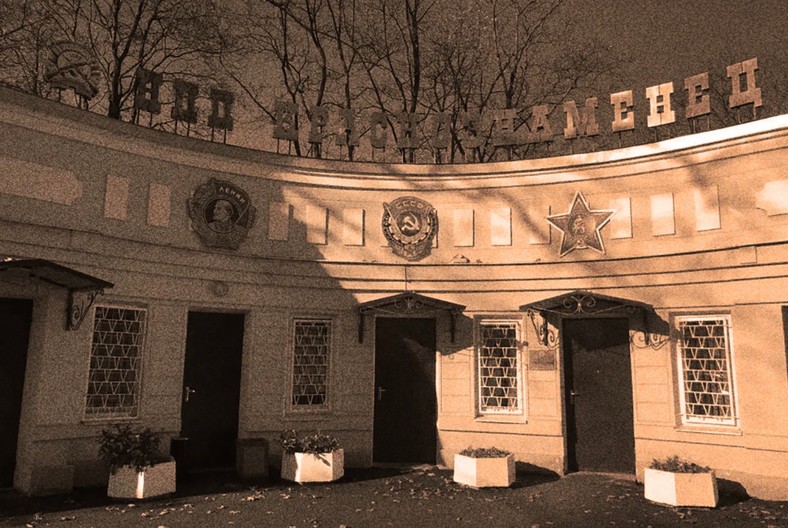
The “Krasnoznamiamjet” plant, in which Aleksander Łabutkin worked
A year after moving to the new job, Łabutkin got married. His wife was Maria, born in 1913. After the wedding of Łabutkin, he moved to his wife, to a private house near the gunpowder on the outskirts of the city at the time (today it is the center of St. Petersburg).
The first “hunt”
At that time, there was neither the concept of “serial killer” nor specialists who would try to find out what was pushing them to commit a crime.
There is a supposition that Łabutkin committed murders because of the injuries. But why did he wait three years before he committed the first murder? Currently, you can only speculate about Łabutkin themes.
As we have already mentioned, Łabutkin liked the weapon very much. However, in the 1930s, the USSR authorities were quite careful that the population did not have firearms. Officially, getting a gun was difficult, but Łabutkin found a way. He made friends with his father's colleague, a locksmith from “Krasnoznamjenca”. He worked in a military factory in tsarist times and brought home different parts of pistols, scales, gunpowder, tools and many other things. So when an older locksmith retired, a pretty decent workshop was created in his shed.
It was this locksmith, whose name has not survived in history, was constructed for Łabutkin with a quite decent revolver. He also produced cartridges. For some time Łabutkin practiced shooting his left hand from a new revolver, but at some point shooting cans and bottles ceased to be enough – he wanted to check his skills on a lively goal.
At the end of summer, August 30, 1933, Łabutkin took a revolver and went to his first hunt. He sought victims in forests on the outskirts of the city, where there are currently housing districts.
Unfortunately, mushroom pickers returning from the forest – two marriages and a lonely woman, stood in the way of the murderers. All five were found the next morning. Four of them were dead. One of the women was seriously injured, she was taken to a hospital, where she soon died without regaining consciousness. The criminal was a small cash, which mushroom pickers kept to travel to the house, and baskets with the fungi collected.
A thorough investigation was held at the crime scene. From all evidence, it appeared that the murderer used a revolver because no scales were found anywhere. Moreover, criminologists clearly stated that all victims were killed by their own production cartridges. Instead of factory bullets in the cartridges there were balls from bearings that were tailored to the revolver caliber.
The militia actively dealt with the investigation. The officers questioned all residents of the area, patrolled the forest, checked who could have illegal revolvers, but everything was in vain. In autumn, the enthusiasm of investigators clearly weakened. Then Łabutkin dealt a new blow.
On December 2, 1933, he shot two people returning home from work. Cake rollers, a bag with food products and 85 rubles (the average salary of the worker at that time at that time was 120 rubles per month). This circumstance – a large stolen sum – directed the investigation into a false trail. There was no murderer who liked to kill, but a bandit committing a crime for profit.
All this is the fault of the enemies of the people
The party issued a command to supplement their order forces in the suburbs with additional troops. Forests around the previous crime places were constantly patrolled by militia and army troops. At the same time, policemen actively worked with the population. They probably also questioned Łabutkin. Perhaps that is why he fell silent for a few months. However, some researchers are convinced that when the militia combed the area, Łabutkin could commit murders in other districts. At that time, in Leningrad and its suburbs, there were often crimes using firearms.
However, no one thought to compare the murders in one place with others. “When I was collecting materials for a doctoral dissertation, I was allowed to review the files of Łabutkin's case,” the lawyer Sergei Afanasjew told us, who defended his doctoral dissertation on Soviet serial murderers. – I think he was neither a serial killer or a mentally ill. He was an ordinary robber. He did not kill for pleasure, but for purely material reasons. It did not matter that most often the loot was small, Łabutkin simply had to get rid of witnesses, because the lack of a hand could quickly lead to its capture. And the fact that he took quite long breaks between the killings shows that he was quite cautious.
Another blow of Łabutkin dealt on April 11, 1934. At that time, a locksmith was killed, who returned from work to the estate near the gunpowder. The loot of the murderer fell a set of locksmith tools, 150 rubles and two golden crowns, which the criminal pulled out of the victim's mouth.
Until then, the intensity of the patrols dropped again, because the criminal failed to catch in the act, and keeping in one area quite serious forces was expensive. So in April only local militia and a few military patrols remained in the area.
After the killing of the locksmith, it became clear that the murderer was prowling near the gunpowder for a reason. The reinforced patrols returned to the forests in the murder area. Łabutkin stopped again for several months.
Łabutkin set off for the next hunt on November 13, 1934, six months after the previous murder. This time, a bird hunter fell victim to people. The poacher went to the forest in the evening to check the launched snares. Two frames with caught birds fell prey to the murderer. We don't know what Łabutkin did with them.
Law enforcement and party authorities were confused. In Leningrad and the suburbs, rumors quickly spread about the appearance of an elusive murderer. Rumors have already said that the devil himself came out hunting for innocent souls.
To capture a mysterious killer, specialists from Moscow were called to the settlements around the gunpowder. According to some data, even a few detectives were released from the labor camps, who prosecuted criminals in tsarist times.
– It is worth recalling that it was when Łabutkin was prosecuted that a great terror began – he says “New Europe” Grigory W., a former employee of the Museum of the History of the St. Petersburg Militia. – On December 1, 1934, Sergei Kirow was murdered. Detectives of the old date were actually sent to Leningrad. However, I would not say that they were looking for Łabutkin, they were most likely called to examine Kirov's murder.
While Leningrad law enforcement agencies hunted the enemies of the people, tracking former aristocrats, merchants, tsarist officers, priests and others, Łabutkin managed to commit a few more murders. On January 11, 1935, two marriages were immediately fell, which died at two hours. All this took place within a kilometer radius from the murder of a poacher.
It was clear that the mysterious killer was associated with a specific place. Perhaps he lived nearby, or maybe he kept a weapon somewhere.
Fatal passion
While the detectives hesitated, Łabutkin did not intend to stop.
On February 17, 1935, a worker's body was found in the same forest. He was killed from the same revolver as the previous victims, and homemade cartridges were re -used. But this time the militia had a lead. After thoroughly examining the traces around the corpse, the investigators understood that there were two people: a man and a woman. The policemen came to the conclusion that the woman diverted the victim's attention and led her to the ambush in which the man was shooting. The worker had nothing valuable with him, so in this case the robbery version was not even taken into account.
The best experts in the country, after getting acquainted with the materials of the criminal case, thought that the murderer is a madman who kills not for profit, but simply because he likes. The investigation immediately focused on the search for mentally ill people.
It is not known how long law enforcement agencies would follow another false trail if Łabutkin did not make a fatal mistake. On March 18, 1935, he went on hunting again. And he planted a couple in love. The man died on the spot, and the woman twitched at the time of the shot and the bullet only scratched her. She lost consciousness for a moment, and when she recovered, Łabutkin took off his jewelry.
For unknown reasons, the murderer did not finish the work. What's more, he made an appointment with a woman. After the murderer of her friend disappeared in the forest, the woman ran home. Shaking up from the shock, she did not go to the militia, but to her friend to ask her about the advice if she should go on a date with a killer who – as her friend later testified to the militia – she liked her very much.
But the victim's friend turned out to be smarter and immediately reported the event to the police. The policemen found the last victim of the mysterious murderer. And when the would -be Łabutkin sacrifice informed them that the murderer had no right hand, the arrest became only a matter of time.
On the bench of the accused, in addition to Łabutkin himself, there were four other people: his wife Maria, who not only knew about crimes, but also helped to lure victims in ambush; Mother of Łabutkin, who sold things murdered; The locksmith who made a revolver and ammunition; and the neighbor of Mother Łabutkin, who knew about crimes, but did not report it to the militia – for which he received five years in prison.
Łabutkin was sentenced to shooting, the other accused received from 10 to 20 years imprisonment. Their further fate is unknown. It is also not known how many people actually deprived of Łabutkin's life. Only crimes committed in the gunpowder area were alleged to him, no data on other districts was checked. And there, as it turned out later, a corpse was also found with the footsteps of killings committed using ammunition for a revolver of own production.