“Your fun, our misery.” Spain turns into a tourist hell

In the early 1960s, the Spanish construction entrepreneur Miguel Perdiguer discovered the power of concrete. Torremolinos was then a sleepy fishing town on the Costa del Sol coast. Perdiguer, however, noticed something different: a gold and sun gold mine.
The first hotels grew like mushrooms after the rain – Quick, cheap, no plan. Spanish dictator Francisco Franco blessed this project: the country needed foreign currency and prestige was obvious.
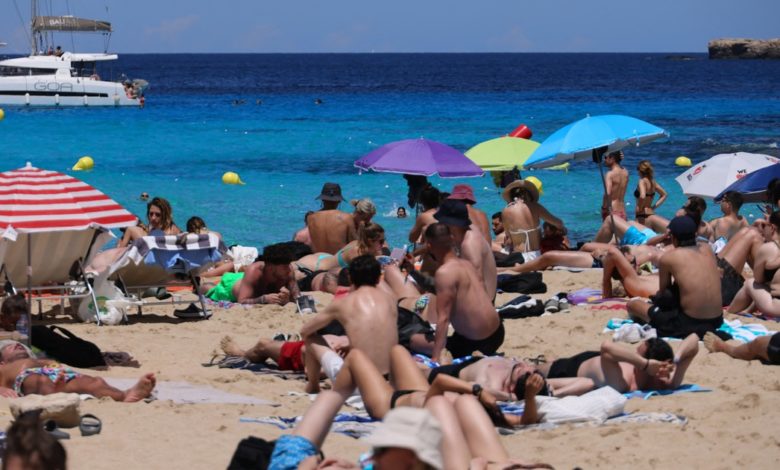
Torremolinos has become a symbol of the beginning of the great history of success: Spain is today One of the most popular tourist destinations in the world. Last year, this country was visited by almost 94 million tourists – this is a record. In April alone, it was 8.6 million foreign tourists, i.e. a good 10 percent. more than a year ago.
However, they are becoming more and more visible Dark sides of a sun -based business and beaches: drastically rising rental prices, no water, more garbage. In mid -June thousands of Spaniards went out into the streets throughout the country to protest against the effects of mass tourism. They carried banners with inscriptions, such as “Vuestra Diversión, Nuestra Miseria” (“Your fun, our misery”). While Spain adopts a record number of tourists every day, More and more young Spaniards are packing suitcases.
Ana, a 31-year-old environmental engineer, is just visiting her former home. She doesn't want her full name to appear in the media. “I live in Beijing now,” Ana explains. “Madrid was too expensive,” he adds. Almost all her friends left. Some work in Lisbon or Berlin, others still live with their parents after graduation.
Housing breakdown
Since 2014, rents in the center of the Spanish capital increased by 95 percent. 1.4 million households already spend more than a third of its income on the apartment. One of the reasons is the growing number of holiday apartments. In the former Lavapies workers' district itself in the center of Madrid, there are 847 registered and approx. 8 thousand. illegal holiday apartments. According to the city authorities, there are 23.4 thousand throughout Madrid. Airbnb facilities, of which over 90 percent has no license.
Tourists bring more money than ordinary tenants, as Tono Camunas knows well. The 45-year-old is based on a wall covered with graffiti near Gran Via shopping street and stares at the offer of a flat that he cannot afford. Camunas, a lecturer at an art school, improves the diploma thesis at the cafe because he lost the apartment in Lavapies: the owner transformed it into a holiday apartment.
Camunas now lives in his tiny studio. As he says, several of his friends have already founded an artistic collective in the Mexican city of Veracruz. “The whole house costs less than a bed here,” he says. The financial crisis of 2008 driven young Spaniards out of the country – today the reason is the lack of apartment.
According to the Platform of Real Estate, Idealista House prices in Spain increased by 44 percent over 10 years, while rents have increased almost twice. However, according to the National Statistical Office, in the years 2012–2022 income increased by only 19 percent. According to the Spanish central bank, 600,000 are missing throughout the country. apartments.
The housing crisis is socio-political breakthrough – says Jose Maria Lassalle, professor and former secretary of state for culture. Pushing the middle class is not a side effect, but a symptom of a deeper structural problem. If the apartments become primarily a capital investment, the city will lose its social tissue. Lassalle warns against urban division between real estate owners and those who are displaced from the city. For him, the apartment is the basis of democratic participation in social life, and his loss “imperceptibly undermines the foundations of our society.”
The issue of survival
And yet Spain is doing well in comparison with most European countries. In 2024, the economy increased by 3.2 percent. Tourism is one of the most important driving force of the economy, and the industry turnover amounted to EUR 126 billion (PLN 534 billion) last year, which is 13 percent. gross domestic product.
However, the effect is paradoxical: Those who maintain tourism can often no longer afford to live in tourist cities. Employees of this industry earn an average of 20 thousand. 910 euros per year (88 thousand PLN). It is about 30 percent. less than average income, while rents in places particularly popular among tourists are up to 75 percent. higher than the average.
At the same time, the growing demand causes that More and more apartments disappear from the market. According to the annual report of the Catastral Office, 93,000 were sold last year. real estate to foreigners. Wealthy Latinos buy, for example, apartments in Madrid, thus securing their capital and the right of residence. In addition, approx. 321 thousand apartments in Spain are used as holiday apartments – the regular offer is still shrinking.
On the Mediterranean island of Ibiza, the housing crisis is even more severe. It is no longer about expensive rents, but about survival. Jose is a taxi driver and talks about his permanent client: a bodyguard, whom he regularly receives from the campsite in San Rafael, 10 km northwest of the city of Ibiza, next to the new Unvrs night club. While next to the guests pay 400 euros (PLN 1.6 thousand) for a bottle of champagne, a man who provides them with safety lives between rusty containers and makeshift tarpaulins.
The taxi driver says that he barely finished the night shift at the entrance, and on the other side of the island there is already a morning change in a luxurious hotel – Double change, two uniforms, 16 hours daily. The security guard avoids the official bus from Sant Antoni, because at this time he is full of drunk party people. The taximeter is not turned on and the fee is determined by the hand of the hand – says Jose. – We stick together. Otherwise, the system will completely break down.
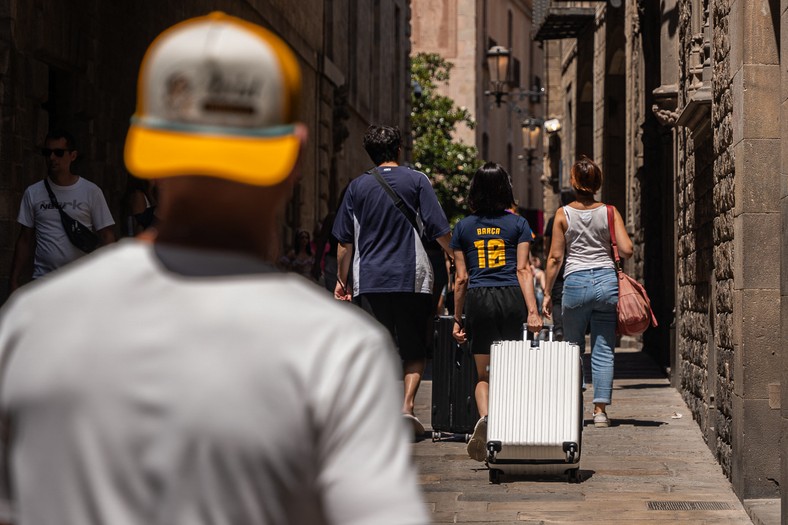
Tourists in Barcelona, Spain, June 21, 2025.
Tent village
The island needs 40 thousand seasonal employees, but apartments are only for 8,000 of them. 21 tent camps have already been established in the public area in Ibiza. They provide shelter for even 1.1 thousand. people, and many of these places do not have electricity or running water.
The largest of them is located just behind the airport – it is a tent village made of blue tarpaulins and makeshift booths, where chefs, maids and paramedics divide Dixie toilets among themselves. The red cross in Ibiza had to introduce a new category to its statistics: “homeless with full -time work”. Currently, even policemen live in buses for teams on makeshift campsites.
Early morning in the CAN BUFI industrial zone in the south-eastern part of the island. Miguel, 26 years old, is a nurse at the Can Misses hospital and has been sleeping in a Peugeot partner for eight months: a hospital mattress, a battery fan from a construction market, two canisters with water from a gas station, two tourist stoves for preparing warm meals.
He pays 60 euros (PLN 254) for a parking place between trash containers and trucks) to an industrial company in which he lives – this is his personal limit of expenditure on rent. – Better is than 1.4 thousand. euro (PLN 5.94 thousand) per bed – says Miguel pragmatically, shaving in the side mirror. None of his colleagues have the idea that he lives in the car. “I wouldn't tell them about it,” he adds. – Patients should trust, not pity.
He knew Carla from hospital cuisine before she moved to a more lucrative work of the maid. He pays 200 euros (848 PLN) per month for a container in ES Canar – 12 people, one shower, which can only be used in the morning between 6.00 and 8.00. During the day, he cleans apartments in the luxury ES Vedra hotel for 800 euros (PLN 3.3 thousand) per night, polishes marble bathrooms and prepares champagne service. In the evening, 41-year-old Carla washes under a cold tap in a neighbor's container when nobody looks and dries her uniform on the outer wall of the container. – Privacy is a luxury, but thanks to this I save 1.2 thousand. euro (PLN 5,000) per month – he says.
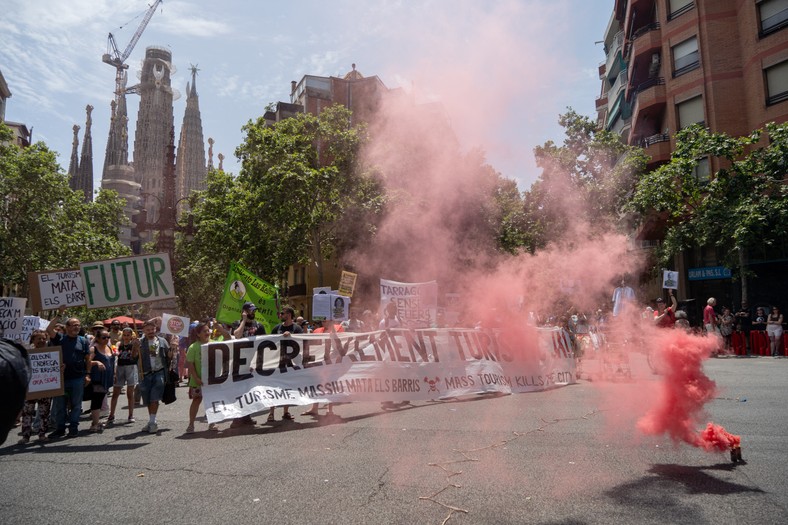
Protests against tourists in Barcelona, June 15, 2025.
The balearic government reacts by advertisements: until 2026 they are to be created Modular residential houses for 2,000 seasonal employees. Real estate owners who demand over 900 euros (PLN 3.8 thousand) for peace will be punished with fines of up to 90 thousand. euro (PLN 381 thousand), and new licenses for holiday rental will be suspended. Miguel moves his arms and points to the construction site across the street. – 80 luxury apartments are being built there. Who do you think for? – says. He knows the answer for a long time.
“There are no tips without tourists, there is no home with tourists”
While in Ibiza people sleep in containers, in the port of Barcelona in the morning giant cruise ships moor, from which thousands of passengers spill out. Only last year 12 million people arrived – more than the entire Catalonia population.
In the old Barrio Gotico district, digital nomads sit in century-old cafes in front of laptops, order Americano for 4.50 euros (19 PLN) and use Wi-Fi for three hours. The locals are hardly visible – most apartments are currently rented for short stays by Airbnb.
In the Barceloneta district – near the city beach – glued hourglasses hang in the hotel bathrooms. Four minutes in the shower are to be enough because Catalonia's water reservoirs are filled only in 16 percent. – This is the lowest level since the beginning of the measurements.
While the tanks supply drinking water to the dried Delta of the Ebro River in the south of the autonomous province, the luxury Hotel Arts Barcelona pumps 200,000 every day. l sea water through its own exposing installation. According to official statistics, a hotel guest consumes an average of 300 liters a day – almost twice as much as a city resident.
But also in the Mediterranean metropolis you can see the tourism dilemma. An example is 33-year-old Carlos. For eight years he has been working as a waiter in the Old Town and pays 800 euros (PLN 3.3 thousand) for 10 sq m in the Nou Barris district. 45 minutes commutes to work. “There are no tips without tourists, there is no home with tourists,” he says, shaking his head.
The authorities of Barcelona under the leadership of the mayor Jaume Collboni are now planning further actions: by 2028, approx. 10,000 will expire. License for short -term rental, without the possibility of extending. Tourist tax will increase from 4 to 7 euros (from 16 to 19 PLN) per day. Of course, this was met with criticism, hoteliers are already talking about the transfer of tourist accommodation to Sitges or Giros, located south or north of Barcelona. Above all, however, this problem will only move – the solution is not in sight.