The wave with “meat assaults” of the Russians submits to Sumî: 50,000 soldiers, massive losses and the unique offensive tactic that Moscow's army is in a state

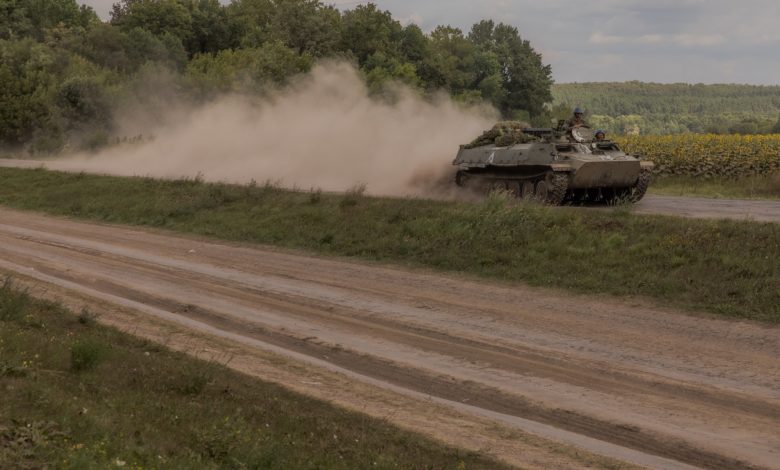
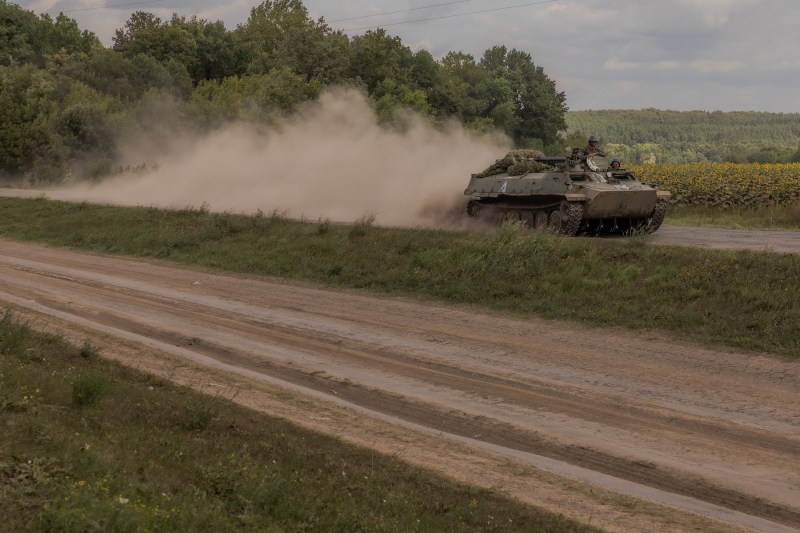
Ukrainian soldiers in a MT-LB armored battle vehicle of Soviet manufacture, held in the Sumî region, near the border with Russia, on August 11, 2024, in the context of the Russian invasion of Ukraine. Photo: Roman Pilipey / AFP / Profimedia
The Russian army advanced up to 12 miles (about 19.3 kilometers) near the city of Sumî, northeast Ukraine, intensifying its military operations around the region's capital, The Wall Street Journal (WSJ) said.
After the Ukrainian units withdrew from the Kursk region, located in western Russia, at the end of April, the Russian army entered the Ukrainian territory and has then held 50,000 soldiers in the Sumî region, the American publication wrote on Sunday, according to The Moscow Times.
Ukrainian soldiers who talked to WSJ say that Russian forces are three times more numerous than Ukrainian units.
This month, Ukraine carried out the unit of special forces “Timur” in positions near the city of Sumî, in an attempt to slow down the Russians' advance.
Kappa, a commander of the “Timur” unit, said, in an interview with the American publication, that “the number of Russians is a big problem for us, although not (is) enough to overwhelm.”
“The enemy loses between 300 and 400 people a day throughout the region. But they can cope with such a level of losses … continue to bring reservations,” Kappa said.
“Meat assaults”
The large -scale assaults, described in the Russian army as “meat assaults”, have become a main tactic, said independent military analyst Yan Matveev for The Washington Post (WP).
“These tactics (mass assault) are the only ones that the Russian army is capable of at this time. And it is very inhuman, because, in fact, the dead people are” in exchange “for (conquering) territory. What we now have in the Russian army, but they have no training,” Matveev said.
In addition to the number of troops, Russia also has an advantage in terms of supply with ammunition and missiles, The Washington Post noted.
However, according to Matveev, Russian forces are still struggling to carry out complex operations in Ukraine due to information in information, armament and insufficient equipment, corruption, logistical disturbances and inadequate training.
As a result, Matveev believes that although the summer offensive is unlikely to bring a radical change for Russia, it could still conquer several thousand square kilometers from the Ukrainian territory.
On Monday, the Russian press and war bloggers said that the Russian forces had a village in the Ukrainian region for the first time, the announcement coming in the conditions in which Russia has occupied 950 square kilometers of territory in the last two months, according to Reuters. There was no immediate confirmation from the Ukrainians or the Ministry of Defense in Moscow.
While Moscow and Kiev discuss a possible peace, the war has intensified, the Russian forces conquering a portion of 200 square kilometers in the Sumî region of Ukraine and starting a few weeks ago on the Dnipropetrovsk region.
On Friday, the head of the Ukrainian army, General Oleksandr Sîrski, said that Russia has gathered about 110,000 soldiers near Pokrovsk, from the Eastern Ukrainian region, trying to conquer it. According to the Ukrainian general, the Pokrovsk area is the “hottest point” on the front line, which covers 1,200 kilometers along the east of the country. Together with Kostiantinivka, Kramatorsk and Sloviansk, the Pokrovsk strategic city forms the spine of Ukrainian defense in the Donbas area still under the control of Kiev.
The areas under the control of Russia include Crimea, over 99% of the Lugansk region, over 70% of the Donetk, Zaporojie and Herson regions, all located in the eastern or southeast of the country, as well as small parts of the regions of Kharkov, Sumî and Dnipropetrovsk.