When it is appropriate to sell or buy shares. Investors, pressed by decisions when the market is rushing


Lately, although the assessments of the actions have stabilized and there are signs of supervision, investors know that they have to make prudence decisions, because there are opportunities, but the risks remain high, say analysts.

Economic uncertainties force investors to be cautious. Photo Truth
Donald Trump's ads caused an emotional earthquake on the markets – first, they triggered massive decreases, at the limit of a market correction, and then offered one of the best meetings in Wall Street.
When investors could sell their actions
In periods of uncertainty, investors tend to look for liquidity sources, which can even lead to a sale of safe assets, such as gold. On the other hand, recessions can also represent opportunities for many investors.
“In other words, the decision to buy or sell actions belongs to the investor and must be based on clear reasons and a well-established output strategy. If the perspectives in the portfolio have changed, a reanal can be justified. However, the sale in volatile periods is rarely encountered, which suggests that the complete liquidation is not.”, Explained XTB analysts.
According to them, at one point, S&P 500 registered a decline of over 20%, but the same day, investors also attended a remarkable return. “It is important to remember that a decrease of over 20% from a peak is usually considered a decrease market. Over the years, the market has often witnessed corrections between 20-25%, although more severe decreases were held ”support the analysts.
The largest decline in the history of S&P 500 exceeded 55% and was related to the 2007-2008 financial crisis. As such, the current movement can be interpreted either as a correction followed by a return or as the beginning of a longer negative market, explains XTB analysts.
The ideal strategy of selling at the top and buying at least is impossible to anticipate precisely. In a long time horizon, the markets have been resilient: in recent decades, S&P 500 has offered an average annual yield between 6% and 10%, and the correction periods have been generally recovered in 5-110 years.
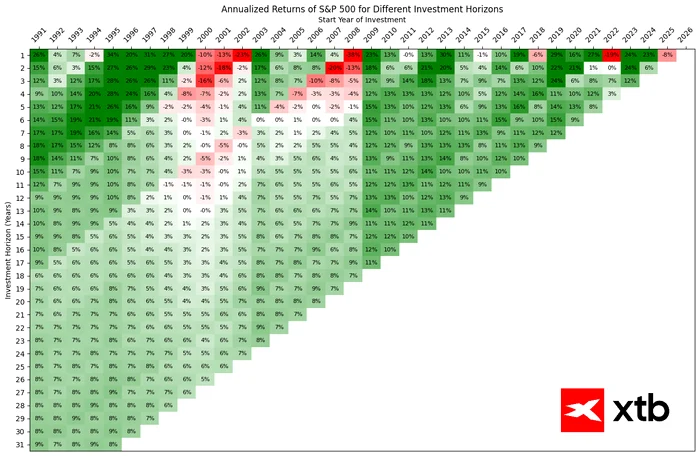
Source: Bloomberg Finance LP, xtb
The calculation of annual yields may seem complicated, which is why the cumulative yield offers a clearer image. For example, an investment of $ 1,000 in S&P 500 in early 2015 would have reached $ 2,620 so far, representing a 162%yield, without including taxes and dividends that would have increased even more.
The analysis of the major descending markets of the last 75 years shows that, after reaching a minimum, S&P 500 had an average of 40% in a year. Even the weakest recovery exceeded 21%, and the best ones reached 75%.
In general, the return after a decrease of 20% lasted about 70-75 days, but the current correction ended in just 48 days. Unlike the pandemic period, when there have been massive interventions from governments, investors are now facing an uncertainty generated by global commercial tensions, XTB specialists underline.
Uncertainty still dominates the market
The uncertainty still dominates the market, points to XTB analysts, adding that Trump's decisions have the potential to completely transform the landscape. It is important to note that the announcement of suspending tariffs does not mean that the US president has completely given up this scenario.
In addition, although certain tariff exemptions for electronics (especially from China) were granted, the initial optimism of the market was later temperate after it became clear that the rates were not completely eliminated – but only reduced to each rate of 20%, points XTB.
Indicators such as VIX (or fear index) can provide signals on reaching a minimum market. Recently, Vix climbed to 65, over the usual 10-30 interval, suggesting a possible supervision. From a historical perspective, such levels have often coincided with market return points.
Not only the price variations matter, but also the price-cherry ratio
The recent decreases on the stock market can be purchase opportunities, but it should be taken into account that S&P 500 and Nasdaq 100 were recently at historical maxims, under supracumation conditions. Although the S&P 500 index has registered significant losses compared to the beginning of the year and even compared to the same period of 2024 – a rare phenomenon – the market seems to have reached the area of supervision.
Not only the price variations matter, but also the price-price ratio (P/E). Recently, the P/E report has dropped from about 28 points to 23 points. From a historical point of view, this brings it closer to the average, as the chart below shows. Meanwhile, the predicted report has decreased from 26 to 20. In the past, the interval between 25 and 30 has often reported supracumation conditions, so it could be said that, in relation to the earnings, the actions are no longer expensive, but they are certainly not very cheap.
Therefore, decisions to buy or sell must be carefully adopted, taking into account personal strategy and risk tolerance because market conditions can be changed dynamically, especially during unpredictable periods, such as the one we are currently going, stresses XTB analysts.