The wars are unpredictable. However, one of the predictable consequences is that people are running away to save their lives. In connection with the re -outbreak of the conflict in the Middle East, the High UN Commissioner for Refugees warned last week that “when people were forced to escape, there is no quick return.”
It doesn't have to be said to Ukrainians. The full -line invasion of Russia in 2022 caused the greatest refugee crisis in Europe for decades, as a result of which millions of people escaped, mostly women and children. Three years later, over 5 million Ukrainians still stay abroad. How are they? Did they find a job? Will they ever come back?
The good news is that refugees from Ukraine have found a much more job than it is typical of other migrants.
Although comparisons are difficult due to the diverse data sources, Ukrainian employment indicators seem particularly high in countries like Polandwhere migration flows have already taken place and linguistic similarity occurs. However, they are much lower in places such as Norway, where the language barrier is greater.
Continuation of the material under the video
In general, after several difficult years, the income of Ukrainian refugees increases. According to regular research commissioned by the Ukrainian Think Tank Economic Strategy Center, the percentage of refugees who claimed that they had to save or borrow money to afford clothes, increased from 7 percent. Before the war, up to 28 percent In November 2022, however, until December 2024, this percentage fell back to 7 percent.
“It condemns people to failure”
Why do Ukrainians cope better on the labor market than other refugees? First of all, the macroeconomic situation helped them. The abandonment of Ukrainian refugees coincided with an extremely tense situation on the labor market, especially in neighboring countries, such as Poland and the Czech Republic.
Most countries also allowed people escaping from Ukraine to immediately apply for a job. The EU extended the status of “temporary protection”, which meant that Ukrainians did not have to apply for individual asylum and could immediately access work, apartment, education and social welfare. They could also decide to settle in places with a strong local labor market.
In contrast to these solutions, many countries prohibit persons applying for individual asylum work during consideration of their applications. For example Great Britain does not allow people applying for asylum to work while considering their applications (unless this process lasts longer than 12 months) and grants them only 49 pounds and 18 pence (about PLN 250, counting at the current exchange rate) per week for maintenance. This condemns people to failure.
Lab Mo / Sopa Images / Lightrocket via Getty Images / Contributor / Getty Images
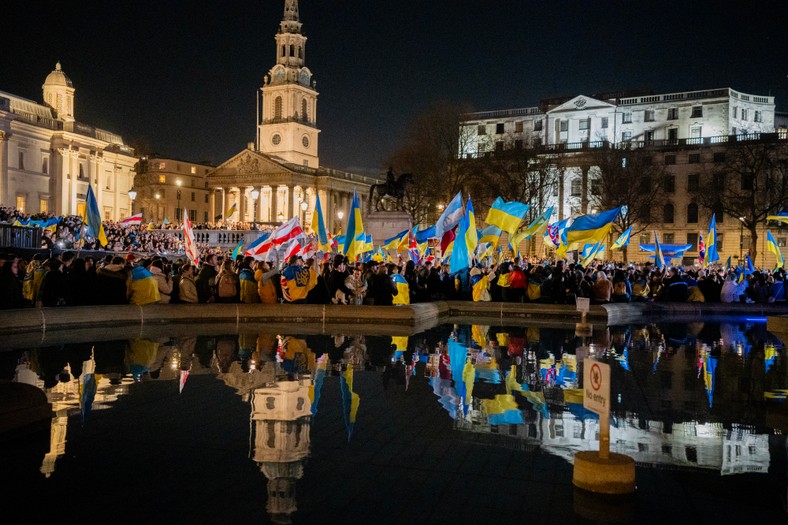
Ukrainian demonstration at Trafalgar Square in London (illustrative photos)
Meanwhile, data analysis from Germany showed that the employment rate was about 20 percent. Lower among refugees who had to wait an additional seven months before they were allowed to the labor market. It took ten years to eliminate this difference.
“After the outbreak of the war, it is very difficult to put everything back to the poop”
The study conducted in EU countries suggests that about two -thirds of Ukrainian refugees have a university degree, and over 40 percent. respondents have a master's degree or higher. They are not only better educated than most other groups of refugees, but also better educated than many residents of the host countries.
However, many people had to take up a job for which they have too high qualifications. Regardless of whether this is due to language barriers or from the inability to recognize qualifications, OECD data indicate that Ukrainian refugees in Europe are employed mainly in sectors of gastronomy, administration, production and residential.
Are they planning a return after the war? Ukraine must hope so. The loss of so many highly qualified women would not be good news for the economy destroyed by war, and the loss of children would deteriorate the already weak demographic perspectives.
The relatively successful integration of Ukrainian refugees abroad (although with a reservation regarding not using their skills) may become a double -edged weapon for Ukraine. The more people settle, the fewer people declare their desire to return. According to CES research [Customer Effort Score to wskaźnik, który mierzy stopień wysiłku, jaki klient wkłada podczas kontaktu z firmą np. podczas dokonywania zakupu] The percentage of refugees who definitely plan to return fell from 50 percent. in November 2022 to 20 percent in December last year.
Well -financed activities, supported by the international community, aimed at rebuilding apartments and economic potential, would probably encourage some to return. Of course, Ukraine could have some benefits of having an extensive diaspora that could help transfer money, investments and trade contacts. It is, however, a reminder that after the outbreak of war and dispersion of society, it is very difficult to put everything back to the poop.
I’m Ashley Davis as an editor, I’m committed to upholding the highest standards of integrity and accuracy in every piece we publish. My work is driven by curiosity, a passion for truth, and a belief that journalism plays a crucial role in shaping public discourse. I strive to tell stories that not only inform but also inspire action and conversation.