In your book you developed the “Formula of Peace”. What did the research look like?
Everything I write in my book is based on hundreds of statistics about war and peace. If you look at the 50 poorest countries in the world, the vast majority of them were involved in armed conflicts. The consequences are serious. They not only mourn millions of fatalities. Civil wars cause an average loss of 18 percent. gross domestic product and cause an extremely slow economic recovery.
There is no reason to think that the war between states is less destructive. From an economic point of view, the war usually has no winners. There is a prejudice that says: if the economy is weak, start the war. That's not true. Ultimately, at most individual leaders or companies derive profits from the war economy. What's more, erroneous circles are created that last for generations: war leads to poverty, poverty increases the risk of war, as did the erosion of trust in the state or lack of education. In an unstable society, it is much easier to recruit people because there are no other ways to feed families. Being a rebel is a business. People are fighting to earn money.
If there are almost no winners: why is the war still going on?
First of all, according to research, democratic countries are extremely rarely attacking each other. The relationship between democracy and peace is so strong that it is almost the law of physics. On the other hand, autocratic and democratic countries are more likely to wage war, as well as auto -cookies. If we had more democracy in the international system, we would have fewer wars.
What are the reasons for this?
The heads of countries in auto -citizens win more in the war and pay a lower price than average people. Dictators' children are rarely incorporated into the army, instead marginalized social groups from rural areas must go to the front. People are not stupid, they know what war means. Particularly interesting is the study in which the election behavior of American parliamentarians in the 20th century was analyzed, when the US was involved in several wars. At that time, more young men were incorporated into the army. Those who had male offspring voted more pacifist than parliamentarians with their daughters.
This is the first pillar of the “room formula” that you will decipher in your book. You call him a “voice”, ie a representation of people in parliaments. The second pillar is “work” – although this applies less to the general well -being of the country, and more to the economic prospects for the individual.
Yes, if people can legally ensure their livelihood, they do not want to follow the war. It is different in the case of poor education and poor economy – in such circumstances people are easier to recruit.
Continuation of the material under the video
Is this choice always available to everyone? Economic motivation is one thing, but sometimes the decision is not in our hands.
In international wars between countries with strong armies, the individual often has no choice. However, in poorer places, the state is often weak, for example in Niger or the Democratic Republic of Congo, where the government lost control of large parts of the country. In such cases, armed groups grow like mushrooms after rain. In some cases, they are only interested in controlling a specific mine. Income is then used to recruit new mercenaries. Economic logic is behind it, in which the correct settlement of income and expenses is practiced.
Let's move to the third pillar of the room, or “security guarantee”. What does this mean?
If the state has an inclusive system and wants to revive the economy, but it is poor in terms of security, the essence of the state apparatus is lacking. One example is Sudan: former Prime Minister Abd Allah Hamduk conducted well thought -out reforms with a team of well -trained technocrat. However, a few years later there was a coup in which the army took power. Then there was a struggle for power between two generals who plunged the country in a bloody civil war. It is a pity that Sudan was not supported by the UN peace forces and Marshall plan.
There is also research on the reconstruction of Iraq, which show that a well -thought -out policy does not go to fertile ground if security is not guaranteed. In some cases, countries can cope without external help, but this often requires the involvement of other countries through the UN. It was here that the West could really contribute to world peace.
Does your peace formula ultimately mean that every country would have to take the form of Western democracy? Is this not an old unsuccessful idea to make our form a pleasant government?
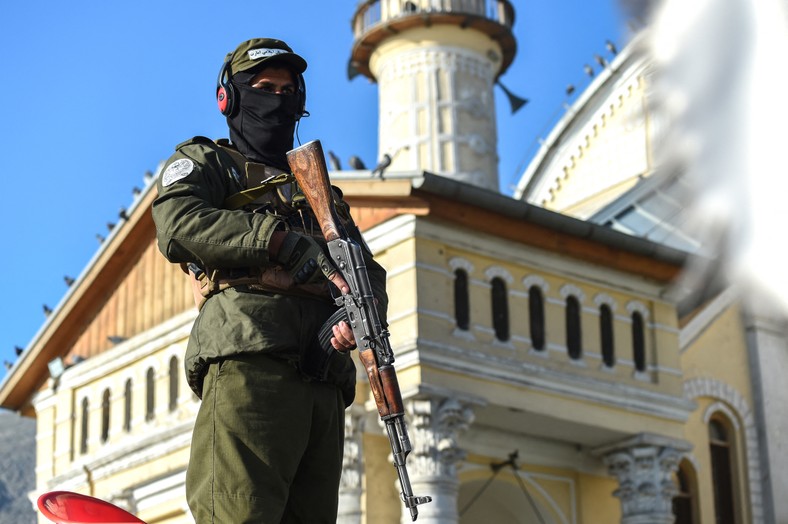
I often hear this argument. I'm not convinced. The fact that the state cannot do with people what it wants is not only a western rule. As part of the “World Happiness Report”, the same questions are asked to people from 143 countries every year. Scandinavian countries are usually at the top, uneven societies, such as the USA, appear slightly lower, recently Afghanistan was at the very bottom. The Taliban authorities would say: “We rule according to the will of people, you, the imperialists, you only want to impose your democratic ideals to us!” In fact, however, similar factors determine a happy life all over the world. These are A good healthcare system, the right to speak or small corruption.
Ahmad Sahel Armman / AFP
Representative of the Taliban Security Services, Kabul, Afghanistan, March 2025.
Would the introduction of democracy mean a strategic weakening of the autocracy in the event of war? In Ukraine, the president Wołodymyr Zelanski He must recruit citizens and at the same time be criticized for suspension of elections. On the other hand, Vladimir Putin recruits soldiers and mercenaries from distant regions and does not have to worry about criticism in the press or re -election.
The question suggests that autocracy has a basic advantage over democracy in war situations. These factors are accurate arguments – but not the only ones. Empiric research shows that self -successes may be in a short period of economic successes, but democracies are richer in the average perspective. And the money helps to win war. The rich democratic USA – with the help of their allies – was able to defeat Nazi Germany when they finally joined World War II. Information flow is also better in democracy. If you are a commanding officer, you may not dare to report that, for example, the armored fleet does not work.
You say that since 2022, over 50 countries have been simultaneously in armed conflict, more than ever since World War II. Why is this happening?
For 10 years, we have been observing an increase in the number of armed conflicts and a parallel decrease in the number of democracy. There is certainly a relationship. For a long time we had the so -called Waves of democracy, which have been repeatedly interrupted by autocracy waves. If we are lucky, the current decline is only a temporary trend.
Having the knowledge acquired thanks to the research – is there any advice that you would like to give to negotiators in War in Ukraine?
Ultimately, we return to the three pillars, which I describe in my book. It is important to give Ukraine sufficient security guarantees in the case of a potential peace agreement. In addition, the fate of the population cannot be decided from above. There must also be a strong economic basis for the future.
I’m Ashley Davis as an editor, I’m committed to upholding the highest standards of integrity and accuracy in every piece we publish. My work is driven by curiosity, a passion for truth, and a belief that journalism plays a crucial role in shaping public discourse. I strive to tell stories that not only inform but also inspire action and conversation.