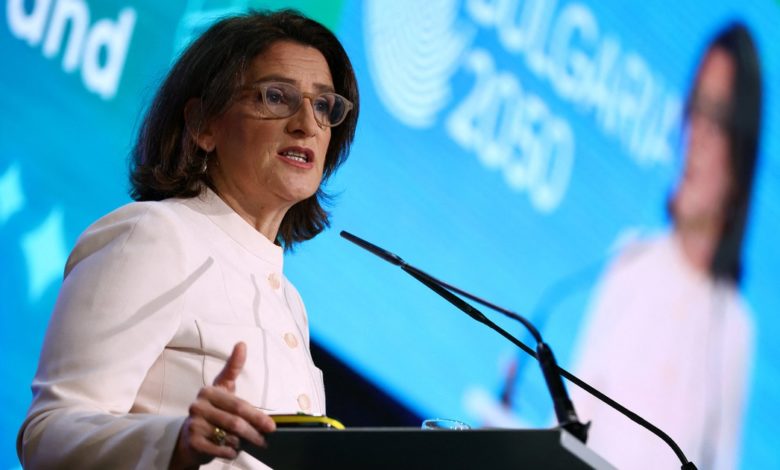
On Wednesday, the Vice -President of the European Commission responsible for the competition Teresa Ribera presented a new set of rules regarding state subsidies for pure energy. He determines how domestic governments can transfer public funds to enterprises to help them decarbonization.
The new clause regarding the mechanisms of “temporary relief in electricity prices”, which appeared in the changed project of the state aid framework contained in the packet for pure industry (Cisaf), which Politico has reached, basically approves Berlin's plans. It enables the same EU government to compensate for electricity costs for energy -consuming entities.
This is a bright example of the evolution of the way of thinking about national subsidies – known in EU jargon as state aid.
Article 107 of the EU Treaty, by default, prohibits state subsidies to prevent the favor of some enterprises or products by individual countries and disturbing competition in the EU single market.
However, the Commission is aware that part of the help is necessary to achieve major purposes and over the years has developed a number of so -called Ram, which define exceptions to this rule.
In addition, Germany's goals are important for the EU economy. – If the Germans follow the bottom, we will all follow them – said the lobbyist representing energy -consuming enterprises anonymously.
Continuation of the material under the video
Mechanisms of reducing energy prices described in Cisaf PThey will benefit not only to Germany, but also to Italy and countries that are still largely dependent on fossil fuels The lobbyist pointed out.
In a letter of June 19, organizations of employers from 10 EU countries, including Germany, Italy and Austria, regretted that Cisaf It does not go far enough in the field of support for energy -consuming industries.
France will also feel benefits. The changes introduced since the Commission published by the Commission of the First Cisaf Project in March covers several references to the Act on the Zero Emission industry. France hopes that it will make it easier for her to obtain the consent of the Commission to finance nuclear projects – which is a priority for Paris.
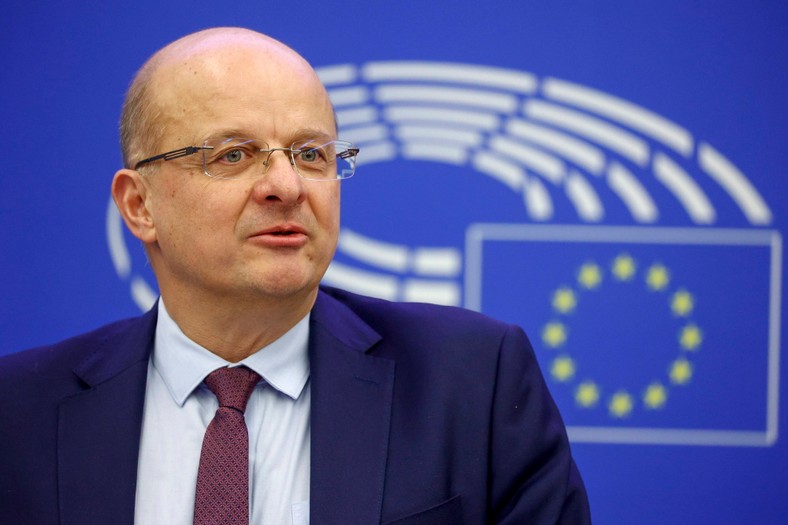
The French MEP Christophe Grudler noticed that the latest version of Cisaf includes a wide range of nuclear technology, which is “good news for the entire value chain.” The MEP admitted that he had sent some remarks to Ribera to pay attention to inconsistencies in the first project.
Julien Warnand / PAP
Christophe Grudler, Strasbourg, France, February 14, 2023
– It's absurd that [pierwszy] The project included natural gas, which is imported and pollutes the environment, not nuclear energy, which is clean and produced in Europe, “said Politico.
Cautious compromise
In the turbulent period after the departure of Mario Draghi, from the function of the President of the European Central Bank, the search for ways to increase EU productivity continued. Reduction of obstacles for the flow of domestic funds to industrial projects It is practical – and perhaps the only – real solution.
“There are no real instruments except the help of a state that would enable the EU to implement industrial policy,” said Lena Hornkohl, a law, a law professor at the University of Vienna.
Although Cisaf is the latest of these frames, it may not be the last. “The Commission may expand the goals of its state aid policy practically indefinitely, if they serve the interests of the Union,” Adina Claici, an economist from Berkeley Research Group, pointed out and a former clerk at the Main Economist team of the EC Directorate for Competition.
However, the latest framework of the Commission is, as always, a cautious compromise between the urgent need to introduce industrial policy at EU level and the principles that are the basis of the uniform market.
Katarzyna Berestecka, legal for antitrust for Norton Rose Fulbright noticed that although the framework is aimed at simplifying and accelerating the approval of support for projects on clean technologies and decarbonization, “They still retain key securitywhich apply to all means of state aid. “
These protections include limiting the amount that EU countries can spend on their industry, and adding conditional clauses. For example, in relation to electricity prices, the conditional clause requires that enterprises receiving relief in energy bills invested 50 percent. assistance in projects related to decarbonization.
The next test will be to check how Cisaf will function in practice, when applications for financing go to the desks of competition officials, especially in the case of larger projects. – The Commission risks losing in the appeal proceedings [wniesionym przez konkurentów, którzy nie otrzymali pomocy państwa] After making the decision, so the rate is high, 'said Claici.
I’m Ashley Davis as an editor, I’m committed to upholding the highest standards of integrity and accuracy in every piece we publish. My work is driven by curiosity, a passion for truth, and a belief that journalism plays a crucial role in shaping public discourse. I strive to tell stories that not only inform but also inspire action and conversation.