Iancu Guda, hard message for unions: “35% higher salaries in the state compared to private. And threatens with strikes. Ready!”

Economist Iancu Guda expressed his dissatisfaction with the threats of trade unionists if their bonuses are cut, arguing that the salaries of the budget are 35% higher than those in the private. He proposed three strategic directions for recovery of the huge deficit of Romania.
Economist Iancu Guda explained how the deficit can be reduced. Photo FB Iancu Guda
“You have seen the statements of the unions in the public sector which threatens us with strikes if the bonuses and wages are cut? The immortal trade unionist Bogdan Hossu, Cartel Alfa tells us why it is normal for the public sector to earn over 35% compared to the private and why it is not a problem that Romania pays the highest salaries in the public sector by reference to the revenues, salaries that have increased by 62% in the last 5 years (2020-2025
Ready, it doesn't work anymore! There is no money, if I'm not, I'm not … where to be? We don't have it anymore! Well, what do you think, that the private sector produces money, or that we can indebted? Moromete's word: “What, do we make money?”the economist Iancu Guda wrote.
He has prepared an analysis in which he presents the strategic directions to reduce the fiscal deficit. We give, below the analysis.
Three strategic directions to reduce tax deficit
There are four ways to spend the money. When you spend your money for yourself, you are responsible and you want “Value for Money”, so good quality and price. When you spend your money for others, you will choose one of the two: it will prioritize the quality when you spend for important directions in relation to your loved ones (eg education or health health), or the budget allocated when you give a gift to a close friend. When we talk about the money of others, things are often different. When you use others' money for you, you choose the best, without looking at costs. And when you spend the money of others for others, neither the cost nor the quality matters so much. This is where the greatest risk of waste appears and in this situation the governments are. The four quadrants centralize these situations.
Table 1
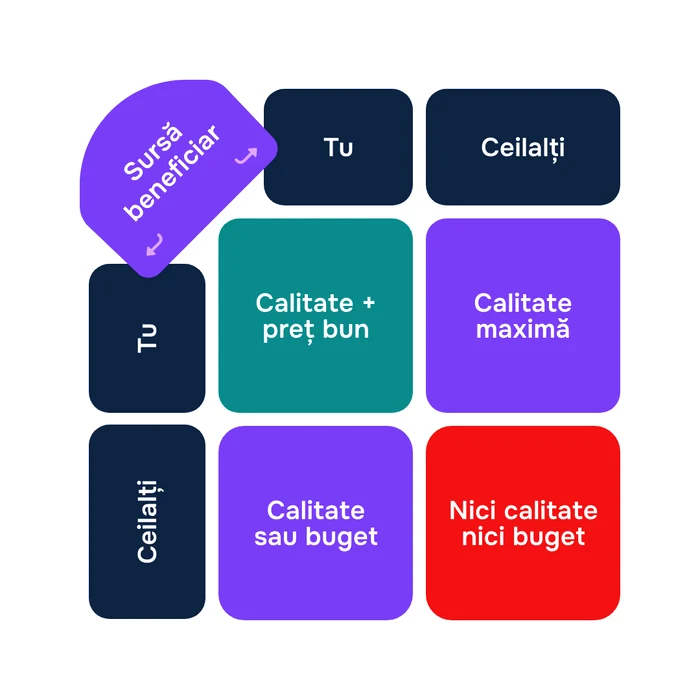
What money and for whom we spend
In the same thing regarding the situation of the governments, which spends the money of others (taxpayers) for others (the society as a whole: the households of the population and the business environment), the risk of waste or inefficiency occurs. Even here, there are some thinking schools that support the exact opposite: public finances cannot be compared to the budget of a private business, because they have fundamentally different goals. If a company wants to maximize the profit and the value of the long -term business, the state has as a fundamental objective the collective well -being – a noble purpose that can justify apparently inefficient short -term expenses (eg cheap public transport with money from the budget, or canteen for students with cheap food).
Agree, with only one mention: the waste must be minimal and the public budget, as an overall financial situation, must remain sustainable and financing, based on a long -term coherent strategy that benefit from trust from international partners and those who finance the deficit by buying bonds issued by the state. Unfortunately, Romania is no longer in this situation: the waste increases in the public sector, the financing of the deficit is at the limit of the gap and the quality of the public services has not improved, despite the increase of the debt and the public expenses. The figures and graphs that follow speak for a thousand words.
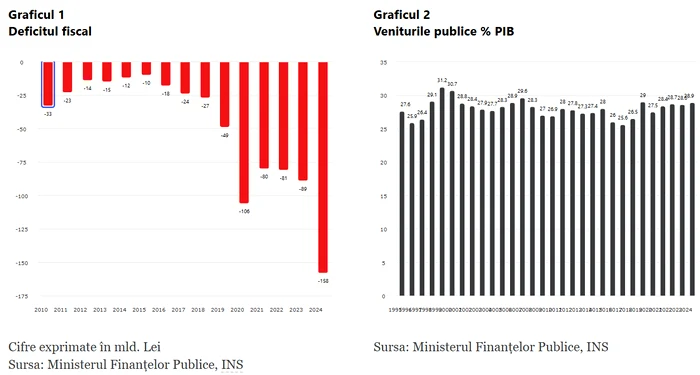
The fiscal deficit still increases to 158 billion lei in 2024, maximum historical, with almost 50% more than the one registered in 2020 (106 billion lei), year of reference severely affected by the Covid-19 pandemic (-3.7%).
This phenomenon is caused by the much more accelerated increase in public expenses related to GDP, which have reached almost 41% (dec. 2024) vs. only 32% (dec. 2024).
The situation has been massively damaged in the last decade, given that the public revenues related to GDP were 33% in Dec 2015 while the public expenses were 34.6%. Basically, the state has spent much more in the last decade (+6.5% of GDP), while public revenues have decreased by 1PP, reflecting that the underground economy, illicit traffic and tax evasion have not been systematically and generalized at the economy level. If we extend the analysis period for the last 3 decades (1995-2024), we reach the same conclusion: the public revenues related to GDP have always fluctuated close to the 30% threshold, 10% less than the EU average at the end of last year.
Basically, Romania loses about 10% of GDP each year due to the underground economy, respectively 175 billion lei, which means more than the entire PNRR program (about 29 billion €).
The public debt increases at an alarming rate, the trend being caused by the increase of the fiscal deficit that requires financing. Basically, in the preceding decade of the Covid-19 Pandemic (2010–2019), the balance of public debt has increased by about 250 billion lei, while only the last 4 years (2020-2024) have generated an increase in public debt by about 700 billion. So, in the last we borrow twice more accelerated, three times more, respectively 6 times more / day.
Even if Romania still registers a debt related to GDP less than 60%, well below the European average of 80% at this rate the direction is not good. On the one hand, it increases the indebtedness more accelerated than GDP as long as the tax deficit (8-9%) is higher than inflation (about 5% seen in nominal GDP), the difference between them being reflected by the increase of the indebtedness.
On the other hand, the increase of the salary is slower, which affects the ability of the economy to pay the debts without tax changes, retirement age or inflation (for debt deflation). Basically, the average debt / inhabitant compared to the average net / inhabitant salary increased from 60% (2010) to 105% (2024), see graph 4.
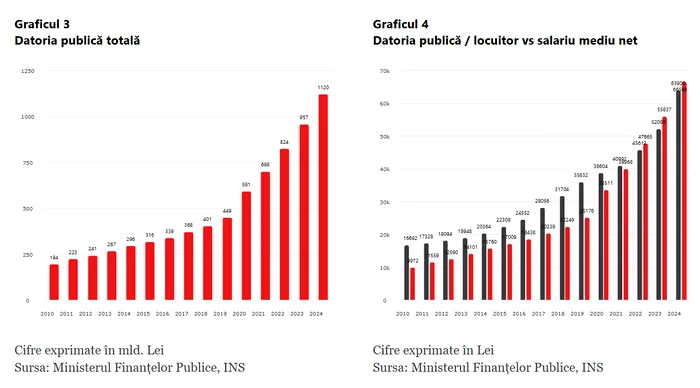
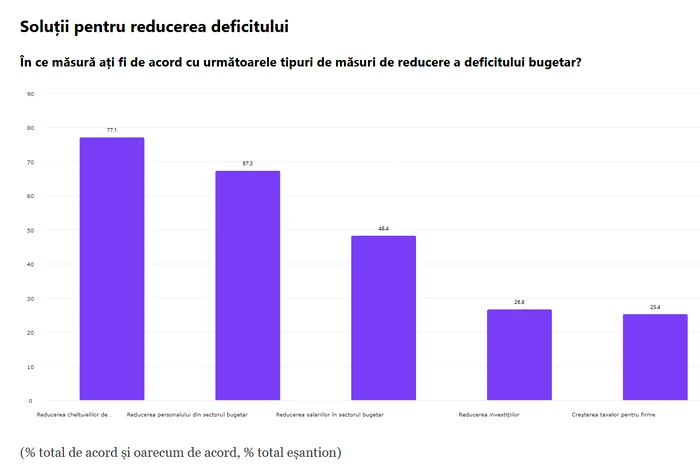
Basically, the problem comes here, when the fiscal deficit becomes unsustainable and very difficult to finance, in which we are now. And people's expectations are clear: it is insistently desired to reduce expenses and waste in the public sector, not just tax increases. A study recently published by the information platform.ro and conducted by Inscop reflects this aspect very clearly, as it appears from the results illustrated below.
Other principles required for those tax adjustments:
- Eliminations of exceptions than generalized growths (better increase VAT rates than to increase VAT for all)
- The capital (companies) is very little charged in Romania, but the work (employees). A gross salary is charged 42%(easy above the EU average of 38%), but the profit tax (16%) + dividend 10%× (100% – 16%) = 8.4%, so cumulative 24%of the gross profit vs European average 48%!!!! But, if the tax on profit and / or dividend is increased, it also helps a positive stimulant (extended tax deductions for development or profit reinvested in the company). Otherwise, the private sector will not comply if it sees only certain increases in taxes and generalist promises on the adjustment side of expenses and reduction in the public sector. Basically the problem of deficit is aggravated.