The boulder of memory about Polish victims stood in Berlin. In the future, a monument will be built in its place

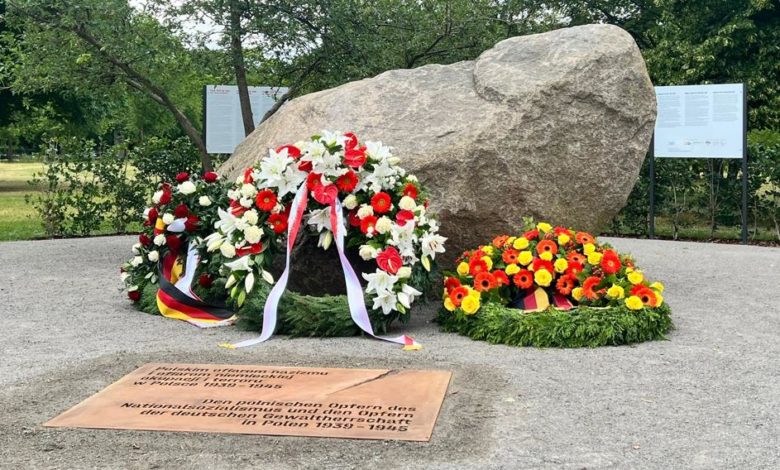
Near the Chancellor's Office and the Bundestag in Berlin, a place of memory for Poland 1939-1945 was solemnly unveiled on Monday, commemorating millions of citizens of the Second Polish Republic, who in 1939-1945 became victims of the German setting war and occupation.
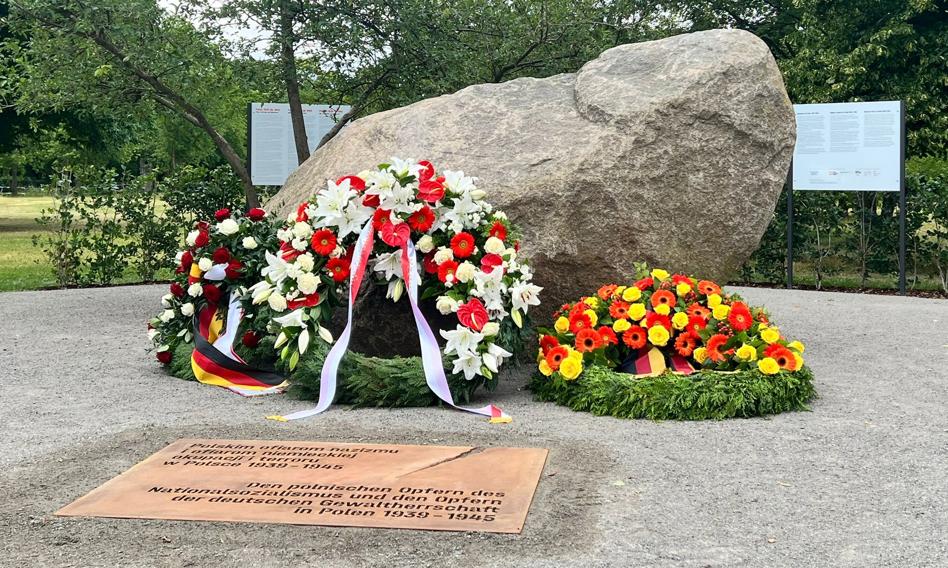
The temporary monument dedicated to the victims of German aggression and occupation in Poland was established in a symbolic place, in the area of the Kroll Opera, in which Adolf Hitler announced an assault on Poland on September 1, 1939. In mid -April, there was an erratic boulder weighing almost 30 tons with a plaque with an inscription in Polish and German:
“Polish victims of Nazism and the victims of German occupation and terror in Poland 1939-1945”.
The temporary commemoration unveiled on Monday is to be an important step on the way to the creation of an official memorial site in the Federal Republic of Germany. In the future it will be the so -called The German -Polish house, i.e. the monument and the place of education and meetings – was emphasized during the event in Berlin.
“This is a day we have been waiting for a long time,” said Heiko Maas, former head of the German Ministry of Foreign Affairs, president of the German Institute of Polish Affairs (DPI), welcoming the participants of the event. At the same time, he noticed that everyone would like a permanent monument and a meeting place for Germans and Poles as soon as possible.
He emphasized that the 2017 Citizens' Initiative led to the creation of a place of memory. In this context, he reminded about the role of German initiators, including The former chairmen of the Bundestag Rita Sessmuth and Wolfgang Thierse present at the Monday ceremony.
Maas emphasized that the place of memory is necessary because “we, Germany, are not sufficiently aware of the misfortune, pain and damage that our country brought to Poland during World War II.” This place should “be a signal for all people in Poland that Poland is important to us” – he added …
Minister of State, German Government Plenipotentiary for Culture and Media Wolfram Weimer said that the memory stone unveiled on Monday symbolizes the burden of history.
“Never again hatred, violence and injustice can not be triumphed,” he said.
Hanna Wróblewska, who was present at the ceremony of the Minister of Culture and National Heritage, emphasized that from the words “there is almost no Polish family who was not affected by German occupation in 1939-1945” a group of 140 initiators and initiators began in 2017 a job in which they included a postulate of a monument to Polish victims of German occupation.
“The initiators of the open letter are with us today. I hope that they are accompanied by a sense of peace, and maybe even satisfaction and emotion, that their postulate begins to take on a real shape today and that another visible foundation is created for the Polish -German agreement built for many decades,” she said. The head of the ministry also reminded about the “great advocate of commemorating Polish victims of World War II” by Władysław Bartoszewski, who died in 2015.
The minister emphasized that “a monument is responsibility”. “Responsibility consisting in the courage to look into the past – without avoiding difficult matters, without silence, without oblivion. Its current formula paves the way to implementing the Bundestag resolution of October 2020 on the construction of the target monument. It is a gesture towards specific people and their families. It is a symbol of European culture culture – honest and common” – noted the head of the Ministry of Culture and National Heritage.
“Today our memory is taking shape,” she emphasized.
The head of the Polish-German parliamentary group in the Sejm Marek Krząkała (KO) told PAP that someone said during the ceremony that The memory stone was erected “too late at 80 years”, but he pointed out that efforts to build a monument lasted for years, including the previous PiS government.
“And this is the main problem in the policy of Law and Justice, which harms our mutual (Polish -German – PAP) relations, but also harms our security in Europe. Today we have to seek agreement, bridges. And the construction of this monument, today it is a form of stone, I treat as the first step (…) in the future that in the future both a monument and a place of meetings and a permanent place (…) Shrinking.
MP Klaudia Jachira (KO) recalled the words from the ceremony that “friendship cannot be imposed from above, it must be an act of reconciliation coming out of both civil societies and (…) This place is the best example of this.” She pointed out that “of course, historical memory would require such a place to be created earlier, but maybe just so much time it was necessary for certain wounds to heal, that very difficult memories and (…) experiences could be worked over for generations.”
The opposition criticizes: Germans want to settle the matter with a stone
Polish opposition criticized the German initiative of temporary commemoration. “The Germans today want to finally deal with the issue of their crimes with a stone, which they rolled in front of the Reichstag building,” wrote Paweł Jabłoński on Monday on platform x PiS MP. “It is in the interest of Poland to completely cut itself off from this shameful attempt to escape Germany from responsibility. At today's + ceremony + unveiling of this stone should not appear any politician from Poland” – he added.
At the beginning of May, PiS MEP Arkadiusz Mularczyk told PAP that “80 years after the end of World War II, this stone is a symbol of some kind of failure of German policywhen it comes to building relationships with Poland in the field of memory policy. “In his opinion, a temporary place of memory of Polish victims” comes too late “and is insufficient.
On the website of the Polish-German House, it was recalled that DPI from 2017 was involved in the initiative of creating a place in Berlin commemorating the victims of the German occupation of Poland during the Second World War and supported this initiative of civil society. The commemoration place was to be combined with an exhibition dedicated to Polish-German history and extensive educational activities.
On October 30, 2020, the Bundestag adopted a resolution “on respect for the character of Polish-German history and to cause deepening these special bilateral relations by creating a memorial and meeting.” After numerous consultations and talks with experts, the German Ministry of Foreign Affairs presented in September 2021 the initial concept of “Memorial and meetings with Poland”.
After the election to the Bundestag in the autumn of 2021, the issue of “Memorial and Meetings with Poland” was responsible for the representative of the German government for culture and media, which on May 12, 2022 ordered the Monument to the Monument to the Murdered Jews of Europe on work on existing proposals, with the participation of DPI.
In March 2023, a team of the Polish-German House was established at the Foundation. The project is currently commemorated at the Bundestag approval.
From Berlin Berenik Lemańczyk (PAP)
bml/ akl/ lm/