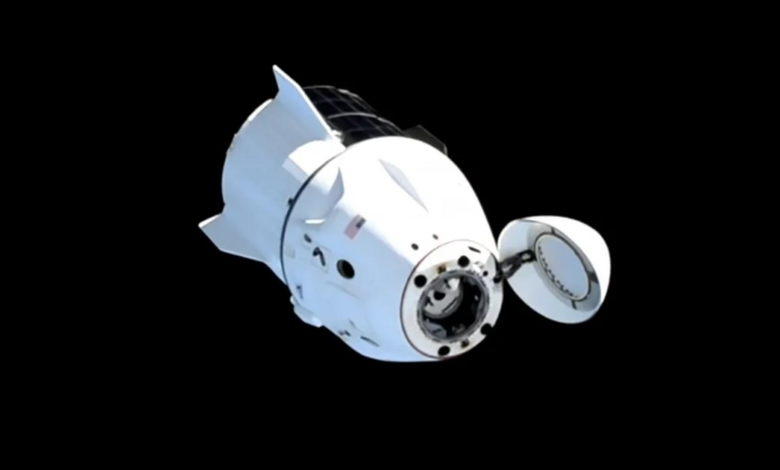
The dispute between US President Donald Trump and billionaire Elon Musk on a major draft spending law has exacerbated the uncertainty on the fate of the NASA budget, which is already facing substantial discounts.
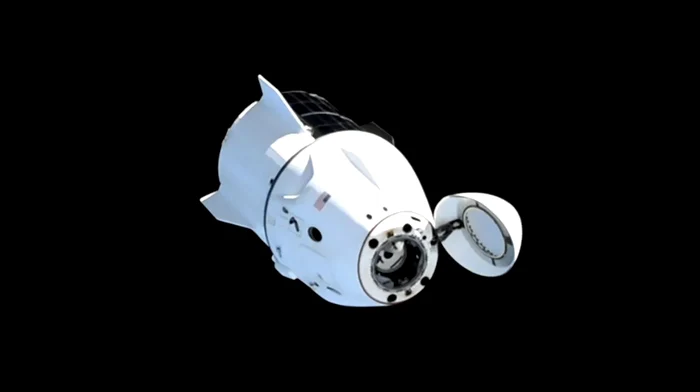
Spacex Drago spacecraft leaves the NASA's International Space Station
The White House has requested huge discounts on the budget of the space agency, which would reduce the financing of scientific projects by almost half.
During his dispute, his former ally, the US president threatened to cancel the federal contracts of Musk's company, Space X, endangering the American space program.
NASA depends on the Falcon 9 rocket fleet to replenish the international space station with crew and supplies. The space agency also expects to use the Starship rocket to send astronauts to the Moon and finally to Mars.
Simeon Barber, a scientist at the university, said that the state of uncertainty has a “scary impact” on the human space program.
“The amazing exchanges, the rapid decisions and the turning situation that we have assisted in the last week undermines the foundations that we build.
Forty scientific missions that are already under development or space, are to be stopped
All sectors are targeted by the saving initiative, apart from an effort to send astronauts to Mars, who received a $ 100 million impulse.
According to Casey Dreier, the head of spatial policy at Planetary Society in Pasadena, who promotes space exploration, potential discounts represent “the largest crisis ever faced the American Space Program.”
NASA has published details about how he intends to perform the discounts requested by the White House in his request for a budget to Congress, proposing a decrease by almost a quarter. The agency says that the plan “Aligns the science and technology portfolios on the essential missions for exploring the Moon and the Mars plant.”
Dr. Adam Baker, a space analyst at Cranfield University, told BBC News that if these proposals are approved by Congress, they would fundamentally change the attention of the agency.
“President Trump changes the NASA direction for two goals to send astronauts on the Moon before the Chinese and for astronauts to plant an American flag on Mars. Everything else is secondary.”
Those who support the proposals say that the budget of the White House gave NASA a clear purpose, for the first time since the Apollo Aselenization of the 1960s and 1970s, when the goal was to overcome the Soviet Union on the Moon.
NASA critics say that, since then, the space agency has become a bureaucracy, which exceeds the budget in its space missions, and dispel the taxpayers' money.
One of the most revealing examples in this regard is the new NASA rocket that is part of the plans to bring back American astronauts, Space Launch System (SLS). Its development was delayed, and the costs increased so much that they reached $ 4.1 billion for each launch.
In contrast, the equivalent rocket system of Spacex, Starship, is estimated to cost about $ 100 million per launch, as it is designed to be reusable. Jeff Bezos's spatial company promises similar savings for its New Glenn rocket.
SLS will be gradually eliminated, according to the proposals of the White House, in the hope that Starship and New Glenn can take its place. But the last three starship launches were not successful, and Blue Origin started to test their monthly rocket recently.
“The concern is that NASA could jump from the pan, in the fire,” says Dr. Barber.
“The development of these SLS alternatives is funded by Elon Musk and Jeff Bezos.
“If they lose their appetite for this effort and Spacex or Blue Origin say they need more money to develop their systems, Congress will have to give them.”
An even greater concern, says Dr. Barber, is the potential loss of 40 missions to explore other planets and to monitor the impact of climatic changes in the land in space, many of whom involve collaborations with international partners.
“I think it is very sad that what lasted to be built can be demolished so quickly, without any plan to rebuild.”
Projects that face cutting include dozens of planetary missions already in space for which most development and launch costs have already been paid, with relatively small savings proposed for their operating costs.
Space X, a cheaper variant
In contrast, the equivalent rocket system of Spacex, Starship, is estimated to cost about $ 100 million per launch, as it is designed to be reusable. Jeff Bezos's spatial company promises similar savings for its New Glenn rocket.
SLS will be gradually eliminated in the proposals of the White House, hoping that Starship and New Glenn can take their place. But the last three starship development launches were not successful, and Blue Origin has only recently started testing their monthly rocket.
“The concern is that NASA could jump from the pan, in the fire,” says Dr. Barber.
“The development of these SLS alternatives is funded by Elon Musk and Jeff Bezos.
“If they lose their appetite for this effort and Spacex or Blue Origin say they need more money to develop their systems, Congress will have to give them.”
A greater concern, says Dr. Barber, is the potential loss of 40 missions to explore other planets and to monitor the impact of climatic changes on the land in space, many of whom involve collaborations with international partners.
“I think it is very sad that what lasted so long to be built can be so fast, without any plan to rebuild it.”
Projects that face the top include dozens of planetary missions already in space for which most development and launch costs have already been paid, with relatively small savings proposed at their operating costs.
Spacex has concluded a partnership with NASA
Spacex has concluded a partnership with NASA
Also, two collaborations with the European Space Agency are threatened: an ambitious plan to bring the Martian rocks collected by the Perseverance Rover of NASA back to Earth and a mission to send the European Rovelind Rosalind Franklin to seek signs of life.
Professor Sir Martin Sweeting, head of the British space company Surrey Satellite Technology LTD and co-author of a Royal Society report, says that, although the evolution is “unwanted”, there could be an advantage for Europe, as it takes on greater responsibility for its own space exploration program.
“Maybe we relied too much on NASA as a big player, to put a lot of emphasis in space,” he told BBC News.
“It is an opportunity to think about how Europe wants to achieve a better balance in its space activities.”
Much more disadvantages to Europe in the short term
In addition to returning the samples from Mars and its rover, ESA risks reducing access to the international space station if it is closed, and the budget discounts cancel the extensive NASA contributions to its successor, a monthly Gateway, a planned multinational space station will be blinded around the month.
In his recently published strategy, ESA said that “he will seek to build a more independent space capacity and continue to be a reliable, powerful and desirable partner for space agencies around the world”, with the involvement that he will do this with or without NASA.
Also, many current and proposed programs are found to observe the Earth, according to Dr. Baker.
“These earth observation programs are our canary in the coal mine,” he told BBC News.
“Our ability to predict the impact of climate change and to mitigate them could be drastically reduced. If we stop this early warning system, it is a frightening perspective.”
The budget proposals have not yet been approved by Congress. Casey Dreier from Planetary Society told BBC News that many Republicans have told the lobbyists in private that they are ready to vote against discounts.