The European Commission and the European Central Bank approved the decision thanks to which Bulgaria will become the 21st member of the euro area, recognizing its success in meeting the required economic criteria, Despite persistent concerns about such issues as money laundering and high political corruption.
However, “Bulgaria still has to face a number of political challenges … related to the fight against corruption, the independence of the judiciary and the effectiveness of public administration and public procurement,” said Suardi.
“Coming to the euro area is the best investment that Bulgaria can make in her future,” said journalists on Thursday, the vice -chairman of Ke Valdis Dombrovskis, adding that membership will help Bulgaria in the same way as his homeland helped – Latvia – and other Baltic countries.
– Given the geopolitical situation in the region and the war of Russia with Ukraine, the euro plays the role of a shield … Our savings are safe, the currency is stable, and our countries have shown resistance in the face of subsequent economic shocks – he said.
He added that “our economies and enterprises benefited from the abolition of currency exchange costs, increased price transparency, access to cheaper financing and greater interest from international investors.”
Closer to the Union, further from Russia
This move is more strongly associated with one of the poorest EU countries with the institutional structures of the Union when Russia exerts economic, political and even military pressure on its former neighbors from the Eastern Bloc, which prompts some to flirt with foreign policy more friendly to the Kremlin.
It is not surprising that European officials close to the trial informed Politico that they did not expect other members of the euro area in the final decision on joining [Bułgarii]which will be taken during the Meeting of EU Finance Ministers on July 8 this year.
This Balkan country of 6.4 million inhabitants undertook to join the euro area in 2007, but was repeatedly rejected after it did not meet the series of so -called convergence criteria that are aimed at ensuring economic and legal compliance. The persistent high inflation follows Pandemia and invasion of Ukraine destroyed the country's chances of joining the “Euro Club” in 2024 and 2025.
However, the authorities responsible for finances managed to master inflation, which in the period of 12 months to April amounted to 2.7 percent on average. National inflation increased at the beginning of this year to four percent. As a result of VAT increases and the expiry of some support measures introduced during Pandemia, but Suardi noted on Tuesday that this effect would be “temporary”.
Suardi also praised Bulgaria for “relatively flexible and efficient” labor market and “very low” public debt, which is 24.1 percent. GDP and is the second lowest in the EU, well below 60 % reference value required to join the Union.
“I would like to congratulate Bulgaria with a huge commitment in introducing the necessary changes,” said ECB's chief economist Philip Lane during a separate conference.
Continuation of the material under the video
Threat and fears
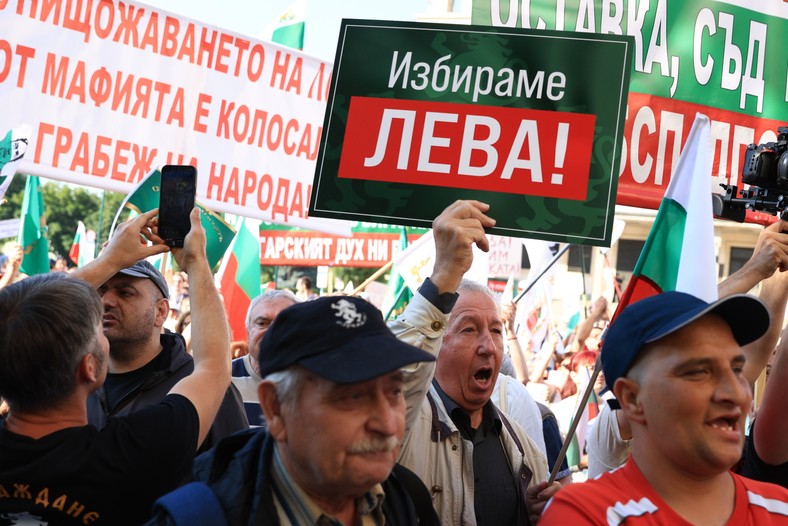
However, fears remain – both in and outside. On Saturday, thousands of people went out to the streets of Bulgaria, calling the government to preserve the left, which until now was the currency of the country. As is usually the case during such changes, there are fears that traders and companies will use redenomination as an opportunity to raise pricesand increased trade with the rest of the euro area can also cause them to increase locally.
“Ensuring price transparency and combating excessive increases will require special efforts,” Dombrovskis warned, however, stating that other countries that took the same step eventually overcame all related problems.
In his report, EBC admitted that in the perspective of the future Bulgaria must supplement membership in the euro area “appropriate policy to avoid excessive threat to Bulgaria's competitiveness and prevent the growth of the unbalanced increase in loans and other macroeconomic balance disorders.”
Although hourly labor costs in Bulgaria are still the lowest in the EU, wage growth must be consistent with, among others, an increase in efficiency to maintain the country's competitiveness and attractiveness for foreign investors, the central bank said.
PAP/EPA/VASSIL DONEV/PAP
Participant of the protest against the admission of the euro with a poster with the inscription “I choose left”, Sofia, Bulgaria, June 4, 2025.
Political decision -makers are also thinking about the rule of law and transparency. Organized crime and oligarchy have been harassing Bulgaria for years, and in the latest EU report regarding the rule of law, concern has been concerned about the lack of independence of some regulatory bodies, while noticing that “high -level corruption at prosecution of cases of high -level corruption was still not achieved.
Monetary authorities are also concerned about the results of Bulgaria in the field of money laundering, as a result of which last year the country was on the “gray list” of Financial Action Task Force money, which requires increased monitoring and puts it in one row with Syria, Venezuela and Yemen. This designation is reserved for countries that Fatf recognizes as cooperating, but which still have to improve the control and prosecution of money laundering.
“Further progress is necessary to eliminate other shortcomings in the field of counteracting money laundering and financing terrorism,” said EBC. Importantly, these obligations, however, do not constitute an integral part of the convergence criteria, and therefore will not affect the decision on membership.
Suardi added on Tuesday that Bulgaria is also excessively dependent on fossil fuels, indicating a deficiency of qualified workforce and deficiencies in the education system. According to the Commission 30.3 percent The population of the country is threatened with poverty or social exclusion.
I’m Ashley Davis as an editor, I’m committed to upholding the highest standards of integrity and accuracy in every piece we publish. My work is driven by curiosity, a passion for truth, and a belief that journalism plays a crucial role in shaping public discourse. I strive to tell stories that not only inform but also inspire action and conversation.