The annual inflation in the European Union was 2.4% in April 2025, decreasing from 2.5% in March. The highest annual rates were registered in Romania (4.9%), Estonia (4.4%) and Hungary (4.2%), according to data published by Eurostat, the Statistics Office of the European Union.
Eurostat measures a harmonized price index, in order to compare the increases in the EU Member States. Inflation in Romania was 4.9% measured in March both by the CPI (consumer price index) and by the harmonized index of consumer prices (IAPC). See below in the article what is the difference between the two types of measurements
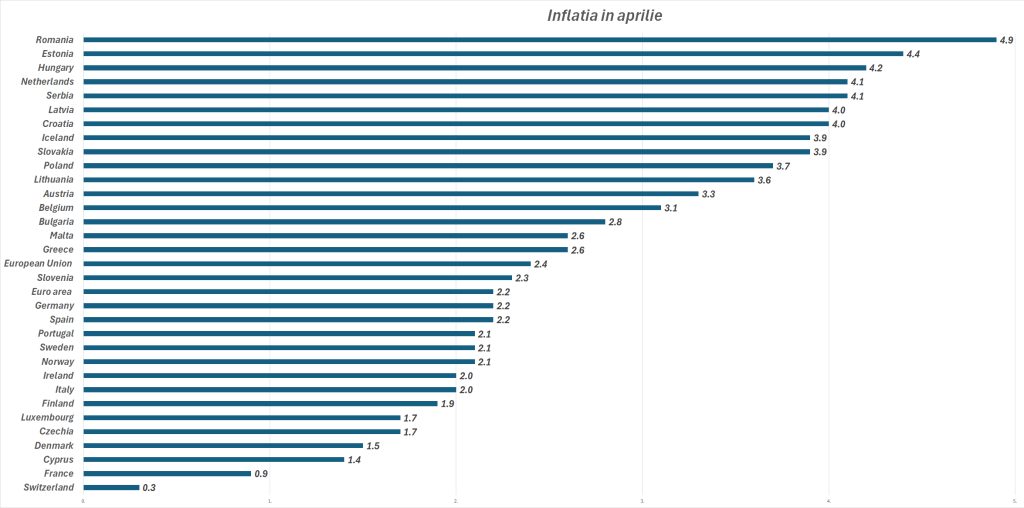
The lowest annual rates were recorded in France (0.9%), Cyprus (1.4%) and Denmark (1.5%).
Compared to March 2025, the annual inflation decreased in thirteen Member States, remained stable in three and grew in eleven.
In April 2025, the highest contribution to the annual inflation rate in the euro area came from services (+1.80 percentage points, PP), followed by food, alcohol and tobacco (+0.57 pp).
The counter -performance in terms of inflation is also mirrored by the evolution of the economy. Ins published the preliminary estimate for the GDP in the 1st quarter of 2025, showing a quasi-stagnation compared to the 4th quarter of 2024, when it increased by 0.5% compared to the previous quarter (seasonal adjusted data).
A comparison of the growth rate of Romania with the other European economies is only available on the basis of the seasonal adjusted data, according to which Romania increased by 0.5% in the 1st quarter of 2025, much slower than the euro area (+1.2%) and the EU (+1.4%).
“Romania's performance was among the lowest in the EU, probably triggered by the low performance of the German economy, which decreased for the fourth consecutive quarter (-0.2%), the Romanian processing industry being closely linked to the German auto industry. At the same time, the other two commercial partners of Romania increased by 0.6%. Compared to the previous year, ”shows a report by UniCredit Bank.
The best performances in the EU were recorded by Ireland (+10.9%), Poland (+3.8%), Lithuania (+3.2%) and Bulgaria (+3.1%). Other countries in Central and Eastern Europe that have grown faster in this year's first quarter were the Czech Republic and Slovakia.
The difference between inflation measured by IPC and IAPC
IPC uses the “national” principle of consumption, following the consumption expenses of residents, whether they are performed inside or outside the country's borders.
IAPC measures the changes produced in the evolution of prices that occurred on the territory of Romania. Thus, for the construction of the IAPC the “domestic” principle is used, taking into account Consumption of all households in the country, regardless of nationalityresidential or social status, except for foreign embassies on the territory of Romania.
Also, as a methodology in the construction of IPC, a nomenclature of goods and services is used, structured on 54 foodstations, 111 non -foodstuffs and 50 service positions, significant for the consumption of the population.
In the European system, in the construction of the IAPC, a classification of the expenses after the consumption destination is used, which regrouping the posts From the national system that ensures the comparability of indices at European level, and is structured on 12 detailed divisions, 47 groups, classes and sub -classes.