
Since joining the EU, wages have tripled in Romania. Why don't we feel this growth in pockets / country in Europe with the highest index of inequality


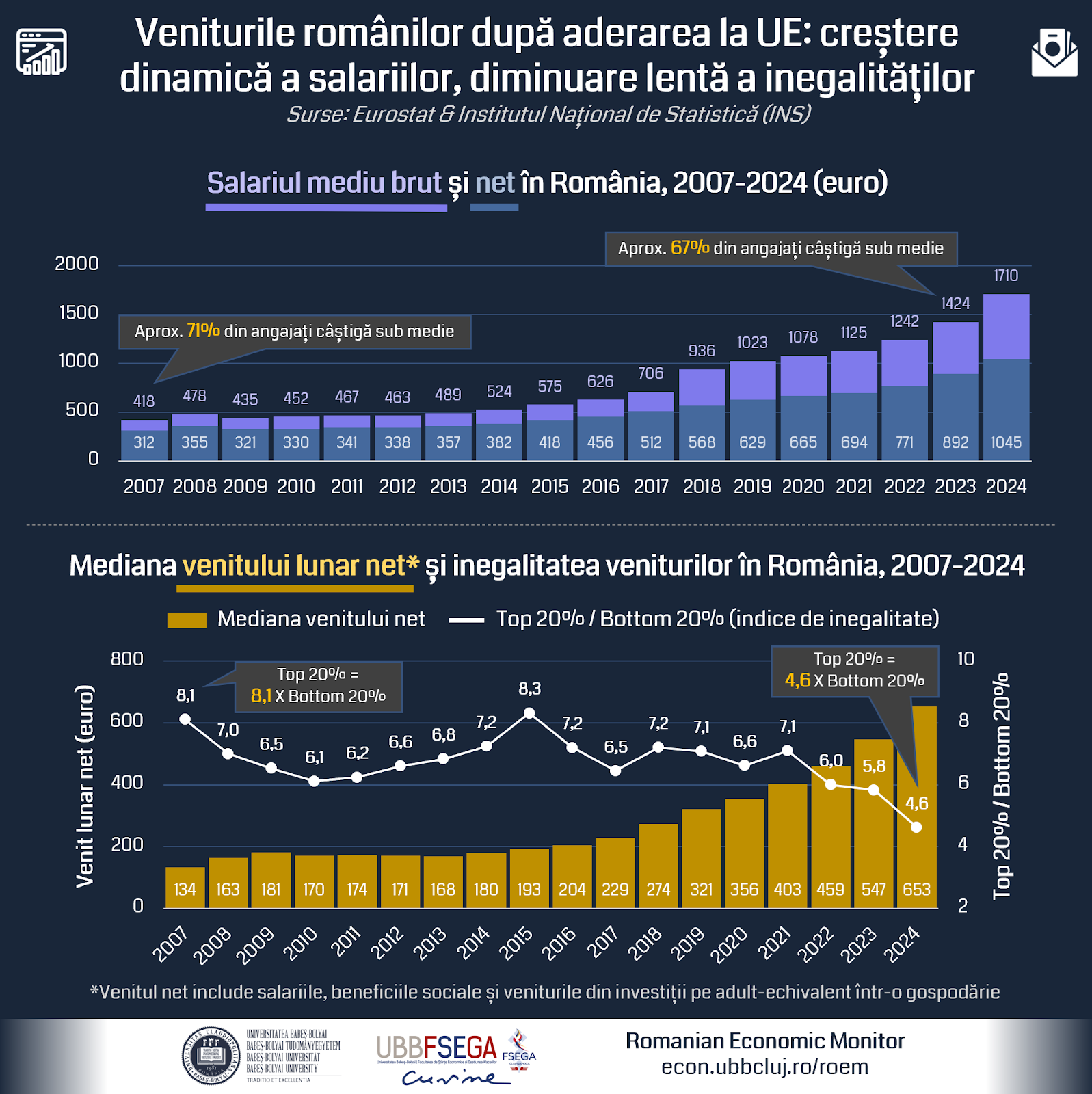
From the moment of Romania's accession to the European Union, but especially in the last 7-8 years, the salaries in Romania have registered a spectacular evolution, in nominal terms, the average monthly net salary increasing more than three times, from 312 euros, in 2007, to 1045 euros, in 2024. A part of the population does not charge these income increases. One of the explanations is related to inequalities in society, even if they have begun to decrease in recent years. However, it happens very slowly, and this can affect the future development of the country, warns the researchers.
Even taking into account inflation, which erodes the purchasing power, the increase remains significant, with an increase of over 122% of the net average salary, thus exceeding several countries in this area of Europe, considers the analysts of the Romanian Economic Monitor, research project of the Faculty of Economic Sciences and the Business Management (
“In Romania, the average monthly net salary exceeded the threshold of 1,000 euros for the first time at the end of 2023. And yet, despite these positive evolutions, a large part of the Romanians has a different perception on the evolution of their own monthly income and does not feel a significant increase in the standard of living,” explains Levente Szász Roem.
The economic inequalities in the country
The expert says that an explanation for these different perceptions is the economic inequalities in the country.
“Even if the average level of wages increases dynamically, if a large part of society benefits less of these increases than others, social tensions become more accentuated and can endanger the country's future economic development,” says Levente Szász.
“The three Romanians”
The analysis performed by the team of economists on the monthly wage inequality indicates a descending tendency at national level.
In a previous study, the same specialists highlighted the existence of “three Romanians” from the perspective of the economic well-being of the population: the capital with the highest salaries; the counties with economically dynamic cities, such as Cluj, Timiș or Brașov, where the salaries generally exceed the national average; And the rest of the country's regions, where the average salaries are well below the national average.
“The diminution of the inequalities is very slow: if in 2007 about 71% of the employees in Romania they earned below the national average, in 2023, the value is slightly lower, 67%. This decrease of 4 percentage points does not represent a relevant improvement of the situation, especially since this evolution happened during a period of 17 years,” the direction is too much: Ottó Csiki, a researcher within the ROEM team.
Those with the highest revenues earn 4.6 times more than those with the lowest income. In 2007 the report was almost double
The analysis of the total income of the population (which, in addition to salaries, also include social benefits, such as pensions, respectively investment revenues, including their own companies) shows that, during the period after the European accession of Romania, the total revenues also had a spectacular evolution, the more significant increases being recorded especially after 2016.
Specifically, the analysts say, the median value of the total monthly income (ie the middle value of all the incomes, the half of the population earning, and the other half of the population earning below this value) increased almost five times in this period (from 134 euros, in 2007, to 653 euros, in 2024).
ROEM analysts specify that the total monthly income is calculated on the equivalent adult, including in the equation all members of a household. Thus, the value of the total revenues reported on a person can be lower than the average salary of the same year, the latter being calculated only for employed persons.
The index of inequality, calculated as the revenues of the segment of 20% of the population with the highest revenues related to the 20% segment with the lowest revenues (Top 20% vs Bottom 20%), shows a marked decrease in inequalities.
If this report was 8.1 in 2007 (those with the highest revenues won 8.1 times more than those with the lowest revenues), its value almost halved until 2024, reaching “only” 4.6 (those with the highest revenues win 4.6 times more than those with the lowest income).
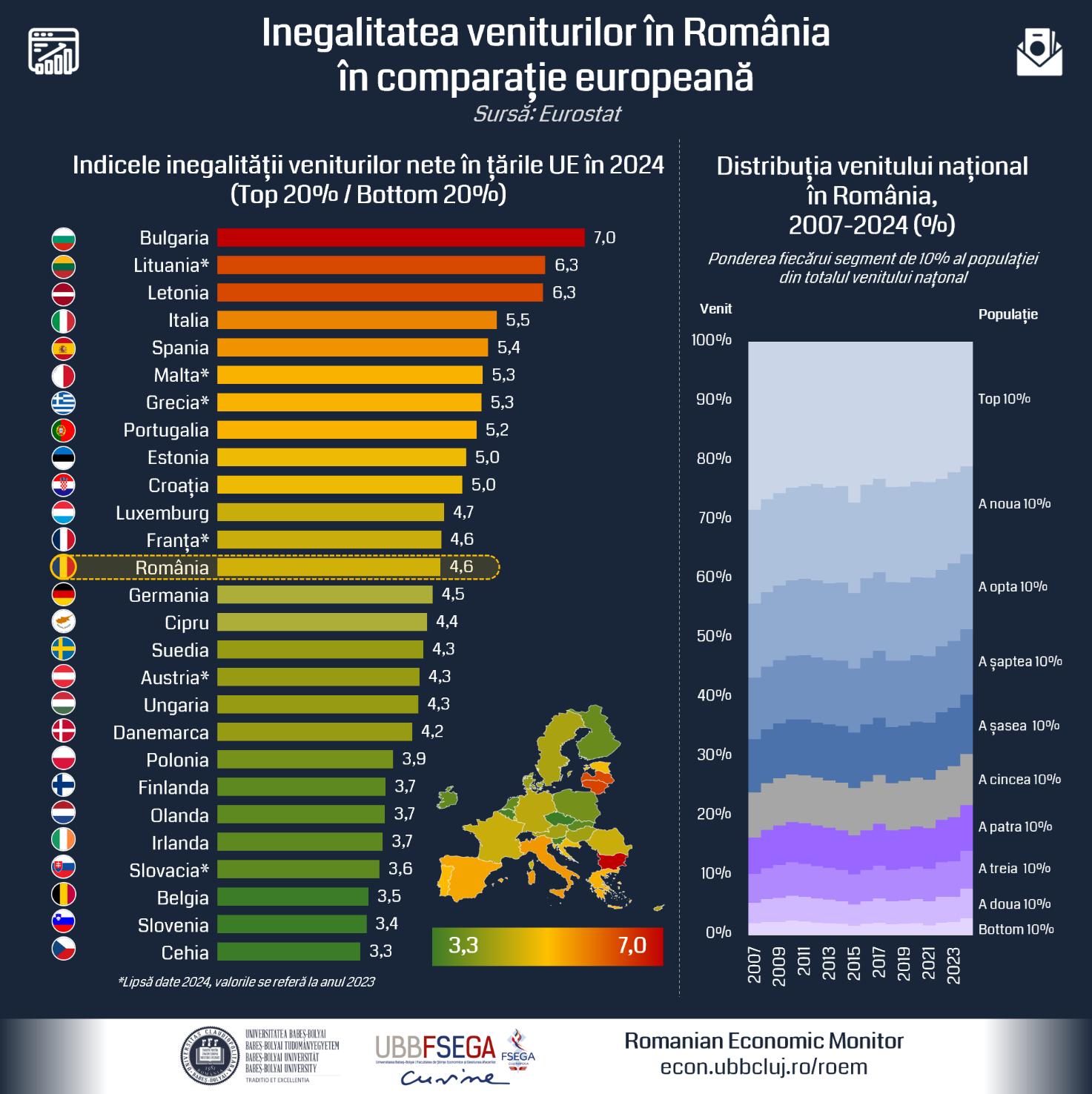
“In general, the data show that the share of each segment of the population with monthly revenues over the median has become lower and lower from the total revenues made at the country level, and the same weight for the segments with low incomes has begun to increase gradually. This decrease in income inequality is more pronounced in the last four years, especially in the last year, especially in the last year, especially in the year 2024 Economy, respectively pensions.
What is the country in the EU with the highest index of inequality
In this European ranking made for 2024, Romania is in the middle of the hierarchy, equal to France, exceeding 11 countries, where the inequality of population revenues is higher. Among the countries with the highest values of the inequality indicator are Bulgaria (7.0), Lithuania (6.3) and Latvia (6.3), and at the top of the ranking are the Czech Republic (3.3), Slovenia (3.4) and Belgium (3.5).
“It is also important to emphasize that in 2015 Romania was still the country with the highest inequalities of the EU revenues, with a value of 8.3 of the ratio between the revenues of the two segments of 20% of the population with the highest, respectively the smallest monthly earnings. Thus, the progress in reducing the inequalities can be considered in the last years, in the last years, in the last years. Recent and, given the social tensions existing in the country, it is important that these results are maintained in the long term ”, concludes the coordinator of the ROEM team.
Romanian Economic Monitor is a research project of the Faculty of Economic Sciences and Business Management within Babeș-Bolyai University in Cluj-Napoca, through which the six researchers of the university involved in this scientific approach publish a series of economic data in the form of interactive infographics, meant to show a comprehensive image, updated in real time, of the economic situation in Romania. The purpose of the project is the clear and precise information of the Romanians regarding the evolution of the economy, based on credible and verified data sources, but also to provide real support to the decision -making factors in the Romanian policy and economy, by making and updating the analysis of the economic situation, and offering a starting point for making some forecasting scenarios, which will help.


