One of the most read economic newspapers writes that the Polish stock exchange, despite great results this year, is not popular among investors. The British weekly “The Economist” noticed the WIG index for the WSE on the WSE and is diagnosed with this state of affairs. It may worry that such articles usually appear just before the trend change. May it be different this time.

“The Economist” devotes a lot of space in its article entitled “Poland: ignored the Stock Exchange Supergivting” (in the paper edition the title was “Time for Masurka”), focusing in the title on poor interest in the market of our country's stock market. Finally, he suggests readers not to bet that it will go on. The publication was noticed on Platform X by the head of the Polish Stock Exchange, Tomasz Bardziłowski and Minister of Finance Andrzej Domański.
WIG from the beginning of the year +31%. A year of breakthrough. @Theeconomist pic.twitter.com/1jub2ryuvk
– Andrzej Domański (@Domanski_andrz) May 16, 2025
While it should be glad that the read -like title of the global range deals with the subject of the Polish capital market, the symbolism of this type of publication may worry, which announces that the WSE is “The fastest growing European stock market”. It reminds you of the popular cover effect among investors, which symbolizes reaching the top of the trend.
In order not to look far in the past, let us remind you that in August 2022, the Bloomberg agency published an article calling WIG20 the worst stock market index in the world. Bessa lasted two more months and from October the index began to march up, which continues to this day. This is over 30 months of Hossa and another article of the global medium, this time about this year's behavior of the WIG wide market index, which in dollars has already gained 40 percent.
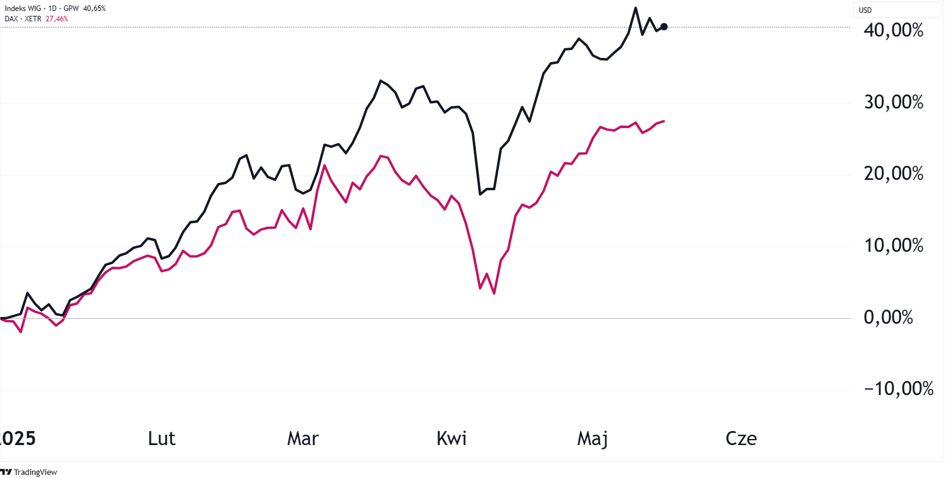
For comparison, “The Economist” lists him with “poor” 27 percent. German DAX. The comparison is not accidental, because, apart from the profitable nature of both indexes, it focuses on the description of the fundamental causes of WIG, quoting Peter Bosek, i.e. the president of Erste Group, the poignant of Santander Bank Polska, who says that “Poland is new Germans.”
The analogy refers to the Polish economic transformation – reminiscent of Germany in the second half of the 20th century. The weekly also cites the MFW data, which estimates that this year Polish GDP per capita (on the head) will exceed the analogous GDP of Japan, after taking into account the purchasing power. “In 2005, Poland's income according to this indicator was 50 % of the EU average; in 2025, the IMF believes that it will increase to 85 percent.” – writes “The Economist”.
Lost WSE years and good foster. A legendary daily about the Polish capital market
It is rare for a recognized industry diary to devote so much space to the Polish capital market. It is all the more glad that the crowds of investors from around the world “Financial Times” reminded of the WSE.
However, the decades of economic changes were not to be noticed by investors, as proof of which the statistics of 2010–2020 were cited, when dollar share prices were at a similar level. However, the analysis served by “The Economist” seems incomplete. It was only mentioned about the turmoil on the market during the Covid-19 pandemic and the crash after the outbreak of the war in Ukraine, especially the latter, which burdened the indexes of the converted country, but still selectively treats events affecting the growth of the stock exchange, concerting on the political dimension without market context.
“Poles began to look more German in the second way: by throwing their populist, interventionist and anti -EU Law and Justice party,” reads. The rightly accusation of manual control of concerns such as Orlen, which reduced fuel prices before the election, was supplemented by the sentence that “PiS approach to the markets included installing a friend to manage the Polish Central Bank, which then reduced interest rates during the election campaign in 2023.”
According to The Economist, the government was to change Poland much more attractive in terms of investment. While in fact the so -called The “Tusk effect”, or post -election euphoria, was visible on the market after the election and lasted somewhere to May last year, until the end of 2024 was sometimes a deep correction on the WSE.
The unlocking of the EU funds from the KPO is to be behind the good condition of the Polish stock exchange, but billions of which it is easy to write on X for now you can not see available data from the real economy. Investments in 2024 lay, and all the height, much below the potential, was basically due to private consumption. It is difficult to agree to the fact that manual control was forgotten, since a few weeks ago we heard from the prime minister itself that maximizing profits in state -owned companies is not to be a priority for their presidents.
Focusing only on this year's height, hope was completely omitted from the beginning of the year to the rapid end of the war in Ukraine, which seems to be the main driving force driving the Polish stock market this year. In January, February and March, WIG gained 9.8 percent, respectively. 5.3 and 4.3 percent In April it was 2.3 percent, and in May now the increase is about 4.1 percent.
The second omitted factor is the zloty force with the dollar weakness. The latter is impossible not to notice. The reverse correlation of the American currency ratings with the condition of the Polish market is quite visible over many years, while the zloty force itself is also the result of the MPP decision, which until May did not reduce interest rates. The weaker dollar additionally conquered WIG ratings expressed in it.
Finally, let's recall the forecast, not so much for the Polish stock market as for the domestic economy, which, according to the words cited in the article Mai Doan with Bank of America, “should benefit from German growth, which is to accelerate, due to the increased expenses of Germany to defense and infrastructure”, as if the increase in Polish GDP in 2024, despite stagnation in Germany.
While “The Economist” sees the strength of the Polish stock exchange, it is not entirely true that the domestic market has not been noticed by foreign investors. Certainly Poles do not see him yet, which is more about in the article “When will greed turn on?”. Foreign investors certainly invest more this year than in previous years, which means that they see the potential of our market. This is evidenced by the never -borne turnover, which has not been in the article “such capital on the WSE yet.” Of course, they can always be bigger, which everyone is counting on.
The problem according to the weekly may be the amount measured by the capitalization of all market companies, which in the American currency is about $ 520 billion. “However, 40 percent of this amount are shares of financial companies, which are well prepared to draw profits from a strong economy. The market remains temptingly cheap. Share prices are only ten times higher than the expected profits of companies this year, compared to 15 times for Europe and 22 times for America”-The Economist advertises us. May the advertisement go to buyers.
Michał Kubicki