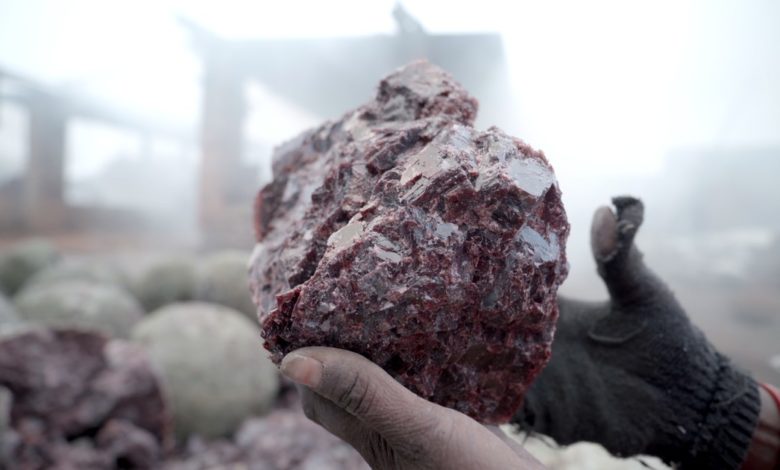
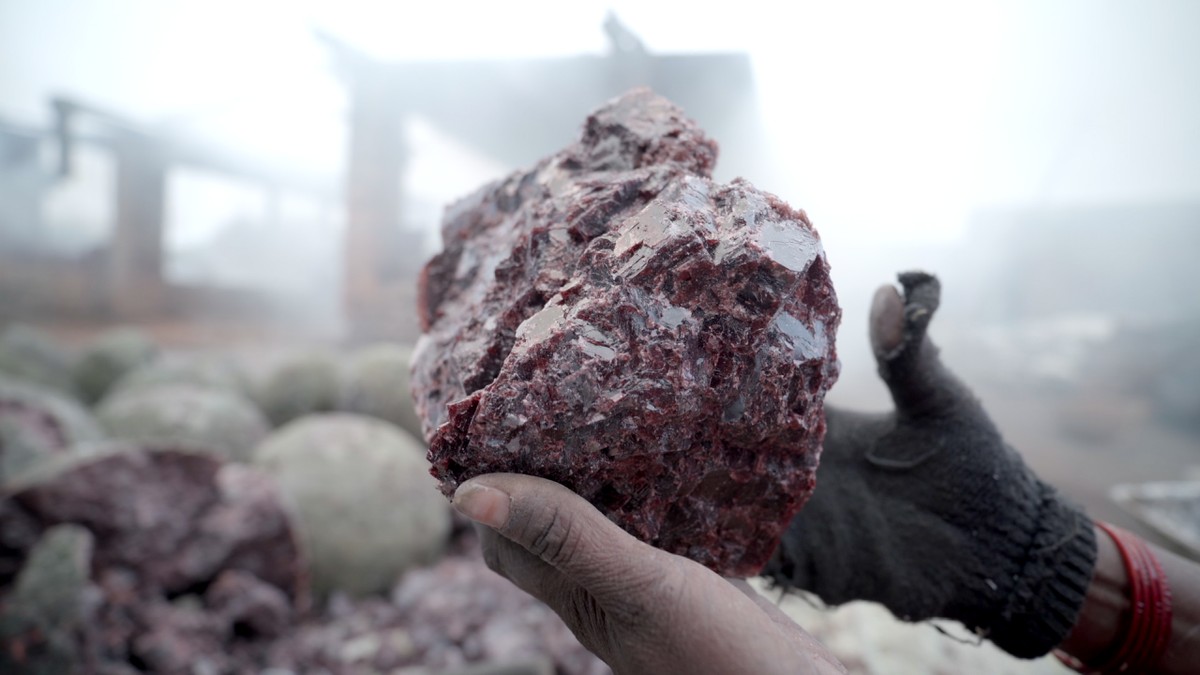
Narrator: After breaking this gray ball, one of the most popular salts in India is revealed.
It is called black salt or Kala Namak.
Centuries ago, it was used as a medicine for digestion.
Today, this salt is the basis of South Asian cuisine known for egg flavors and Umami.
Workers risk burn the skin in an oven with a temperature of almost 1000 degrees Celsius and spend hours inhaling smoke.
All this to produce salt in a traditional way.
However, the long and dangerous trial pulled people away from this craft.
Chetak is one of the last factories producing Kala Namak in this way. However, it is close to the closure.
We went to Lucknow in India to see how this black salt is created and how this factory survived.
Although it is difficult to produce, Kala Namak is still extremely popular in South Asian cuisine.
It even finds use in mixtures of spices produced in the USA.
When employees are preparing for cooking, Kala Namak, they must light the stove to dangerously high temperatures.
High temperature damages the stove over time, so they have to rebuild it every year.
They fill the stove with cow dung, which serves as fuel for fire.
In the black salt factory, chetak is used 5000 pieces a week.
Employees pour in a layer of coal and use burning bicycle tires to set everything on fire.
Sometimes they use diesel, but it is more expensive.
On the other side of the factory, employees prepare pots.
Shiv Shankar Prajapati has been producing them for a factory for seven years.
He learned this profession from his father.
Shiv Shankar Prajapati, potter: This is traditional craftsmanship.
My father did after my grandfather, and now I do it.
Earlier it was done for about 80 years.
Narrator: Shiv still uses the techniques of his family to produce pots completely manually.
This pottery wheel is based on a rush resulting from turning.
Shiv: You have to turn your head in the same direction to focus on the hole.
Otherwise, the wheel will spin so quickly that the hole will not be visible at all.
Narrator: Shiv says that this stage can only be done by hand.
It must constantly change the speed of clay rotation to get the perfect shape.
Shiv: This cannot be done on an electronic potter's wheel.
Narrator: This wooden tool, called Thapa, helps smooth the surface of the pot.
Putting a perfectly round dish from clay takes 18 minutes.
Shiv is able to make 30 to 35 pots each day.
Employees add another layer of clay inside and outside the pot to fill all cracks, and then leave it to dry for four hours.
Each furnace can hold up to 32 pots.
Employees must make sure that each of them is stable and heated from all sides, so they add coal and cow dud to fill all gaps.
The temperature can reach almost 1000 degrees Celsius, and smoke from burning coals and cow's dung absorbs air during combustion.
Mohammed Faruq, employee, chetak: When the weather is cooler, you don't feel so warm from the oven and we won't sweat.
In summer, however, it is like in hell.
Still, we have to do it.
When I started working here, I often had red eyes.
I got used to after some time.
Narrator: When the pots are hot enough, employees add 3 kg of raw Sambhar salt.
This salt is obtained from Lake Sambha – the largest inland salt lake in India.
It lies over 670 km from Lucknow.
This mixture of finely ground plants and fruits is a key ingredient Kala Namak.
It gives salt a characteristic black color and expressive taste.
Employees must be careful when they pour a kilo of salt into each pot.
Shiv: The salt melts in the oven and can suddenly spray and burn someone.
Rohit Kumar, head of employees, Chetak: We cover the pots with a lid.
We assess whether the salt is ready by looking at the holes.
Narrator: After two hours, salt and powder melt together.
Employees use an iron rod to check salt while maintaining the right distance to avoid burns, but this method is not always reliable.
Mohammed: I burned out many times.
I have blisters on my skin.
However, you have to work.
Narrator: Some employees who live in a factory have to deal with the heat all day.
Mohammed: We live, cook and eat together.
Narrator: They work all night, watching fire and adding more salt and powder until the pots are filled.
Mohammed: We spend time listening to music.
We have to wake up at night to work.
Narrator: Cooking one batch Kala Namak lasts 24 hours.
Around three in the morning, the fire under the pots expires.
Mohammed: At the moment, due to the temperature, the pot is quite soft.
In an hour, when it cools down a bit, we will take it out and break it.
Narrator: One pot can weigh up to 35 kg.
Piercing pots is the only way to get into the finished Kala Namak.
The pots will cool for an hour, and then the employees break them with hammers, revealing the finished salt.
At this point, Kala Namak salt is still very hot.
Employees cover it with raw Sambhar salt to cool it.
Then they break the Kala Namak into smaller pieces.
Employee: I have wounded fingers through this work.
That's why everyone wears gloves.
Narrator: Some are sold in large pieces.
The rest is ground to a small powder.
The color of Kala Namak seems to be black after removing from the pot, but after grinding the salt crystals look white.
RAM Chandra Gupta, owner, Chetak: The taste does not change after grinding.
Salt in a compact or powdered form tastes the same.
Narrator: Chetak produces about 250 packages of Kala Namak a day.
RAM: People who are happy to take this salt to their homes and try it, make me feel that we are doing something great.
Narrator: Ram Chandra Gupta has been running a factory for 10 years.
RAM: This business has become my identity.
Narrator: Currently, however, the factory is on the verge of closing.
Working deficiencies and changing weather threaten business.
Ram says that fewer and fewer people want to do this difficult job.
RAM: Even my son doesn't want to do it.
He doesn't interest him at all.
Narrator: Even some of his employees are not interested in transmitting traditional craft to the next generation.
Shiv: I want my children to have a better job.
It's a very hard occupation, so I don't want them to do it.
Narrator: The demand for Kala Namak has increased in recent years.
Its unique taste made it become a popular ingredient for chefs, both in India and abroad.
In 2023, India was the largest exporter of black salt in the world.
To meet this increased demand, the producers of Black Salt switched from traditional practices to machines.
This, however, made factories such as Chetak have problems.
Shiv: We only have two stoves in our factory.
Factories in Kanpura have 20 of them.
Narrator: The location of the factory in Lucknow made it more expensive to obtain raw materials such as Sambhar salt.
RAM: We currently have to pay for the transport of this salt.
People carrying her from Roursean to Kanpuru are not able to come to Lucknow.
Narrator: Rama employees are able to produce Kala Namak this way throughout the year.
Another newer challenge for this tradition, however, is the unpredictable weather.
You have to watch out for heavy rains that haunt this area even at dry time.
Shiv: When it rains, we have to suspend work.
Narrator: Rain can also make the already dangerous salt production process even more risky.
Shiv: Hot salt can spray in contact with water, which is not safe.
Narrator: Despite the challenges, Chetak is still the only factory producing Kala Namak for customers in Lucknow.
This salt is a key ingredient in Indian street dishes, such as chaat and salads.
Rahul Tandon, food seller: We use this salt because it is allegedly the cleanest.
It is not too sour and has a good taste.
Narrator: In recent decades, this salt has found a house outside South Asia.
Barkha Cardoz is a culinary entrepreneur living in New Jersey.
He eats Kala Namak since childhood.
Barkha Cardoz, founder of Cardoz Legacy: As a child, I didn't know what it was specifically.
I only knew that this is a different type of salt added to a drink, food or yogurt.
Narrator: Currently, it introduces classic Indian flavors to the American market thanks to its spices mixtures.
He works with Burlap & Barrel, which brings Kala Namak from India.
Barkha: We introduce this salt to markets outside India.
We spread among people knowledge about our beautiful cuisine, but also about our farmers and those in what conditions they work.
Narrator: Salt is a key component of one of its most popular mixtures – Chaat Masala.
Barkha: I will add a tamarind, ginger, kala namak, chili powder, asafetide.
Not much, just a little.
And other spices.
In this way I like to taste her.
Just take a little.
I love it.
The taste is good, sharp, spicy and tart.
Narrator: Barkha saw this salt more widely used in America, especially in vegan cuisine, thanks to the egg taste.
Barkha: Thanks to a little bit of this black salt, the taste is a bit like the taste of the egg.
There are many amazing chefs, not only Indian, but also American who use it and say it.
I am very proud and happy that we show her to the world.
Growing up in India or even today, we take her for something obvious.
Meanwhile, our friends or friends ask me about her, want to learn more and how to use it.
It tastes perfect.
Narrator: Currently, Chetak sells Kala Namak to merchants who export salt to countries such as the USA and Great Britain.
Ram does not know what his factory will bring the future, but he is proud of the work he did to maintain traditional salt Kala Namak alive.
RAM: Everyone must do something in life, and I can do this unique work, which gives me a lot of joy.
I will do it as long as I can.
Then everything will depend on my children and whether they want to continue this job.
Crowd: Piotr Nazek