Metals of rare lands have already become part of the trade war. On April 4 this year, in response to duties imposed by Donald Trump, China limited the sale of seven metals of rare lands to America. This move forces producers to apply for export licenses. This is not a total ban, but it can transform into it. China has already imposed such bans on the export of three less rare, but still key metals and tightened the controls of others. How harmful would an embargo on rare soils be?
History provides tips. Two years ago, China limited the export of gall and German, which are used in chips, radars and satellites. In December, China banned exports to America of both metals, as well as antimony, a means of reducing flammability. Since then, prices have soared up, and the global market has cracked. According to Jacek Beddera from the Consulting Company, Project Blue, Gal bought in the West is two to three times more expensive than the one bought in China. The supply crisis does not yet paralyze America. Many buyers accumulated wrestling before the ban; China has not canceled existing supplies for deliveries, which are often valid for years; And some materials were still supplied by third countries. The source close to the American Ministry of Defense does not detect panic related to the gallery in the Pentagon.
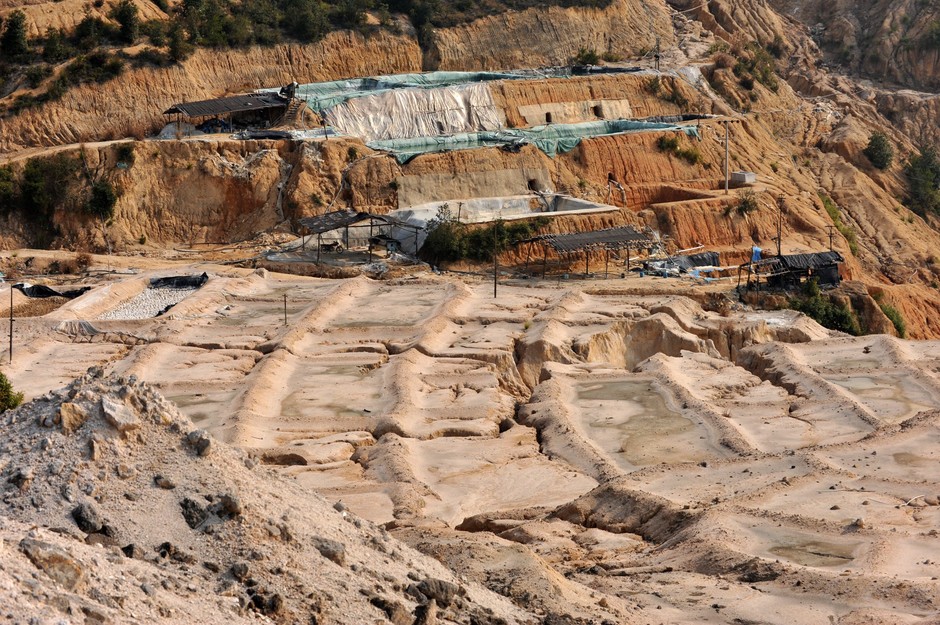
The Metal Mine of Rare Earth in Ganxian in the Central Society of Jiangxi, December 30, 2010.EPA / STR / PAP
However, the latest Chinese restrictions can cause more damage for three reasons.
Firstly, “heavy” metals of rare lands chosen by China are the most difficult to replace. Disposal and terb regulate heat in magnets that supply wind turbines, jets and spaceships. “The larger the engine, the heavier metals of rare lands need,” says Ionut Lazar from CRU, another consulting company. The remaining five metals are crucial for artificial intelligence chips. Some of them are also used in MRI scanners, lasers and fibers.
The second problem is that China dominates even more in the production of heavy metals of rare lands than in the case of lighter types. They control the majority of their extraction, both in the country and in Myanmar. Most importantly, they process 98 percent extracted material. Like most elements, heavy metals of rare lands do not occur in pure form in the earth's crust. And unlike galls or German, they are not by -products of melting mass -produced metals, such as aluminum or zinc. They must be separated from the chemical compounds that create, using specialized skills and high work, for a low profit.
This worsens the third problem: China has powerful tools to enforce the ban. The Chinese government can track any ton of rarely excavated and processed metals in the country and follow where they hit, says Ryan Castillou of Adamas Intelligence, a research company. It also follows the demand from companies around the world, enabling officials to detect anyone who can import more to re -export to America. – There may be many side damage [jeśli Chiny wprowadzą ograniczenia]Because [będą] concerned with the closure of legal gaps – says Melissa Sanderson, a mining veteran who had previously worked in the American Department of State. Given the risk of cutting off [od metali ziem rzadkich]third countries may not hurry with the help of Uncle Sam.
Continued article under video material
Donald Trump must calm down
Thus The Chinese ban would hit America hard. Prices would increase quickly because buyers would start to accumulate supplies. Neha Mucerjee from the Benchmark Minerals, a research company, estimates that the prices of the length will reach $ 300. [1 tys. 134 zł] per kg, from $ 230 [869 zł] Currently. Companies have some supplies, but they will probably run out within a few months. Then, the civil industry would suffer first. Winds sea turbines could become uncompetitive or inaccessible. Electric cars can switch to smaller engines. According to Gracelin Bascaran from the Think Tank CSIS, the defense industry would soon suffer.
America would accelerate efforts to find alternative supplies. Currently, this country has only one mine of rare lands in California. It develops several more and sponsors new mines in Brazil and South Africa. He also uses the Act on defense production of 1950, adopted during the Korean War, to finance the first large plant for metal processing of rare lands outside China, in Texas. However, America, like other countries, lacks specialist knowledge to transform the metals of rare lands into high -performance magnets – whose China exports also limited. Analysts estimate that building a supply chain from the mine to magnets, bypassing China, would take America from three to five years.
I must admit that The ban on export of rare earth metals would also hurt China itself because it would destroy the demand. In 2010, as a result of the dispute over fisheries, China suspended the export of rare lands to Japan. Within a few months, Japan went concession and export was resumed. In the meantime, Japanese car manufacturers have designed new vehicles that depended on a lesser extent on the metals of rare lands. This time it is more likely that China will selectively reduce exports to America – unless Trump continues his aggressive approach. The most severe game in Scrabble in the world can become really unpleasant.
I’m Ashley Davis as an editor, I’m committed to upholding the highest standards of integrity and accuracy in every piece we publish. My work is driven by curiosity, a passion for truth, and a belief that journalism plays a crucial role in shaping public discourse. I strive to tell stories that not only inform but also inspire action and conversation.