Magnete fishing, the fashion of treasure hunters in Romania. Bizarre objects removed from the bottom of the waters

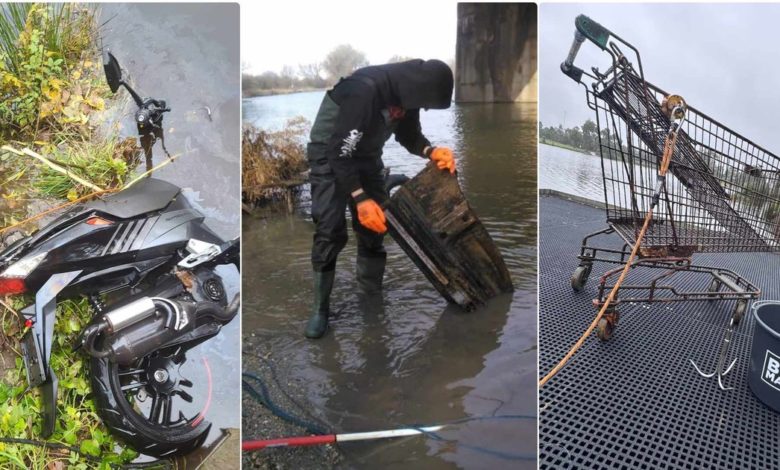
Magnete fishing becomes an increasingly popular hobby in Romania, offering a simple and accessible alternative to metal detectors, which require authorizations and their use by “treasure hunters” is often viewed with suspicion.
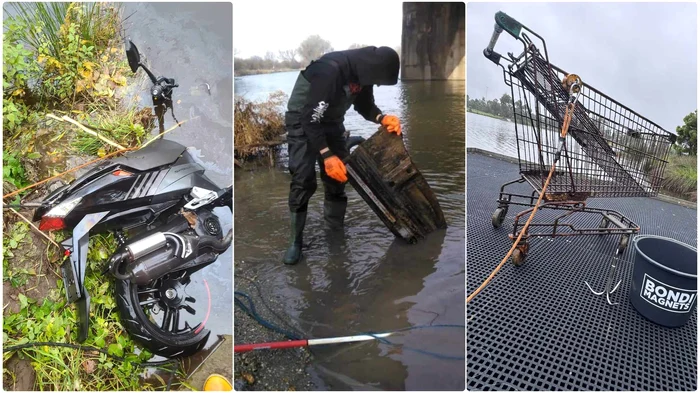
Magnete fishing is an affordable hobby. Facebook group source – Magnet Fishing
Strong magnets, from neodim (NDFEB), are used by urban adventure enthusiasts to look for “beasts” through rivers and lakes.
With a rope and such a magnet, which costs between 100 and 200 lei, the smallest, and up to 800 lei, those with high power, some Romanians managed to remove not only rusty objects, but also relics, weapons and small metal treasures from other times.
Pursuit of old treasures and beasts on the bottom of the rivers
Others have encountered things that would normally have not found a place on the bottom of the waters: electric scooters, bank safes, electric bicycles, traffic signs and car wheels. Sites specialized in the trade of “Magnet Fishing” – the known term of these fishing tools offer for sale various versions of magnets, ropes, hooks, storage boxes, gloves, as well as simple tips for using them. On the social networks, many passionate about magnets fishing told about the discoveries made.
“In 2019, a fisherman who used a magnet caught an active grenade in World War II-still had the nail on it (a round ring). He pulled it out exactly where I and 20-50 fishermen were fishing every spring in the shawl, throwing the water. Somehow the erosion of the bank that year has unearthed it ”, He remembered a Romanian fisherman, in a Reddit post.
Other Romanians have reported on social networks that for them fishing with magnets is only a relaxation, and so far they have not found treasures, but only old beasts and sometimes ammunition.
“You put your phone on the silent and forget about everything. In the rivers you will find a lot of beasts: bicycles, pipes, knives, nails, screws, metal doors. Just like fishing.tells another Romanian.
Image 1/10:
Discoveries with magnet Source Facebook Magnet Fishing Groups (3) Webp
In Romania such practices are allowed, but those who discover heritage or dangerous objects, such as weapons and ammunition, must report this to the authorities. Magnete fishing practitioners say that this hobby is popular being cheap, attractive and adventurous, but also friendly with the environment.
Some have fished in abandoned wells, but the deep rivers and lakes remain the main source of the discoveries made. In Romania, reports on treasures swallowed by water have a long history.
Romania, the homeland of the treasures lost in the rivers
The oldest legends about hidden treasures on the current territory of Romania date from antiquity. The most famous of them speaks of the valuable treasures hidden by King Decebal in the river Sargetia, before being defeated by the Romans.
On the Strei Valley in Hunedoara, the place of a great discovery reported in the medieval era, in the middle of the sixteenth century, was mentioned on one of the oldest maps of the present territories of Romania.
The place is indicated by the message “Sargetia, the river in which King Decebal had hidden his treasures”, mentioned with Latin letters on the map of Dacia and ancient Moesia, made in 1595 by the cartographer of the King of Spain, Abraham Ortelius, who included it in the first historical atlas in the world.
The famous treasure would have included, according to historical reports, over 400,000 gold coins and pieces, including at least one Dacian spiral bracelet and was accidentally discovered, by the locals, in the river Strei or around Dacian settlements.
In the following centuries, in the time of the Habsburg Empire, numerous precious treasures have lost their trace on the bottom of the Danube and Mures, rivers on which they were transported from Transylvania to Vienna.
At the beginning of the 19th century, other precious treasures were found by the locals in the land of the Dacian fortresses in the Orăștiei Mountains. The treasures came to light after the locals scorned the places around the old monuments with rudimentary tools. Sometimes, however, the finding of gold was put on account of divine interventions, or supernatural appearances.
There was almost no village in Transylvania where the locals do not know stories about the treasures hidden or discovered over time, said the historian Iulian Martian, at the beginning of the 20th century. The pursuit of treasures continued in the twentieth century, and in the 1990s it intensified with the appearance of metal detectors, with which the groups of treasure traffickers have tired archaeological sites.