These are the Ukrainian territories at the center of peace negotiations / Why Donbas wants a little and why another region is crucial for the survival of Ukraine

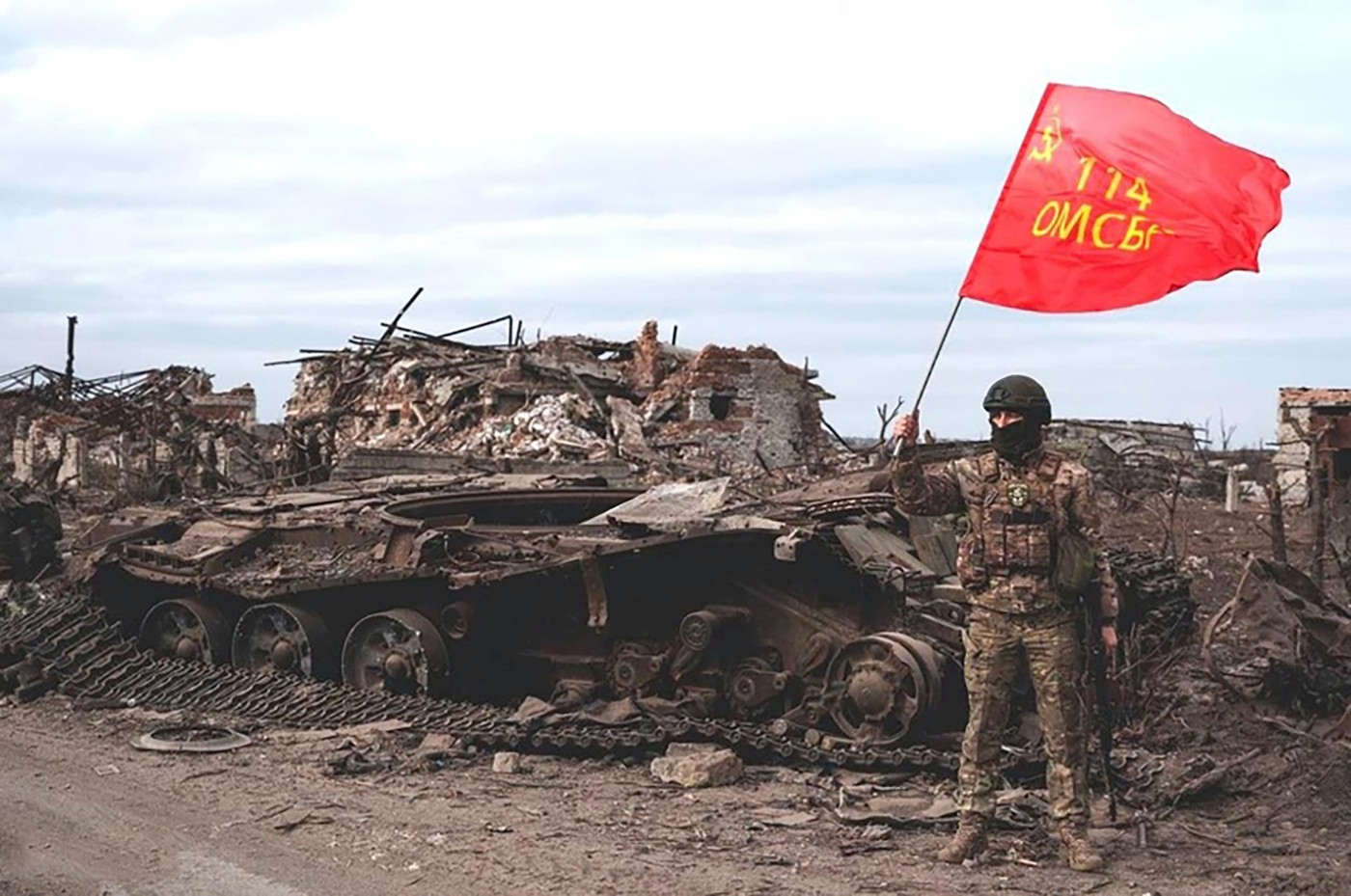
The control over the whole Donbas seems to be an essential condition for Vladimir Putin to declare the mission carried out in Ukraine, but Kiev is not willing to accept Russia's claim, The New York Times and CNN writes. Beyond Donbas, The Telegraph warns that for Ukraine it is crucial to maintain its access to the Black Sea.
One of the conditions imposed by Vladimir Putin at the Friday summit in Alaska assumes that Ukraine will completely give up Donbas, the industrial region of the east of the country, which Moscow claims to annexed, but which it does not fully control. The claim will probably be discussed Monday night, at the meeting between Donald Trump and Volodimir Zelenski at the White House.
The traditional Russian-speaking area is at the head of the list of territorial and political claims of Russia, a central part of the so-called “deep causes” of the war, in the speech of the Kremlin leader.
Putin has tried to take over the donbas since 2014, first through the separatists, then by invading and annexing the region, in 2022.
 Donald Trump, a lightning message before the Monday meeting with Zelenski and European leaders: “Some things never change!”
The forces of the Kremlin and its separatist allies have conquered about 87% of this region, according to Deepate data, an Ukrainian group that monitors the evolution of the situation on the battlefield.
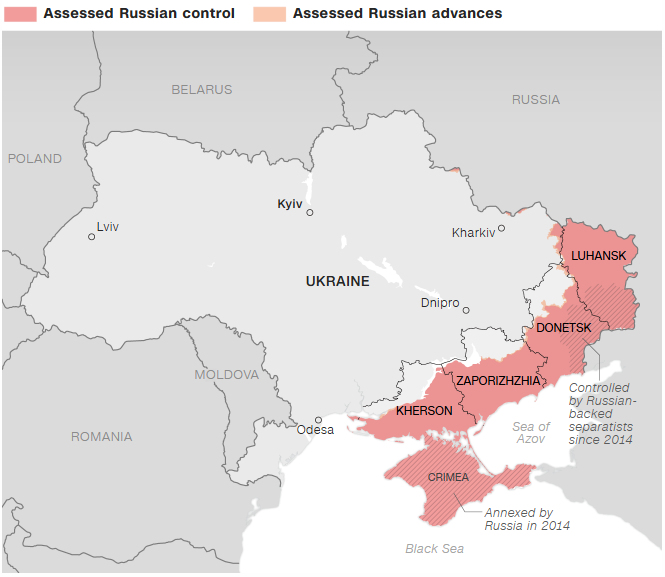
Moscow now wants to conquer the 2,600 square kilometers in the region that remain in the hands of Ukraine – without an armistice, the battle for Donbas will almost certainly extend until next year and will cost tens of thousands of lives, say military analysts.
What a little in exchange offers
The content of the Peace Agreement discussed by Trump and Putin in Alaska on Friday, and will probably be discussed in Washington on Monday night, remains unclear.
Putin demands the withdrawal of Ukrainian forces from Donbas, and instead offers conflict freezing in the rest of Ukraine along the current front lines and providing a written promise not to attack in the future, according to American officials who have discussed with New York Times.
Trump urged Volodimir Zelenski to accept the agreement, noting that Russia is simply a greater power.
But Zelenski refused. It is supported by the population, which seems ready to accept the freezing of the front lines, but not the surrender of the additional territories.
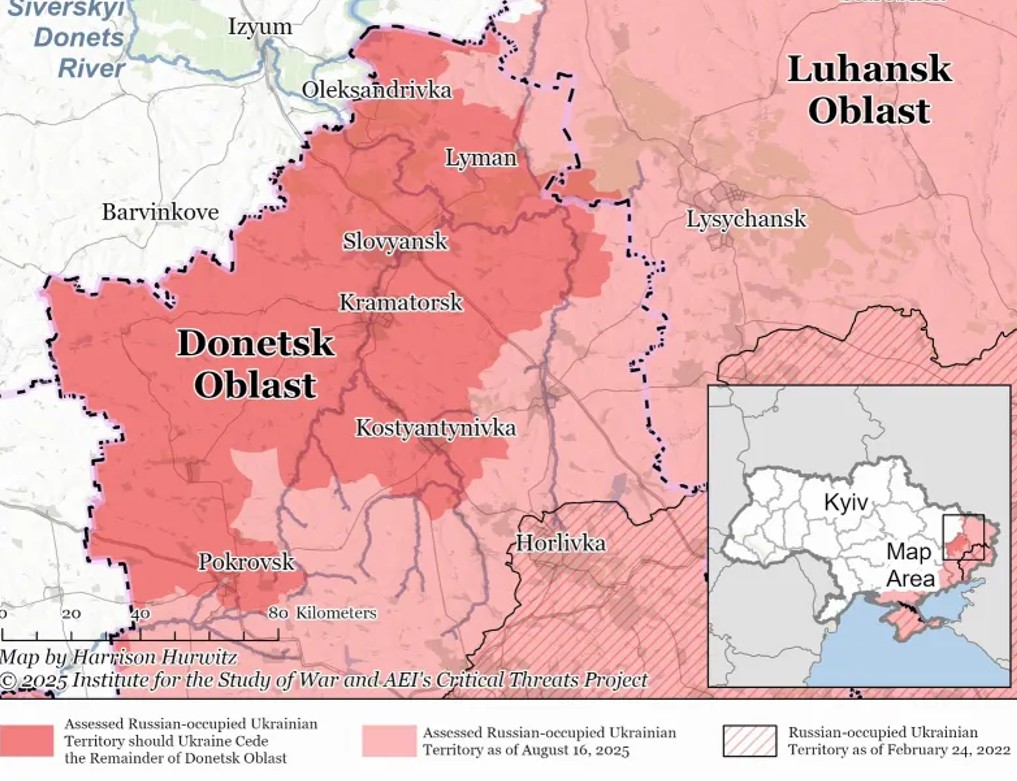
Zelenski's European allies have also tried to explain to Trump that the assignment of fortified positions could cost Kiev in the future, if Russia decides to resume its assault.
Ukrainian authorities estimate that over 200,000 civilians still live in the Donbas area, which are mainly controlled in the dense and strongly fortified industrial area of and around Sloviansk and Kramatorsk.
Why Donbas
Since the large -scale invasion of 2022, Moscow illegally annexed four Ukrainian regions after organizing referendums denounced as false.
The four regions are Donetsk, Luhansk, Herson and Zaporojie. Of the four regions, Russia completely controls only one, Luhansk.
Russia's forces fought in eight other Ukrainian provinces of 2022, eventually retiring from some and occupying fragments from others.
 Why is Zelenski, before the crucial meeting with Trump, take an example from Vladimir Putin
However, Donbas, consisting of Donetk and Luhansk, is in the center of Putin's vision of the war, a vision of his conviction about the historical unity of Russian speakers in the former Soviet Union, writes New York Times.
Putin initially presented the invasion as an action to define the pro-Russian separatists in the region, who fought against the Kiev government with the military and financial support of the Kremlin since 2014.
This promise causes the control over Donbas to be an essential condition for Putin to declare the mission performed in Ukraine, said Konstantin Remciukov, a Moscow publisher with links to the Kremlin, quoted by the American daily.
What Putin's claims are based on
Donbas has been disputed since the appearance of Ukraine as a state, at the beginning of the 20th century, when Ukrainian nationalists, communists and Russian monarchists fought for the region's industrial riches in a chaotic period after the Bolshevik revolution.
Most of the population of the region was Ukrainian until Stalin's forced industrialization and terror campaigns led to the migration of Russian workers to coal mines and factories in the region, mass killing of Ukrainian farmers and suppressing the Ukrainian language.
At the time of the collapse of the Soviet Union, about two thirds of the inhabitants of the Donbas region considered Russian as their native language, according to the census data. The Russian and Russian cultural identity became even more dominant in the first decades after Ukraine's independence.
About 90% of the voters in Donbas voted for Viktor Yanukovici, a pro-Russian candidate, at the 2010 Ukraine presidential elections.
Ianukovici's overthrow by Kiev protesters four years later, leaned to launch a Crimea invasion of Ukraine and organize an insurgency in Donbas.
Trump – Zelenski – Europe. What is the stakes of the territories that will be discussed on Monday, at Washington / What an Information Officer says
The revolt generated an anti-Russian reaction in the region. In the last presidential elections in Ukraine, in 2019, the part of Donbas controlled by Ukraine voted in an overwhelming proportion for Zelenski.
Meanwhile, Putin has resorted to an increasingly noisy nationalism to try to mobilize internal support after years of economic stagnation.
These propaganda efforts have never had a massive impact in Russia.
An independent survey conducted a few days before the invasion showed that only a quarter of the Russians supported the integration of Donets and Luhansk into the Russian Federation, Srie New York Times.
Will Russia continue invasion if he receives the donbas?
Putin has periodically allusions to the annexation of other parts of Ukraine, which determined Ukrainian officials and many Western politicians and analysts to be convinced that the war will continue after Russia will conquer Donbas, either by strength or by diplomacy.
Their opinions are shared by the Russian nationalists and many Russian soldiers, who urged Putin to continue the fight for the rest of the territory in the other two annexed regions, Herson and Zaporation.
Other pro-war commentators have stated that Russia will continue to fight until Zelenski's government and install a more docile government.
However, many independent analysts doubt that Russia has the economic and military resources needed to continue its offensive more than Donbas.
According to some analysts, Putin's authoritarian regime and the economic prospects in decline could convince him to be satisfied with Donbas, at least for the moment.
“The Russian society is in such a deplorable state that it would be willing to accept almost any result of the war,” said Tatiana Stanovaia, an expert in Russian policy at Carnsia Russia Eurasia Center.
“We can imagine different degrees of dissatisfaction from certain marginal segments of society-” ultra-patriots “and those of their tea-but the Kremlin can manage this situation,” she said, quoted by the New York Times.
Odessa and access to the Black Sea
While attention focuses on Donbas, an analysis from The Telegraph's daily warns on another territory, which it considers more importantly.
Ukraine can survive without Donbas, but not without access to the Black Sea, writes the British newspaper, who claims that ensuring that Odessa and the surrounding areas remain under the control of Kiev is essential for the existence of the nation.
Voices from Moscow constantly said that Odessa is a Target of Russia.
The fight for the Black Sea was an intense one from the large -scale invasion of 2022. Ukraine finally managed to push the Russian Fleet from the Black Sea away from its coasts and resume maritime trade, essential to its economy.
This is not accidental and has required considerable efforts, and the balance could be quickly disturbed if the importance of the Black Sea is overlooked, writes The Telegraph.
A Russian fleet that can come out of the hiding place and is able to re -conceive and re -start it could disrupt this balance almost immediately, causing a new disruption to Ukrainian maritime trade.
Estimates indicate that if Ukraine loses navigation freedom by up to 80%, its economy would be affected by 10-12% of GDP. Indirect losses could reach 30% of GDP.
To this would add the loss of influence, access and effect on other countries that need these exports-agricultural products in particular, says The Telegraph, who believes that maintaining freedom of navigation in the Black Sea would be more important than dividing the contested territory and currently discussed.