

publication
2025-07-30 14:30
After one weak quarter, the largest world economy has again recorded a solid growth. Still, the structure of the United States gross domestic product remained disturbed by the impact of the customs wars of President Trump.


In the second quarter of 2025, the gross domestic product of the United States noted an increase of 3.0% in an annualized approach – results from preliminary estimates published by the Government Office of Economic Analysis (BEA). Quarter earlier the largest world economy was shrinking at an annualized rate of 0.5%.
It was a result clearly exceeding the increase of 2.4%expected by economists. But the Fed from Atlanta already assumed that the annualized US GDP dynamics in the second quarter would be 2.9%. This time the model turned out to be better than people.
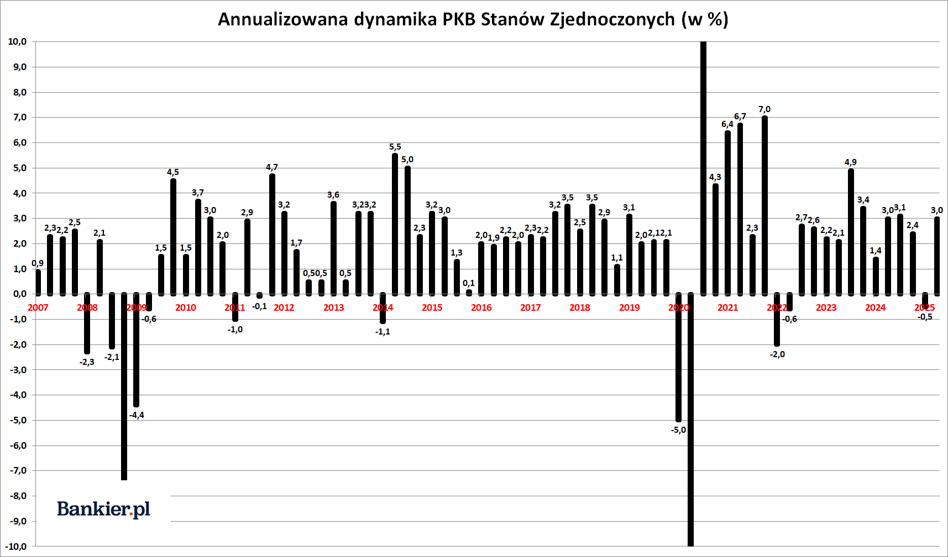
It should be noted here that Americans present dynamics of GDP differently than Europeans – they are annualicing short -term data, i.e. they transform it into year -round. In short, the monthly value is multiplied 12 times and quarterly 4 times. We wrote more about this in the text “What is an annualized GDP? We translate.”
Advertisement
Counting “in European” we would write that the American GDP recorded an increase of 0.73% compared to the previous quarter and was almost 2.0% higher than in the second quarter of 2024.
Data disturbed by customs
We must also take an amendment to the fact that they were two very unusual quarters for the largest globe economy. From the end of last year, American business has been preparing to enter into force of high import duties imposed by the administration of President Trump. As a result, in the first quarter there was an increased import that reduced the dynamics of GDP. At the same time, stocks grew at a crazy pace.
However, in the previous quarter, the statistics from Bea recorded over 30% annualized drop in import value after a growth of 37.9% in the first three months of 2025. At the same time, investment demand (which also includes a change of reserves) was shrinking at an annualized rate of 15.6% after a jump by 23.8% in the previous quarter. Consumption was much more stable, which grew at a rate of 1.4% by 0.5% quarter earlier. In both cases, however, these results were much weaker than in the previous few quarters.
The composition of the American GDP was also very unusual in a row in a row. And so private consumption added 0.98 points. percent to the annualized GDP dynamics (compared to 0.31 percentage points earlier). Net exports added almost five percentage points after he took 4.6 points in the first quarter. percent The change of reserves took 3.2 points. percent After she brought as much as 2.6 points in the first quarter. percent Enterprise investments added less than 0.1 points. percent, while public expenditure added another 0.1 points. percent
GDP deflator – the widest measure of prices in the economy, including not only consumption, but also the prices of investment, industrial or construction goods – decreased in the second quarter to 2.0% compared to 3.8% of the quarter recorded earlier. It was a result lower than 2.2%expected by economists. But the base Defaltor of consumer expenditure (PCE Core) in the entire quarter recorded an annualized increase of 2.5% against the expected 2.3% (and 3.5% in the first quarter).