“The future of the hybrid surgeon.” Dr. Lucian Petcu, MedLife: “The technology gives us power, but the team makes the difference in the fight with cancer”

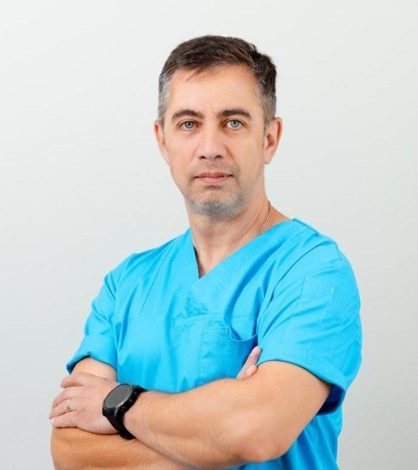
The access to top technology and the interdisciplinary teams trained today give the surgeons the freedom to operate the most complex cases, and to the patients – the chance to be treated at home, in Romania, as in any big hospital in the West. Regardless of the age of the patient or the severity of the case, says Dr. Lucian Petcu, primary surgeon at MedLife Brasov Hospital, who approaches especially cases of digestive and breast cancer and who has successfully operated including patients over 90 years.
Two decades ago, a laparoscope was locked in a closet, used only by the head of the section. Today, the Romanian surgeons operate with the Da Vinci robot, in the halls equipped with the latest technology, and the minimally invasive interventions become a rule, from which exceptions are only the advanced cases in which the classical surgery remains the norm. Dr. Lucian Petcu, general surgeon that operates almost weekly cases of digestive cancer and breast cancer, talks about a process of democratization of the medical gesture, which could take place due to free access to information, specialization in western countries and the possibilities offered by the last -minute technology.
“I think we live in a democratization of the medical gesture. If in the 2000s I was on the outskirts of European medicine, now we are talking on a peer. We have access to technology, information and we can operate in conditions similar to the western ones,” explains the doctor.
Oncological surgery, largely minimally invasive
The main specialization of Dr. Lucian Petcu is oncological surgery, with emphasis on digestive pathology and breast. What has changed radically in recent years is the surgical approach: “over 70% of my interventions are minimally invasive – either laparoscopic or robotic. Even in oncology, where such techniques were considered risky, now they become a norm.”
This transition has been made with great efforts, but also with an increased opening to continuous technology and training. “EO crane technology without operator. We need well -trained doctors, trained teams. And medical education, unfortunately, is still very expensive. Access to training centers – as in Strasbourg – involves costs of thousands of euros. But the investment is reflected in the quality of the medical act,” says the surgeon.
A recent example that he remembers is a patient with a colon tumor and multiple previous interventions: “Every intra -abdominal centimeter was a challenge, but the intervention was a success. The patient was quickly and with good recovery.”
The transformation is not only technological, but also of mentality. Dr. Petcu sees in the current Romanian medicine an obvious progress: “Romania is no longer the country from the 1990s, when we were drawing specialized books in Xerox, in languages we learned from walking. We now have colleagues who present at international congresses, we develop professionally in Western centers, then we return.”
In fact, he himself worked in a medical center in Norway: “They treated me as an equal in the first day. It was a lesson about what professional inclusion and trust means,” points out Dr. Petcu. However, the return home was natural: “I am not part of the category of those who returned to save Romania. I returned because it is home. The social part, the connections, weighed more than a higher salary.”
The age of the patient is no longer limited
Currently, medicine in Romania can not only prolong life, but also increase the quality of life of patients, and the age of patients is no longer an obstacle in many cases. “I had a 93-year-old patient, who has gone through a minimally invasive large surgery. Important is not chronological age, but biological age. I saw 60-year-old people biologically exhausted and cognitively cognitive, who take absolutely delightful conversations, with humor about their situation and very physically fit (no – in form) ”, explains the doctor.
In addition, the minimally invasive approach decreases considerably the duration of hospitalization and postoperative risks: “Even if it invests more in an intervention, the patient wins. The costs are reduced as a whole, and the recovery is spectacular.”
Radiologist, oncologist, surgeon – a team
Changing paradigm in surgery is not just advanced technology. It also means close collaboration with other specialists and an increasing diagnosis of the disease. “The surgeon is no longer the only hero. Radiologists identify tumors impossible to detect clinically, oncologists have more sophisticated molecules, and the surgeon is part of a complex team.”
This team is the key to early diagnosis and timely intervention, which can make the difference even in extremely serious pathologies, such as pancreatic cancer. “Now we see a glimmer of hope and in cases that seemed to be unabashed in the past. The vigilant radiology is decisive for the patient's destiny,” detailing the doctor.
In many cases, the intervention is no longer a rescue emergency, but a stage in a well-developed therapeutic plane. “My role is to remove the tumor radically, but at the same time to respect the healthy tissue as much as possible. To ensure not only the survival, but also a quality of postoperative life,” stresses Dr. Lucian Petcu.
The relationship with the patient, as important as the intervention
An aspect that Dr. Petcu considers essential is the careful pursuit of the patient after the operation. “In the first week, my patients have clear instructions: to contact me daily. I open a direct communication line with each of them. It is important for their safety, but also for my quiet as a doctor.”
This close relationship also contributes to better results to the patient's confidence in the therapeutic process. “I try to offer patients not only a quality intervention, but also constant support. Even if great steps have been taken, the human component remains vital.”
Modern surgeon: specialist, but also solutions integrator
The future of surgery, believes Dr. Petcu, does not belong exclusively to ultra -native specialists, but to those who can sail between several fields. “The future of the hybrid surgeon. The one who knows endoscopy, intraoperative ultrasound, which handles the imaging, who collaborates with the oncologist and the radiologist. We can no longer work on isolated islands,” the doctor considers.
The surgeon must be able to decide in real time what type of approach is suitable for the patient: laparoscopic, robotic, classic, endoscopic. “There is no” One Size Fits All “in surgery. You must give the patient the intervention he needs, not just the one you know.”
***
Read also other informative articles, on medical topics, in the section we well.
This article is supported by MedLife, the largest network of private medical services in Romania, and aims to be a source of information and inspiration for a healthy and balanced life.
Health is the main source of happiness of Romanians. At MedLife, the happiness of people enjoys us and motivates us to offer medical solutions to the highest standards.
Regardless of the specialty, at MedLife you will find good doctors at any time, whose expertise is complemented by the most advanced medical technologies and a modern infrastructure, ensuring personalized care for each patient.
Find out more details about all services on https://www.medlife.ro/
Article supported by MedLife