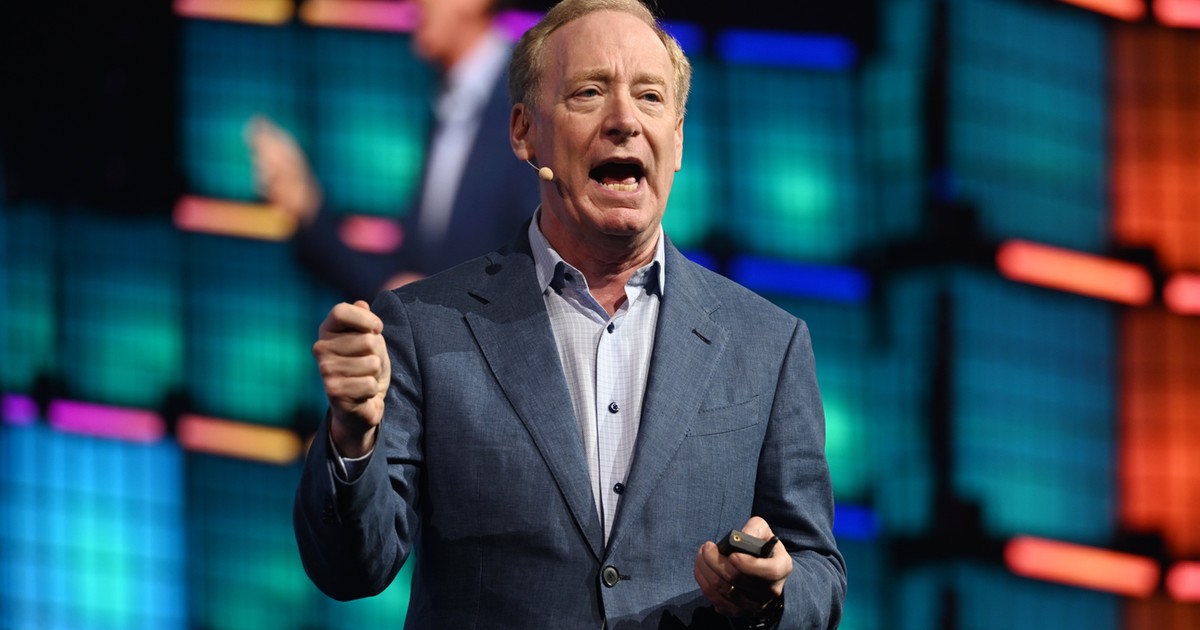
On Wednesday, Smith published a blog post in which he said the recent wave of opposition — including from students entering the workforce — to AI's role in society should be a “strong wake-up call for the tech industry.”
“To those in the tech industry seemingly pushing towards a future where computers replace humans at work and AI becomes more powerful than humans, the next generation's response has been an unequivocal: 'Not so fast,'” Smith wrote.
Fear of work fuels the rebellion against artificial intelligence
For years, company executives have been presenting AI as a technology that will change the world, and at the same time warning that its impact on the labor market could be devastating.
Dario Amodei, CEO of Anthropic, said last year that AI is becoming powerful enough to eliminate half of all entry-level jobs. And Microsoft's general manager of AI, Mustafa Suleyman, said in February that office work “will be fully automated by AI in the next 12-18 months.”
Read also: CEO of Anthropic warns the labor market against AI. “It's an internal quality”
Therefore, it should not be surprising that university graduates – who most often end up in the entry-level office positions that Amodei was talking about – booed during their celebrations such managers as former Google CEO Eric Schmidt, who in his speeches painted the future of AI in only superlatives.
Brad Smith: Young people's fears are justified
In his blog post, Smith acknowledged that students' concerns are valid. He emphasized that today's graduates are seeing “the automation of tasks in today's entry-level jobs through AI” and pressure – especially in the technology industry – from companies that are cutting jobs while investing billions in artificial intelligence infrastructure.
Read also: Thanks to AI, young people have an increasingly difficult time. They lose hope. “Where should we work?”
A sudden change in the narrative about artificial intelligence
In recent weeks, technology company leaders have begun to change their tone, emphasizing productivity gains rather than job losses. Many of them, from OpenAI's Sam Altman to Palantir's Alex Karp, who also previously warned against AI eliminating jobs, are now emphasizing how it can help employees work more efficiently.
This more optimistic message comes as artificial intelligence companies prepare to go public and face growing local resistance to building the data centers needed to run their products.
Read also: There is no massacre of positions yet. However, a Google economist has a warning
The head of Microsoft cools down the industry's expectations
Brad Smith has not yet been one of the main prophets of the destruction of the labor market by AI. His latest post, however, fits the increasingly optimistic tone coming from Silicon Valley.
“AI is at its best when it is used to augment human skills and actions,” he wrote. “Put simply, people can use AI to become better.”
However, Smith believes that the panic surrounding AI may be ahead of reality. He says artificial intelligence is likely to become one of the most important general-purpose technologies over the next 25 years, but he warns that industry leaders often overestimate the pace at which new tools are changing society.
“First, they often overestimate the timing of new technology, especially the speed of its impact,” he wrote. “Even more importantly, they underestimate people's capabilities“.
The above text is a translation from American edition of Business Insider