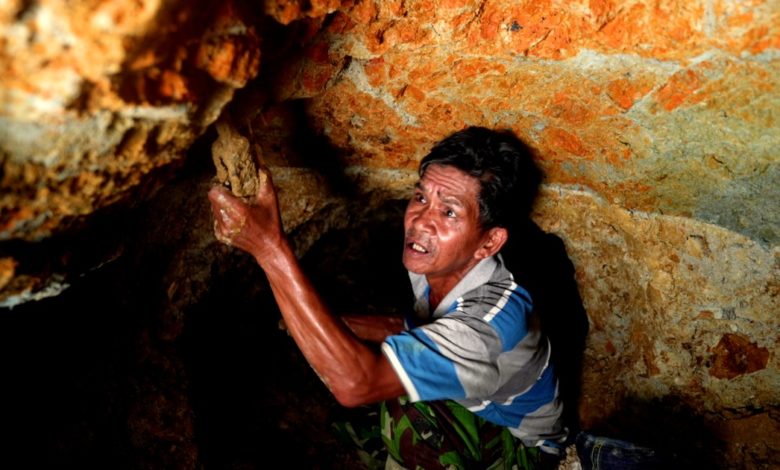
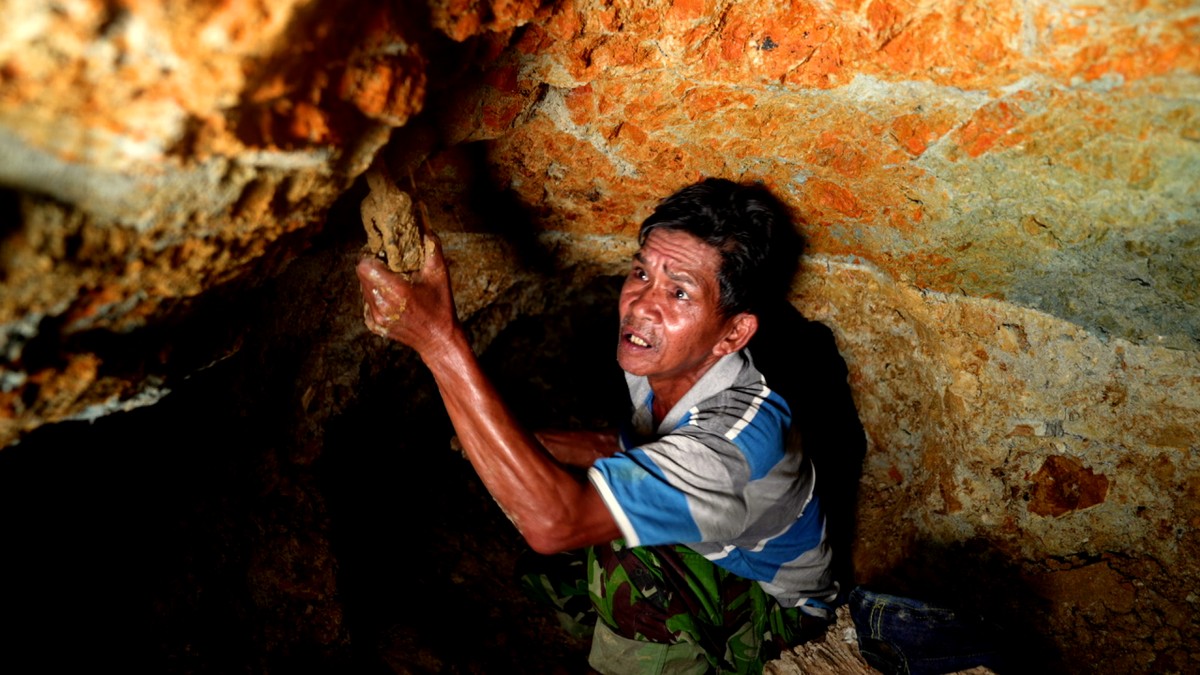
Narrator: This man risks his life to bring out the fossils of trees that are 20 million years old.
They come from the time long before the first people.
The secrets of our past can be discovered from pieces of petrified wood.
Eli Suheli, Górnik: I can't imagine what these trees would tell me if they were still alive.
Narrator: Every year, thousands of fossils turn into furniture, plates and even ashtray.
Items can be sold abroad for four times of what Indonesian miners earn all year round.
What secrets can we learn from these ancient treasures?
And why is extracting them so dangerous?
You need a combination of rare events to make wood transform in this way.
First of all, you need a lack of oxygen to stop the schedule.
This can happen when the tree falls into the river or is buried under the wet soil.
Water causes wood swelling, opening its defects.
Then you need a volcano eruption so that the ash silica can penetrate inside and fill the spaces.
It will start to create crystals by copying the texture of the tree to the molecule.
Over time, the whole trunk crystallizes in various types of permanent quartz.
This is one of the hardest materials on Earth.
Miners can feel it underground with an iron rod.
Eli: We probably found a large piece of petrified wood.
Fossible wood is very hard, and if we tap it, it will make a loud sound.
Narrator: Eli Suhei and his colleagues dug these mines themselves.
He is 68 years old, but he still enters them barefoot, taking only a hammer and a crowbar.
This mine is about three meters deep.
It is not strengthened or secured in any way, it also has no ventilation shafts.
Eli: It will be a valuable piece.
Narrator: Eli finds several fossils in a few minutes of digging.
Wall thoughts to check if there is hidden wood in them.
Eli: I am most afraid of landing land that could imprison me.
Narrator: In 2016, 12 men were killed when a nearby mine collapsed.
Eli never lost his friend, but he had wounds.
Eli: Even falling small stones can hurt my feet.
Narrator: Digging requires a permit, but officials spend it only if the miners have the right equipment.
Eli says that most cannot afford it, so they risk working illegally.
Eli: There are raids on the part of the authorities and it will not be safe if we do not cooperate.
Narrator: Here is the biggest piece they found today.
It is almost three times heavier than a piece of wood of the same size.
Miner: Can we pull?
Eli: This job tires me very much because I'm old.
I often lack breath.
Narrator: It happened that miners dug pieces weighing up to 4 tons.
This is more or less the weight of a medium -sized truck.
They could get $ 480 for such a large log.
They share money and also have to pay the landowner.
About $ 60 stays to each of them. for a month of work.
This is about half of the minimum wage in this part of Indonesia.
Ultimately, the wood is valued and sold too much more than what miners initially receive.
Eli says, however, that work in mining is more stable than in other industries, because there is a lot of petrified wood.
Eli: I would like to stop working, but unfortunately I can't, because I wouldn't have money to live.
Miner: Very hot coffee.
Narrator: Then grinders transport these pieces of wood to the workshop.
37-year-old Suhela has been sanding wood for almost a decade.
He transforms them into plates, stools and tables.
Suheli, grinder: Fossible wood differs from a regular texture.
Narrator: Like most precious stones, fossilized wood can only be cut with a diamond shield.
Suhela: Our work is associated with many threats.
When cutting, you can hurt your hands, and fragments of petrified wood can get into the eyes.
Once I hurt my foot and now I have a scar.
Narrator: Fossils in this part of Indonesia come from a tree called Sempur.
These trees lived 20 million years ago, when the Earth was warmer.
When the wood hardened, it turned the color to beige, white or black.
Suhela: I like wood that has its own character.
I can sell them more.
Narrator: Making larger items such as this table can take up to three weeks.
Smaller, such as plates, Suheli can end in two days.
Kirono, broker: How are you? Everything's all right?
Suhela: Yes, I'm healthy. And with you? Look at my things, please.
Narrator: Suheli cooperates with Kirono, an intermediary who places non -standard orders on behalf of international customers who pay twice as much as local stores.
However, the price of items is not constant.
Everyone is valued depending on the color and designs.
They sold this table for around $ 3,800.
Kirono: This is a rare object made by the artist.
We can sell it for hundreds of thousands or even tens of millions of rupees.
Narrator: For Kirono, work also involves building a reputation of the country.
Kirono: This is an original Indonesian product, and this country is very rich in resources of petrified wood.
Suhela: Look after yourself.
Narrator: On the other side of the world in the National Park in Arizona there is more petrified wood than anywhere else on earth.
It is much older than in Indonesia.
He is about 200 million years old and comes from the time when the dinosaurs still wandered on the ground.
Paleontologist William Parker took us for a walk after this “frozen during” forest.
William Parker, paleontologist, Fossil Fact Park: These trees give us tips on what lived and grew at various periods of earth history, when the level of carbon dioxide was at a high level and there was no polar ice hat.
Narrator: By examining the color and thickness of the jar of trees, scientists can sometimes find out what the climate was when the tree grew.
Then they can use this data to find out how different weather conditions could affect life.
William: Even today, the earth is changing.
It is important that we understand what creates it in this type of environments.
Narrator: Taking even a piece of petrified wood from here is illegal.
Officials say, however, that tourists are stealing anyway.
Sometimes thieves send wood.
William: We would like to tell people that they will be cursed if they illegally take wood, but of course they will not.
Maybe they feel remorse because they send us a whole lot of things.
Narrator: The US government spends about $ 4 million. Annually for the maintenance and protection of the park.
Without protection, this miracle of nature and science could disappear.
William: Trees are an important part of our ecosystem and we must understand everything that we can.
Let's hope that we will be able to better manage these ecosystems or make changes that will give them the best chance to survive.
Narrator: In 1941, scientists tried to determine how much petrified wood is worth.
They estimated that all the pieces in this park in this park would be worth around $ 200 million. after considering inflation.
To this you would have to add wood that is still buried.
However, the park does not attach importance to the monetary value of this wood.
William: If we collected all petrified wood on the ground and placed it in stores, private collections or in the homes of people, we would lose the scientific context.
Narrator: In the entire United States, people can extract petrified wood on their properties and sell it for thousands of dollars.
This furniture store in New York offers items made of petrified wood at a price of $ 5 to 5000. for art.
Philip Tuan travels to Indonesia himself to choose finds, but he does not buy from people whose fate we followed in this material.
Philip Tuan, owner, from the source: Fossible wood is unique.
You can't expect a dream piece to get.
Before grinding and cutting wood, you can't see what's inside.
Narrator: Stumps are sold at a price from $ 1,400 to $ 1,800. for art.
Larger items, such as tables, cost more – from about $ 1,000 to $ 5,000, depending on the size.
Penny Emmet, manager for wholesale trade and sales, from the source: This is a piece of heritage of the entire planet.
She is really heavy and durable.
He won't break down or will happen to him.
It will simply always be beautiful.
It's a great thing.
Narrator: In Indonesia, miners like Eli do not have the privilege of buying such items.
Eli: They are very expensive.
They wouldn't fit into my house.
Narrator: Eli did not graduate in primary school because he had to start working.
He was a motorcycle taxi driver, but it wasn't enough to keep the family.
So he became a miner, like most men in this area.
Inah Suheli, wife of Eli: I often tell my husband that his work is full of risk.
I am worried that the earth will slide on him.
Narrator: The family only has a tray of petrified wood – a small souvenir after all years of Elie's work.
Inah: I would like him to stop working, but I don't know where we would get money for food.
Narrator: They only have a tray of petrified wood, a small souvenir after all years of Eli mining.
Crowd: Piotr Nazek