Not only did the robot not stop once, but it also covered as much as 25 km, moving only thanks to light. This is a dynamic demonstration in a real warehouse. As a result, Aquila Earth set two world records: the highest total laser power transmitted to a moving object and the longest continuous time of wireless energy transfer to a dynamic target.
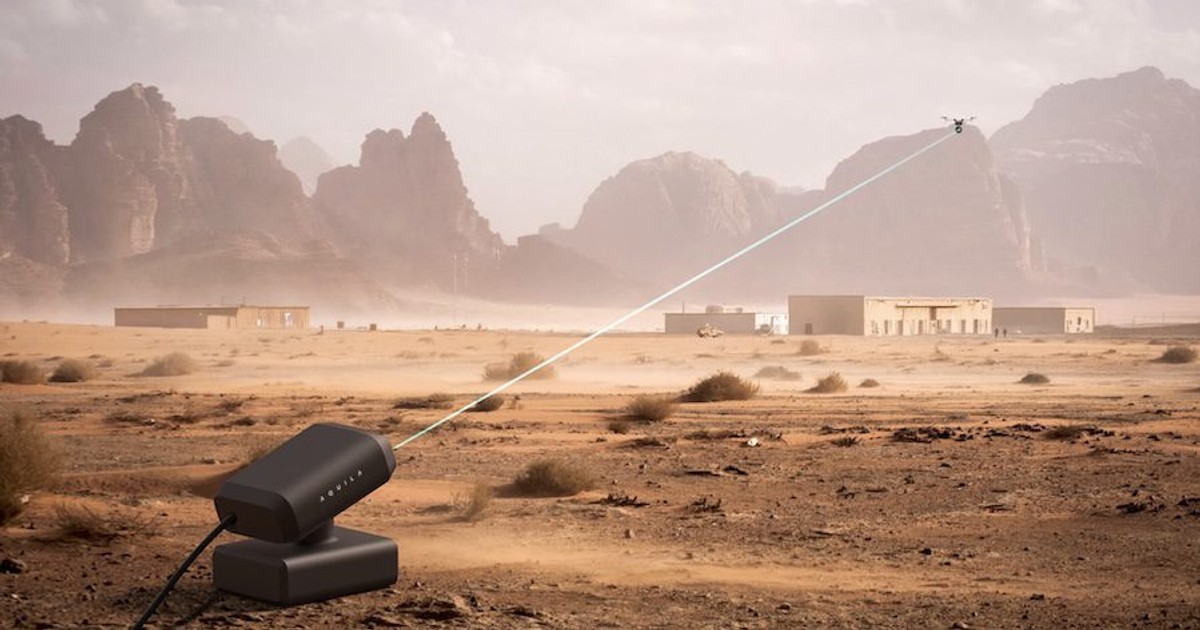
The technology the company is developing works like an invisible power cable. The device sends a narrow beam of infrared light towards the robot. There is a special photovoltaic receiver on board that converts this beam directly into electric current. Thanks to this, the robot receives a constant 4 kW of wireless power. As much as needed for continuous work in the warehouse.
- Read also: Scientists want to print muscles for robots. “They will be like humans”
The system is so refined that the laser tracks every movement of the machine in real time, keeping the beam precisely on the receiver. When the robot turns or changes speed, the platform immediately corrects its direction. Effect? The machine works continuously, without the need to connect cables or replace batteries.
A robot receiving energy from a laser
|
Aquila Earth
Even in a dynamic environment where the robot must avoid obstacles, change direction and work at different speeds, the system maintains stable power supply around the clock.
What is Aquila Earth?
Aquila Earth is a young but very promising player on the market of new energy technologies. The company was founded in 2022 in New Zealand, and its headquarters is currently located in Australia. Already in 2023, it was possible to obtain one million dollars, which allowed for the rapid development of prototypes and tests.
Ruby Jones, who leads the team, does not hide her enthusiasm for the achievement. — This is the most exciting because it is the most power ever delivered to a dynamic platform. No one else has ever done it so powerfully, he says in interviews. He also adds that the robot covered 25 km “only on light, with nominal battery support.”
Jones pays particular attention to the dramatic drop in component costs. In 2022, a kilowatt industrial laser cost approximately PLN 120,000. hole. Today, similar equipment can be ordered from China for just PLN 6,000. hole. “It's amazing how accessible they are — which is also a little worrying,” he admits candidly, pointing to the potential challenges associated with the availability of high-power technologies.
Comparison with previous achievements
This demonstration surpasses anything previously achieved in the field of wireless energy transfer using lasers. In December last year, Aquila tested powering the drone with a power of 500 W. Now it is a jump of an order of magnitude – up to 4 kW and in motion.
- Read also: Quantum Internet is getting closer. Scientists have carried out successful teleportation
For comparison, other companies such as Mitsubishi Heavy Industries achieved only 152 W from a kilowatt laser on a static target in 2025. Power beaming technology is not new in concept – ideas for transmitting energy with light have been appearing for decades, but only now has it become precise, strong and safe enough to operate in real industrial conditions.
Previous experiments were often limited to short tests or fixed targets, which did not answer the question of whether the system would work in practice, where objects are constantly moving and working in a changing environment.
What does this give us?
The significance of this breakthrough goes far beyond one magazine or a single record. Modern autonomous robots and inspection drones spend a significant part of their work cycle charging or replacing batteries. This is the biggest scalability barrier in logistics, industrial inspections, infrastructure monitoring and even precision agriculture.
Thanks to the Aquila laser, robots can work “forever” – non-stop, without downtime, which radically changes the economics of the entire sector. In Amazon, DHL and automotive factories, this means huge savings in time and money. A robot that does not have to return to the charging station every few hours can perform many more tasks in one shift. And this is just the beginning of a broader revolution.
The company already has several partnerships with large drone manufacturers and plans to take the technology into the air. Flying machines patrolling power lines, warehouses and industrial areas could fly for hours or even days without landing, which would be a huge step forward for the inspection of critical infrastructure such as power lines and pipelines.
The road to commercialization
Commercialization of the solution is scheduled for 2027. Jones emphasizes that adding power beaming to an existing robot or drone is surprisingly simple – just install a receiver the size of a standard battery and pair it with the laser system.
- Read also: Directed energy weapon. Will lasers and microwaves put drones out of war?
Costs are falling so quickly that the technology is becoming viable not only for large corporations, but also for smaller logistics and manufacturing companies. At the same time, the availability of cheap lasers from China raises some concerns – easily accessible high-power tools may fall into the wrong hands, which is why the company emphasizes intelligent security systems and authorization. Each laser must be paired with a specific receiver, and the beam is encoded, which minimizes the risk of abuse and provides full control over energy transmission.
Prospects and future of technology
The development prospects of this technology are truly fascinating and open up many new possibilities. Imagine drones patrolling high-voltage power lines over vast forests or mountainous areas without having to return to the base station every few hours. Or robots cleaning huge production halls that never need to recharge and can work around the clock.
In the longer term, the technology may even find space applications – NASA and other agencies have been considering powering lunar or Martian bases with lasers sent from Earth or orbit for years. Aquila Earth shows that the future does not have to wait for a revolution in lithium battery technology or new battery chemistry. All you need is light – precisely directed and efficiently converted on board the device.
It is also worth looking at the broader context of the development of power beaming. This technology draws on advances in semiconductor lasers, optical tracking systems, and efficient photovoltaic cells tailored to a specific laser wavelength. The energy conversion efficiency in the Aquila demonstration is high enough that the losses are acceptable from an economic point of view.
In the future, as costs continue to fall and efficiency increases, these systems may become the standard in many industries. We are already seeing interest from logistics and industry giants who are looking for ways to increase operational efficiency without huge investments in cable infrastructure or expanding the network of chargers.