Eurovision 2026. Who is the enigmatic character who appeared alongside Alexandra Căpitănescu on stage in Vienna

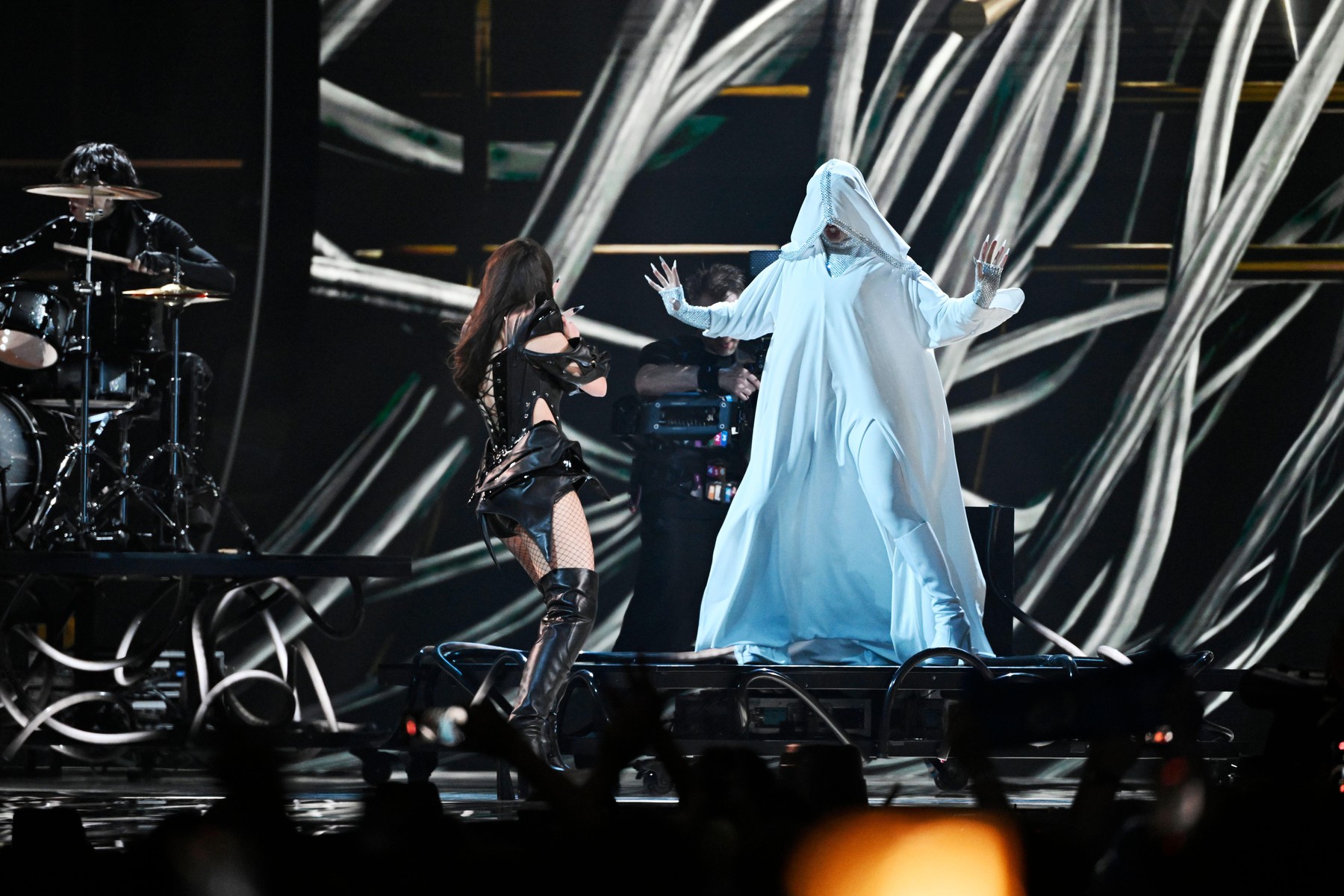
The representative of Romania at the Eurovision Song Contest 2026, Alexandra Căpitănescu, qualified for the grand final of the competition on Thursday evening, after the performance held on the Wiener Stadthalle stage in Vienna.
Along with the artist, her bandmates, Bogdan Stoican, Luca Șofron, Matei Cohal and Thomas Cîrcotă, also took the stage, as well as a young woman dressed completely in white, with her eyes covered by a cape.
The character is played by Daria Cristea, dancer and third-year student at the National University of Theater and Cinematography “IL Caragiale”, according to ProTv.
In the artistic concept of the show, Daria plays the role of the “phantom self”, a symbolic extension of Alexandra Căpitănescu and the emotions conveyed through the play, notes the same source. The artistic concept suggests an inner confrontation, the “phantom self” being the symbol of fears, insecurities and emotional vulnerability that Alexandra Căpitănescu conveys through the song “Choke Me”.
On Thursday evening, the representative of our country had an electrifying appearance to the cheers of the public, qualifying for the grand final along with 9 other countries from the 15 competitors.
A total of 25 countries will compete in the grand final on Saturday, May 16. Among them are the 10 countries qualified on Tuesday in the first semi-final, the 10 qualified on Thursday, plus the 5 big countries directly qualified, the main financial supporters of Eurovision – Great Britain, France, Germany and Italy – along with the host country, Austria.
Controversy surrounding the song “Choke me”
Alexandra Căpitănescu said, shortly after winning the National Selection, that the song “Choke me” is a metaphor for the feeling of being overwhelmed by strong emotions and one's own expectations.
The song reflects a deeply personal struggle with inner fears and pressure—the feeling of being “suffocated” by doubt, self-criticism, or a desire for growth and transformation, according to its Spotify description.
“And the chorus is quite positive: we say how important self-love is and it conveys to be gentler with ourselves, in general, in everything we do, in all fields, because that's the only way we reach our true potential. If we didn't set our own limits, we would reach 100% of our potential”, the artist told eurovisionromania.ro, before a wave of criticism.
But the song with which Romania participates in Eurovision 2026 has sparked controversy, with activists and international experts claiming that it “romanticizes sexual strangulation”, a dangerous practice that can cause brain damage and even death, according to the British publication The Guardian.
In the three-minute piece, the phrase “choke me” (“strangle me”) is repeated about 30 times, writes the British publication.
The lyrics also include phrases such as: “It's hard to breathe in”, “I want you to choke me” and “make my lungs explode”.
Clare McGlynn, professor of law at Durham University and author of Exposed: The Rise of Extreme Porn and How We Fight Back, said the play's repeated sexualised message “shows an alarming lack of concern for the health and well-being of young women”.
“The song, as well as Romania's choice of it for Eurovision and its promotion by the organizers, represents a reckless normalization of a dangerous practice. It's like playing irresponsibly with the lives of young women. The medical evidence emerging now shows that frequent sexual strangulation can cause brain damage in young women,” she said.