Superauto.pl analysts have calculated how the cost of operating combustion engines and electric vehicles is changing in the era of skyrocketing fuel prices at stations across Poland. In their analysis, they used the example of several popular models.
The rest of the article below the video:
It should be noted that these are indicative estimates, but they show a tendency in times of enormous turmoil on the fuel market. The authors analyzed fuel prices from government intervention – VAT and excise tax reductions. It should therefore be taken into account that the prices of petrol and diesel oil will be lower by approximately PLN 1.2 per liter. However, even taking into account these differences, the costs of driving an electric car will now turn out to be attractive.
The cost of using selected electric and combustion cars
|
Superauto.pl / Superauto.pl
How much does refueling cost?
To check how fuel prices translate into the costs of using vehicles, Superauto.pl experts prepared a simulation for popular cars with petrol, diesel and LPG engines, as well as an electric car. They chose models and years often found on Polish roads. The source of information on the actual, average fuel consumption is Autocentrum fuel consumption reports, and fuel prices – from the Reflex office. It is worth emphasizing, however, that the engines selected for analysis have incomparable power, which translates into fuel consumption, as the analysts focused on the popularity of the vehicles.
The most expensive vehicle in use, in terms of fuel costs, turned out to be the Toyota Corolla XI, produced in 2013-2018, with a 1.6-liter petrol engine with a power of 132 HP. Driving 100 km in this car currently costs PLN 50. This brand strongly focuses on hybrid engines, where the cost of use is much lower. You have to pay PLN 36 to drive a Toyota Corolla 1.8 Hybrid (122 HP) for 100 km.
In second place was the Volkswagen Passat, produced between 2014 and 2020, with a 2 liter diesel engine with a power of 150 HP. The cost of driving 100 km in this car is approximately PLN 45.
LPG is number 1 among combustion fuels
Among the combustion vehicles, the cheapest in terms of fuel costs was the 100-horsepower Dacia Duster with a factory LPG installation – in its case, driving 100 km costs PLN 28, but it should be emphasized that the car is equipped with a much weaker engine than the previously analyzed vehicles.
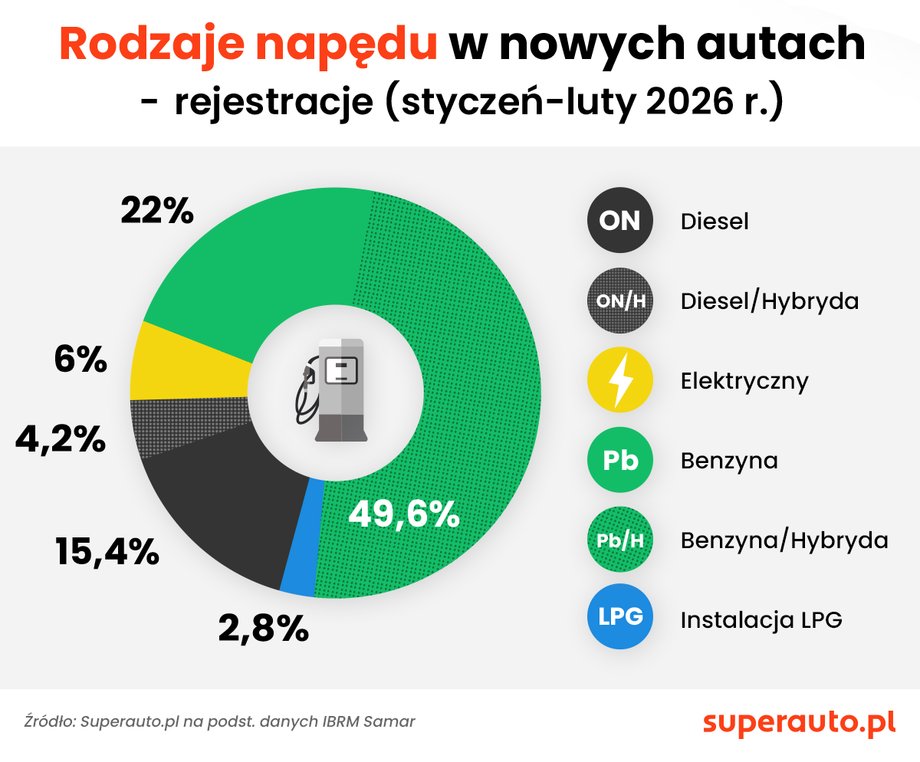
Drive structure in Poland
|
Superauto.pl / Superauto.pl
Read also: I drove an electric car from Hel to Zakopane. The cost surprised me
Electricity is cheaper than petrol, diesel and LPG
During the fuel crisis, the cheapest car to operate in terms of fuel costs may be an electric vehicle. Superauto.pl's analysis shows that, for example, the Tesla 3 RWD is able to beat the combustion competition in this respect.
Home charging is the key to cheap driving
In the case of the analyzed electric vehicles, three charging scenarios were considered. In the first one, it was assumed that the car was powered only by electricity from the home socket, according to the G12 night tariff. In such a case, driving 100 km with a Tesla 3 RWD would cost just over PLN 14 (range data was downloaded from the EV Database). In the 80 percent variant. home charging and 20 percent public charging on a fast CCS connector, this expense would be PLN 20. However, in the case of charging only at public stations, the timetable is 50%. CCS connectors and 50 percent AC connectors, driving 100 km with an electric car would cost PLN 38. Only in this variant, traveling in a Tesla would be more expensive than a Dacia Duster (LPG) and a hybrid Corolla, but it would still be much cheaper than driving a popular diesel or petrol car.
The situation is slightly different with the older model – analysts focused on the 2018-2022 Nissan Leaf. This comparison shows how electric car technology itself is changing. In this case – assuming charging outside the home – operation may be slightly more expensive than combustion cars.
However, home charging will make the vehicle cheaper to operate than many conventional drives.
It should also be added that not every model and in all driving conditions turns out to be more profitable than combustion engines. For example, some electric SUVs consume more than 20 kWh per 100 km, and high driving speeds may be important as they increase battery consumption. Nevertheless, the conclusion of the analysis seems obvious – with the turbulence on the fuel market, electric cars are becoming more attractive.
Electric cars are more stable
— Electric cars have a more predictable operating cost than combustion cars. Energy, like oil, is traded on the stock exchange, and yet prices at charging stations are much more stable than at gas stations. Companies can also use various forms of purchasing cheaper energy. Moreover, market fluctuations in energy prices do not translate into the amount we pay for electricity in the home socket, because it is a regulated market. The exception is when a household uses a dynamic tariff. In popular charging scenarios, with the predominance of energy from a home socket or a company AC connector, electric cars are clearly cheaper to use than combustion vehicles – says Grigoriy Grigoriev, general director of Powerdot in Poland.
He points out that this also applies to Poland, despite the fact that its energy is exceptionally expensive compared to other European countries, including: due to very high distribution fees. — Companies that have measured charging costs in practice decide to further expand their electric fleet because it is simply profitable.. The situation is similar with private individuals who are increasingly aware of the savings that switching to electromobility can offer them. This is an important factor stimulating the demand for zero-emission vehicles, and the current fluctuations in fuel prices may further strengthen this trend, the expert concludes.
Every second car is a hybrid
Economical drives in terms of fuel consumption have long been popular among Poles, and their share is constantly growing. According to IBRM Samar data on registrations of new passenger cars and delivery vans up to 3.5 tonnes in 2026, that hybrids based on petrol and diesel engineshave 54 percent share of sales. — This means that more than every second new car on Polish roads is a hybrid. When we add electric cars to this, it turns out that the ecological drive has 60 percent. new vehicles – emphasizes Marek Srębowaty, e-commerce director of Superauto.pl.
Poles are looking for savings when fuel prices become more expensive
At a time of rising fuel prices, interest in the costs of vehicle use is growing rapidly. — In the first week of the escalation of the armed conflict in the Middle East, interest in the “combustion reports” section on the Autocentrum website increased 11 times, and currently remains at a level eight times higher than the average. The statistics of the fuel prices section are similar, with a record number of visits, says Marek Srębowaty.
According to the expert, it is too early to assess what impact fuel price increases may have on Poles' purchasing decisions. — A car buyer usually needs from 30 to 90 days to think about what model or engine version he wants to buy. This is not an impulsive decision, but a process that may take several months. If fuel prices remained at such a high level for a longer time, we could only see their consequences in Poles' automotive choices – says Marek Srębowaty.