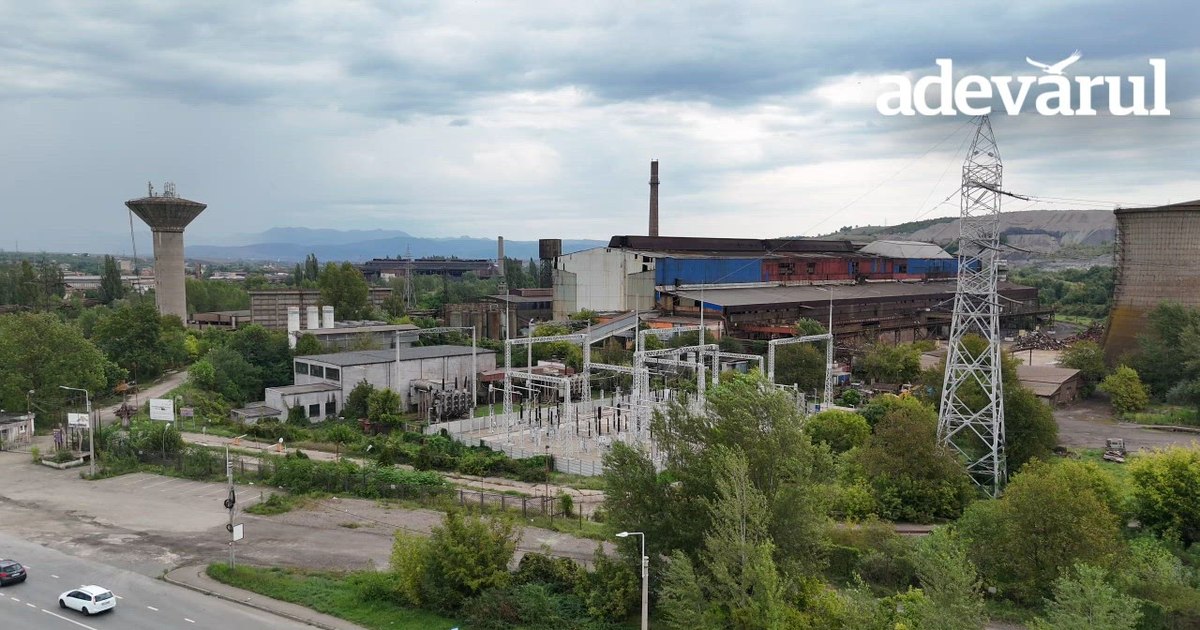
The new owners of the steel plant in Hunedoara will be able to take full advantage of the “slag mountain” in the vicinity of the closed industrial complex from the fall of 2025.
The slag dump of the Hunedoara plant. Photo: Daniel Guță. TRUTH
The steel mill in Hunedoara stopped its activity in the fall of 2025, when it still had about 500 employees.
On February 9, the General Shareholders' Meeting of ArcelorMittal Hunedoara approved the sale of the company's assets to the company UMB Steel SRL, for a total price of 12.5 million euros, to which VAT is added.
The combine, bought with everything with the slag dump
The transaction includes all land, buildings, installations and the slag dump, with an area of more than 250 hectares.
“In total, the transaction concerns approximately 1,060,000 sq m of land within the perimeter of the industrial site, 494,000 sq m of land located outside the site and 928,000 sq m, representing the slag dump and its related lands”, shows the document published by ArcelorMittal Hunedoara.
According to the same February report, UMB Steel will assume all environmental obligations and liabilities associated with the assets sold, activities previously carried out at the industrial site and at the slag dump.
The plans regarding the fate of the plant have not been officially announced by the UMB Steel Group, but the new owners of the plant will be able to take full advantage of the “slag mountain” located in the vicinity of the industrial complex, on Buituri Hill in Hunedoara.
The slag dump of the steel plant covers more than 90 hectares, and since its establishment in 1965, more than 20 million tons of steel and furnace slag (about 13 million cubic meters) have been unloaded here.
Until the operation of the combine was stopped, the dump was exploited for the recovery of iron, which was returned to Oțelăria Electrică, and deferrized slag, used mainly in construction. In years past, landfill slag processing plants could process more than 12,000 tons per day, or more than two million tons per year. As a result of this activity, approximately 45,000–50,000 tons of iron and over two million tons of slag were produced, which was to be used for road and highway construction works, according to a geological report published on the website of the Hunedoara Environmental Protection Agency.
The slag heap, partially moved
In recent years, the works on the tailings dump of the combine aimed at both the processing of the material and the remediation of the problems caused by landslides and the instability of the slope. In the past, they have taken their toll among workers on the dump, burying people and machinery.
“Considering the large amount of slag deposited on the site, its irregular, even chaotic, distribution and the instability of the land, it was necessary to redesign the slag distribution on the dump, for the equal distribution of the deposits (thicknesses) and to ensure a uniform conventional pressure over the entire surface of the dump”, showed a geological report presented in 2017 on the APM page.
The geometric reconfiguration of the dump aimed at relocating a volume estimated at around 11,600,000 tons from some areas with reduced stability and filling some crevasses-canyons on the dump. The specialists noted the need to set up the platform in steps, with a maximum height of 15 meters, separated by protective and safety berms. In the last year, part of the slag from the dump was moved to a land on the bank of the Cerna river, located in the vicinity of the combine, at the entrance to the municipality of Hunedoara from Deva.
The decline of steel mills in Romania. From record steel production to 'dystopian industrial nightmare'
The Buituri slag dump was set up in 1965, on an area of 40 hectares, located in the valley of the Hărăoani stream, and the first deposits of slag date back to 1967. In the following years, the perimeter was extended to the north (towards the Cerna river), on a semi-marshy land fragmented by torrents and two streams, then over the course of the Hărăoani stream.
A geotechnical study carried out in 1972 showed problems related to the instability of the landfill after the first five years of operation.
“The landslides produced are 30–50 m wide and 70 m long, extending from the area of the temporary road (elevation 240–245 m) to the area of the existing houses downstream (223–227 m). The landslides are larger in the upstream area, with depths of the sliding surfaces of 4–5 m, also affecting the slag deposits”, the authors of the study showed.
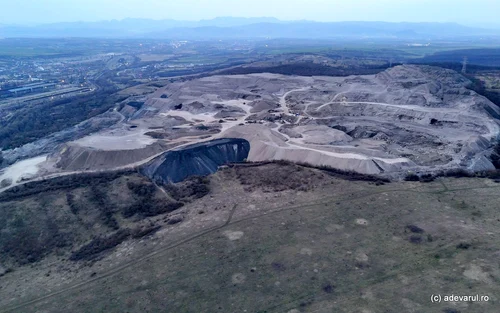
Image 1/11:
The slag heap of the combine Photo Daniel Guță THE TRUTH jpg
The engineers proposed capturing and draining the Hărăoani stream, monitoring landslides, prohibiting excavations in the body of the dump, prohibiting access to the area for heavy machinery and support works for its slopes.
In 1978, the second stage of development of the slag dump began in Hunedoara, when its surface was extended by another 40 hectares to the north. To stabilize the land, two support works were carried out, by building two slag spurs located on the valleys in the area, at the base of the old deposits and the newly created area. They were embedded 5–8 meters into the natural terrain, and under each a large-grained gravel drainage system was made, with a height of 1–1.5 meters, which evacuates the water to the Cerna River, according to the report published by the Environmental Protection Agency.
The slag heap, a mountain of recoverable iron
Since the 1970s, specialists noticed the economic potential of the slag dumps of the Hunedoara, Galați, Reșita and Câmpia Turzii plants. Until then, landfills had not been given importance, due to the possibilities of collecting large quantities of scrap metal from less expensive sources.
“From the summary calculations made on the spot by the specialists, it follows that only in the Hunedoara dump there are at least 800,000 tons of metal, which could be recovered. Simultaneously with the removal of the metal, large amounts of slag can be obtained by grinding, which can be successfully used either in road construction or in the construction materials industry”. informed the Economic Review, in 1977.
In the 1980s, economists calculated that, by putting the value of the iron ore contained in the steel mill slag produced in a year at the three big combined ones from Galati, Hunedoara and Reșita, foreign exchange funds of about 15–16 million dollars could be saved, in addition to the value of the iron and slag removed. In 1984, the plant in Hunedoara was equipped with a slag grinding facility, which aimed to recover the entire amount of iron with the help of electromagnetic drums.
“The installation, designed by IPROMET, but with many improvements brought by our specialists, grinds about 470,000 tons of slag annually, from which 70,000 tons of scrap metal can be extracted”, noted the press of the time in 1984.
Hunedoara steel mill, sold to UMB Steel. The 12.5 million euro transaction was approved
However, the specialists complained that the state had not solved the problem of valorization of the deferred slag, which results after the extraction of iron ore.
“After a period of 6–12 months, required for chemical and physical stabilization, deferrized slag becomes an excellent construction material, with multiple uses — from ballast or drainage material for roads to material for BCA bricks. But, paradoxically, no concrete collaboration with potential consumers has been established.” informed Scânteia, in 1984.
Dump affected by instability
A geotechnical study carried out in 1995 showed that at that time the body of the dump was affected by instability phenomena, and the final storage height (provided in the 1978 project, namely 350 meters) had been exceeded in some places. In 2006, another survey showed that the area was affected by active landslides following heavy rains in the spring of that year and cracks. In the following months, work was carried out to level the slippery steps and fill the cracks.
The most recent studies showed that the instability of the land is maintained and it was necessary to redistribute significant amounts of slag, accompanied by a geometrization and rehabilitation of the steps of the dump. Among the causes of instability was the fact that the dump is uneven, it being made up of about 51% steel mill slag, 45% furnace slag and about 2% foundry slag and pit slag.
“The Buituri slag dump was built over a relief affected by instability phenomena, having natural and anthropogenic causes. The large amount of slag deposited on the dump, the chaotic deposition methodology and the frequent handling of the slag, in several processing cycles for the recovery of iron, were the factors that favored the instability of the dump. The lack of an efficient system for capturing and draining underground water induces an excess of moisture in the foundation land, which causes exceed the limit of the carrying capacity of deluvial and alluvial deposits”, shows the location report of the Buituri dump, drawn up in 2017 by geologists.