The most complex highway interchange is taking shape. “It will have numerous bridges, passages and even viaducts, on three levels”

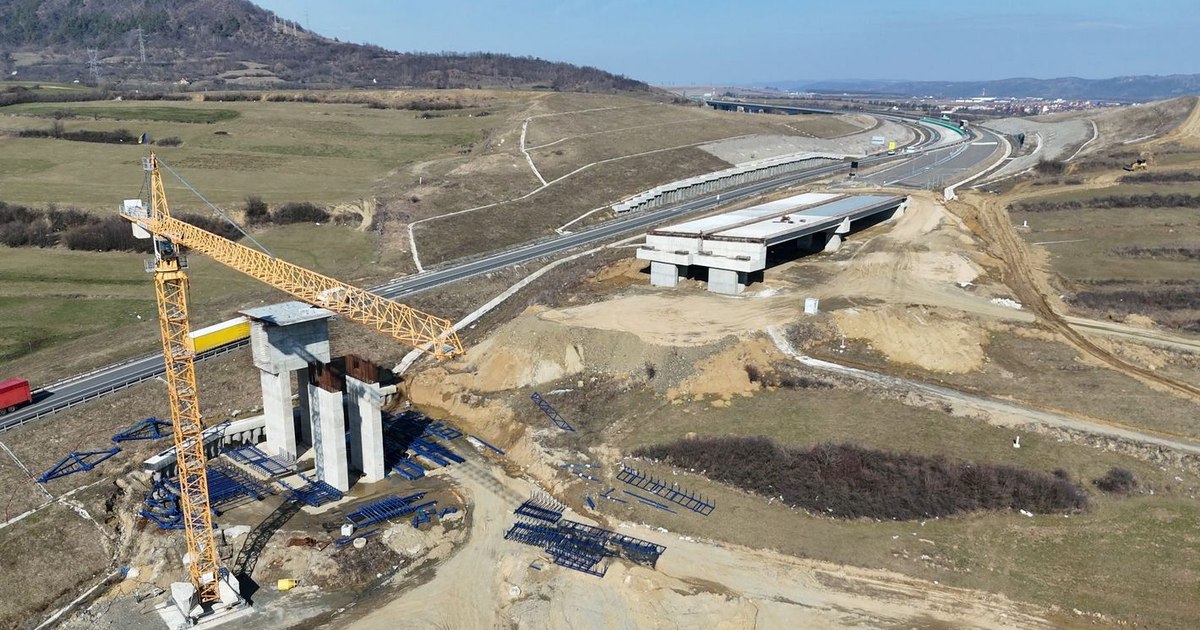
The most complex highway junction under construction in Romania is taking shape in the Oltului Valley, at Boita, the place where the A1 Sibiu – Pitesti and A13 Sibiu – Făgăraș highways will be connected.
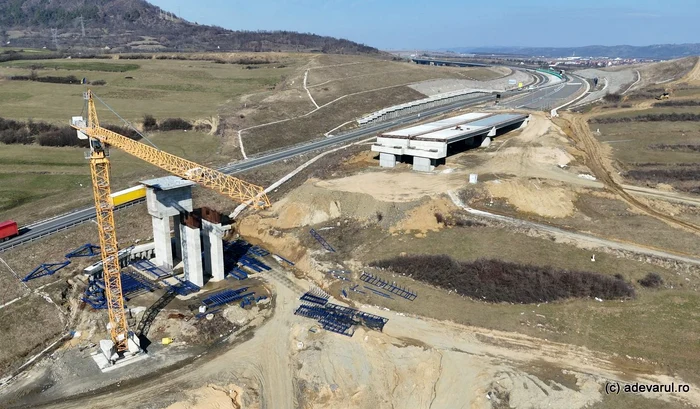
The area of the future Boita junction. Photo: Daniel Guță. TRUTH
In Boita, on the former pasture of the Sibiu village, still occupied by flocks of sheep and a few isolated houses and stables, the builders are working on the embankments and ramps of the future shoulders of the Boita highway junction, considered the most complex junction currently in the construction site.
Work has begun on the drainage structures (floors and coffered concrete floors for draining water from the slopes) and on the foundations on bored piles for the future node.
The “braces” of the knot take shape
Technological roads and work platforms are also being set up for the construction of the intersection that will connect the A1 Sibiu – Pitesti and A13 Sibiu – Făgăraș highways, National Road 7 and Valea Oltului.
“The road junction includes numerous bridges, passageways and even viaducts, on three levels, to be able to ensure connections in all directions. The intersection is part of Section 1 of the A13 Sibiu – Făgăraș highway, 14.2 kilometers long, between Boita (Sibiu – Pitești Highway) and Avrig (DJ105G). The builder of this lot is the Turkish company MAKYOL Insaat Sanayi Turizm ve Ticaret AS, which has 48 months at its disposal (of which 12 months represent the period for design, and 36 months represent the period for the execution of the works) for the construction of this section”, informs the National Road Infrastructure Administration Company.
The Boita junction will ensure high-speed interconnection between the A1 and A13 motorways and the National Road 7. The works at the motorway junction are complex both due to the scale of the constructions and the terrain and relief of the area at the entrance to the Olt Gorge, where it was designed.
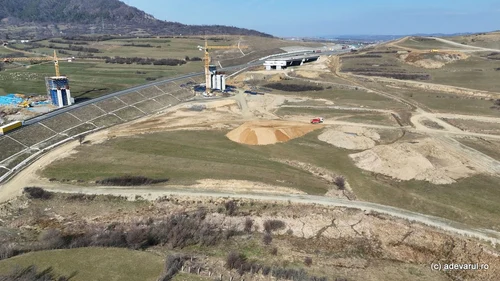
Image 1/12:
Sibiu Pitesti Highway, Boita Junction Photo Daniel Guță THE TRUTH (22) jpg
“On the Sibiu – Făgăraș Highway, the area was analyzed through geological mapping, geotechnical drilling and field visits. Following the interpretation of all the available data, it can be concluded that in the area of the Boita Junction there are phenomena of instability in different stages of evolution. The main cause of the instability of the natural terrain is the sharp slopes of the slopes, the inclination of the geological layers and the geotechnical characteristics of the soils. The main triggering factor is the variation the hydrogeological regime in the massif”, show the Adequate Project Assessment Study.
The Boita motorway junction is built on the 14 kilometer section between the Sibiu towns of Boita and Avrig, part of the A13 Sibiu – Făgăraș motorway. The project also provides for the construction of six viaducts (the longest being 911 meters) and 17 bridges. The value of the contract, signed with the Turkish builder MAKYOL, is 1.89 billion lei (without VAT), an amount secured through the Transport Program.
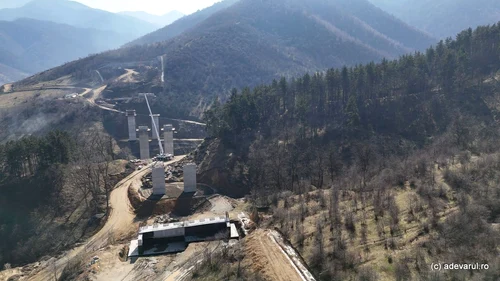
Image 1/11:
Sibiu Pitesti highway, Boita Junction Photo Daniel Guță THE TRUTH (9) jpg
“Work on this lot started in November 2025, but the builder has prepared the land, the technological roads and the site organization by that time”, recently informed Cristian Pistol, director of the National Road Infrastructure Administration Company.
The Sibiu – Făgăraș highway will be 68 kilometers long, and the works have been divided into four sections, all of which are currently under construction, the contracts being awarded by the Romanian state to the MAKYOL company.
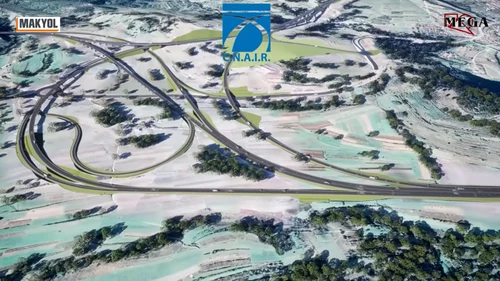
Image 1/6:
The Boița Randare CNAIR interchange (6) jpg
Section 1 Boita (Autostrada A1 Sibiu – Pitești) – Avrig – Mârșa (DJ105G), which includes the motorway interchange, is 14.25 kilometers long. The works are at the beginning, the physical stage being approximately two percent, and the deadline for completion is 2028, shows the data presented by the Center for Road Technical and Informatics Studies (CESTRIN), within the CNAIR.
Section 2 Avrig – Mârșa (DJ105G) – Arpașu de Jos (DN1) is 20 kilometers long, and the work progress has reached 20 percent.
Section 3 Arpașu de Jos (DN1) – Sâmbăta de Sus (DJ 105B) is 17.61 kilometers long. The works have reached the stage of 33 percent and are due for completion in 2027.
Section 4 Sâmbăta de Sus (DJ 105B) – Făgăraș Municipality has a length of 16.26 kilometers, to which is added the connecting road with DN1 (5.6 kilometers). The physical stage of the project has reached 14 percent, with a completion date of 2028.
The Făgărașului highway was designed on the Olt river valley, on a route close to that of National Road 1 Sibiu – Brașov. The future highway with a length of approximately 70 kilometers will have six road junctions, at Boita, Avrig, Arpașu, Sâmbăta, Ileni and Făgăraș. All of them will be able to be used as access points for tourist routes in the Făgăraș Mountains. With the completion of the highway, estimated for 2027–2028, road traffic on DN1 Sibiu – Brașov, one of the busiest national roads, will be reduced, the access of locals to Sibiu will be easier, and the Făgăraș Mountains will become closer to tourists, through the settlements at their foothills.
Boita, the gateway to the mountain highway
In addition to the highway junction, the town of Boita will be crossed by the A1 Highway through several viaducts and two tunnels designed on a segment of approximately six kilometers, difficult in terms of relief, at the entrance to the gorge.
The first viaduct, 650 meters long, entered the construction site in the summer of 2024, being included in the Boita – Cornetu Section of the A1 Motorway, 31 kilometers long, designed for the Olt Valley.
In 2025, four more viaducts came into operation, to complete this one, and recently the Ministry of Transport issued the construction authorization for three more viaducts and for the Boita I Tunnel, 270 meters long.
Seven tunnels will be built on the Boita – Cornetu segment, from Valea Oltului. Two of these, the 270-meter one on the construction site and another of 360 meters, will be built in the area of Boita, at the entrance to the gorge, on the right side of the valley.
Two other tunnels, with a total length of approximately 1.39 kilometers (one of them exceeding 1,000 meters), will be built in the Lazaret area, on the left side of the valley. In the same area, an ecoduct will be built over DN 7, the Olt River and the Olt Valley railway.
Another tunnel, 1.6 kilometers long, will be built west of the town of Câinenii Mari, on the left side of the gorge. In the area of the hydropower development in Robești, the route will cross the slope through a tunnel of approximately 900 meters, located in the construction site, followed by another tunnel of approximately 455 meters.
The contract for the design and execution of the works on Lot 2 Boita – Cornetu, worth over 4.2 billion lei, excluding VAT, was signed in 2022 by the Romanian state and the Mapa – Cengiz association, with a completion date of 2028. On the 31 kilometers of the Olt Valley, in addition to the seven tunnels, an ecoduct in the Lazaret area and 48 bridges, passages and viaducts will be built.