February 12 is World Darwin Day. On this occasion, Huawei CBG Polska conducted a study on health and longevity.
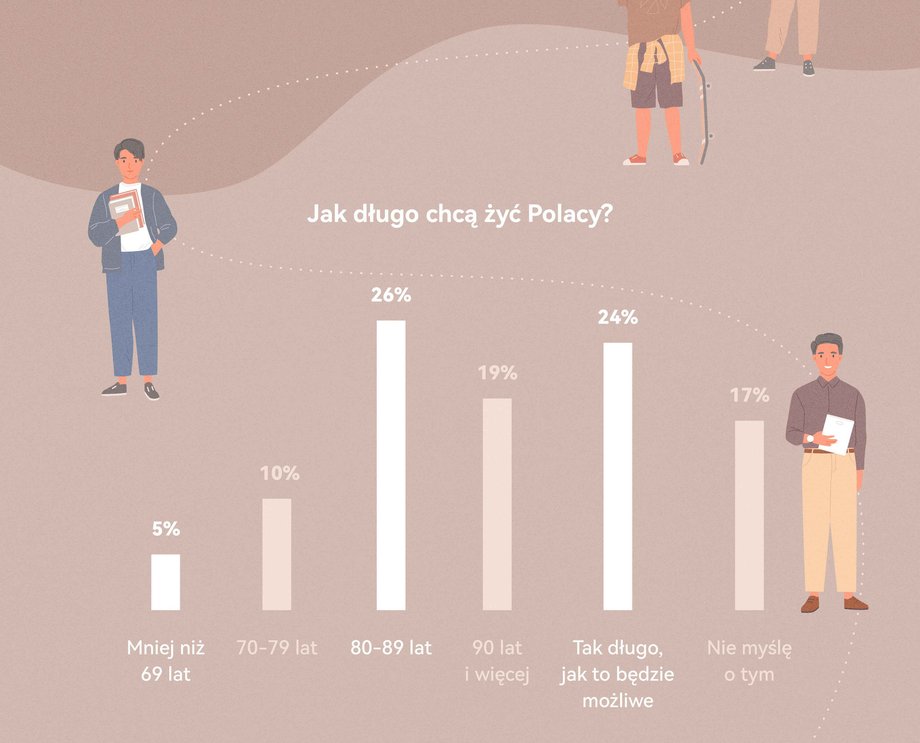
Almost half of us (45%) would like to live to at least 80 years, and nearly every fourth (24%) — as long as possible. 5 percent in turn, chose the answer that they would like to live “less than 69 years.”
This is what Poles want to experience
|
Press materials
Although almost half of Poles assess their health condition as good (48%), and 28% as sufficient, only 16 percent respondents say it is very good, and only 3 percent respondents call him exemplary. At the same time, only 10 percent Poles declare a full sense of control over their own well-being and aspirational life expectancy – according to the Huawei study.
See also: How much can you earn until retirement in 2026? ZUS limits from March
The rest of the article is below the video:
That's how much Poles train
Almost every third Pole (31%) does not undertake any physical activity associated with increased heart rate or does it for less than 30 minutes during the week. Exercise time ranging from 30 to 90 minutes in the same frame is declared by 30 percent. subjects. Every fifth Pole (21%) trains from 91 to 150 minutes a week, every tenth 151-300 minutes (10%), and a similar percentage – more than 300 minutes (8%).
Similar differences are visible in the diet. Almost half of Poles (49%) declare that they try to make good food choices, but they eat unhealthy products several times a week. More than 1 in 5 people (22%) describe their diet as based mainly on nutritious products with small exceptions, while 18% of us admit that we usually eat unhealthy foods and consume large amounts of processed food. Only 2 percent Poles follow a strict diet.
Only 23 percent Poles say that their current lifestyle is conducive to longevity, and almost half of us (48%) are not able to assess this at all. More than every third person (35%) believes that they have only partial influence on their health and life expectancy, because not everything can be predicted. In turn, 32 percent claims that it has only a partial impact on health and life expectancy, because genes play a significant role. Only one in ten Poles (10%) believes that they have full control over their health. A slightly higher percentage (14%) believe that they have no influence on their health because too much depends on the environment and external factors. As the expert emphasizes, longevity is not only a stroke of luck, but also the result of consistency and conscious decisions:
“Genes are responsible for 20-50% of our life expectancy. On the one hand, this is a lot, but on the other hand, more than half of it is in our hands. Moreover, genetic diseases can increasingly be detected and treated early. Most often, in addition to genetic predispositions, the disease requires additional unfavorable environmental factors – poor lifestyle, infection, environmental pollution. We can try to protect ourselves against these factors by improving our lifestyle, vaccinations or limiting exposure to pollution,” says Prof. Ph.D. n. med. Łukasz Małek, sports cardiologist from the University of Physical Education in Warsaw.
In the context of everyday health care, technology is becoming more and more helpful. More than a quarter of Poles (27%) use a smart watch, 10%. from the wristband, and 9 percent from both devices. The most frequently monitored parameters are the number of steps (64%), heart rate (63%) and sleep (46%). These devices are also used to measure physical activity (37%) and stress levels (29%), helping users better understand the signals sent by the body, says Huawei.

This is the Poles' approach to health and longevity
|
Huawei Poland