Gravity also applies to gold and silver. The oldest investors do not remember such declines

On Friday, there was an unprecedented crash in the precious metals markets. On Monday morning, the declines continued and later turned into a cautious recovery. Even the oldest veterans of precious metals markets do not remember such a dynamic correction.
If anyone hasn't seen something like this before, this is what retreat looks like in an extremely “overheated” and “crowded” market. Friday's crash in the precious metals markets was a price illustration of what happens when a crowd of leveraged investors suddenly rush to a narrow exit and try to sell a security that burns in their hands. Often, it was also a sale forced by the exhaustion of the security deposit and carried out automatically by the broker.
Despite everything, the scale of Friday's declines is still impressive.
Silver futures dropped by 28% and gold by nearly 11%. In both cases, these were the largest daily declines in history. Moreover, on Monday morning the depreciation of bullion continued. In the morning, gold prices dropped even to USD 4,434/oz, which at that time meant a decline of 6.6%. But by 12:30 the price of the royal metal had risen to USD 4,782.24/oz.
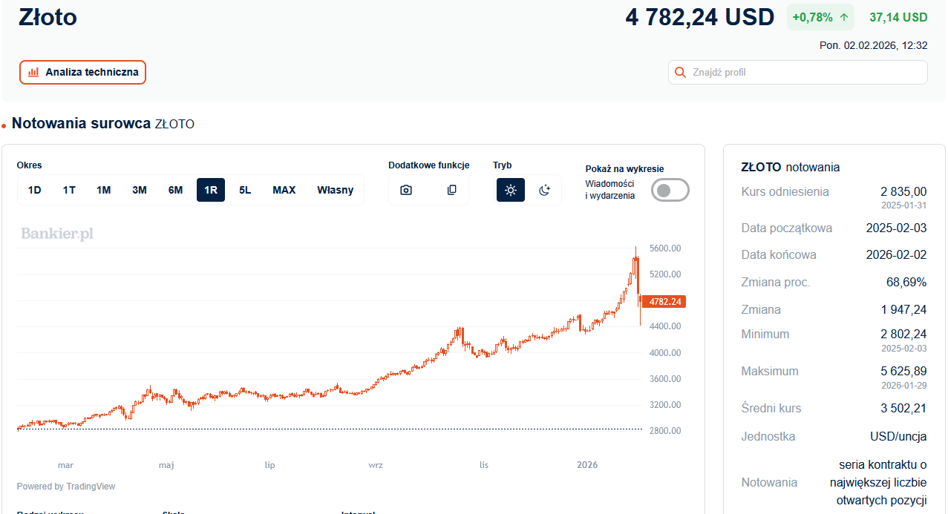
This does not change the fact that over the previous several dozen hours of trading, gold fell even faster than during the memorable collapse of April 2013. Then the gold price fell by 5.1% on the first day and by 8.6% on the second day. Also in February 1983, two consecutive sessions were observed with declines of over 5% each. And now we were over -10% in one day.
It is possible that we will see a correction in gold with a capital “K”
The year is 2026. If someone had said a decade ago that an ounce of gold would cost over $4,650, they would have been considered crazy. Today it is a market reality. Last year was simply not a good year for precious metals – it was an absolute anomaly. In the background of these increases, however, there is not only investor greed, but a fundamental reconstruction of the global financial order. What was last year and what will the new year be like? All this in the latest episode of “GPW”.
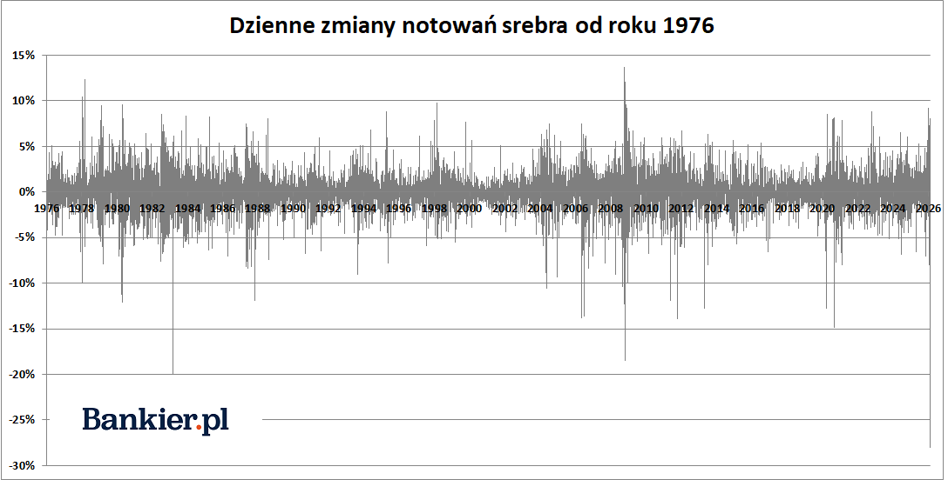
And though silver plummeted by an incredible 28%in the case of the white metal, similar declines have occurred many times in the past. In August '20, we had a session with a drop in the silver price by almost 15%. On March 16 of the same year, -12.8% was recorded. After reaching a multi-year peak at the end of April 2011, the silver price dropped by -11.9%. And five months later it added -13.9%. On October 10, 2008, during the height of the Great Financial Crisis, the price of the white metal dropped by 18.5%. And we also had -20% on the last day of February 1983, which until last Friday was the largest daily drop in silver prices.
What rises strongly may then fall sharply
At the same time, it would be very unwise to consider Friday's events in the precious metals markets without reference to what has happened in the previous days, weeks and months. Since the beginning of September 2025, precious metals prices have been climbing upwards, recording huge rates of return. On Thursday, this year's silver result was +70% and gold +30%. And all this happened after the royal metal gained 65% in 2025, and its “poorer cousin” earned as much as 142%.
And although the decline in precious metals was impressively rapid, silver prices are currently ($83.39/oz.) at a similar level as at the beginning of January! The same applies to gold. Therefore only January's most spectacular increases were erased. After all, in December gold was at USD 5,000/oz. seemed a very bold forecast, and silver at USD 100/oz. the peak of possibilities. Meanwhile, prices of the white metal reached USD 121.76/oz before crashing down.
At this point, I don't really see the point in looking for any reasons or even excuses for such a profound correction. Simply put, the market was incredibly hot and a trivial event was enough for speculative investors to start realizing significant profits. And once the avalanche of closing long positions started, it could not be stopped quickly. She had to roll down into the valley.
Bull market, euphoria, correction and what next?
Usually, corrections after such strong increases do not end after one day. Even if a rebound appears in the near future (and perhaps even a dynamic one), experience suggests waiting for another wave of declines. Then, precious metals markets may enter a longer phase – lasting even months or quarters – of stagnation and a tiring sideways trend, perhaps even slightly downward.
After such a spectacular rally and record correction, the market needs to cool down. Short-term and leveraged speculators are either in the process of exiting the market, or the broker has done it for them, forcibly closing a losing position. A large number of medium- and long-term investors who have been accumulating precious metals over recent months or even years could also realize profits. However, the demand for physical gold from small investors may awaken. Exactly in the same way as it happened in the spring of 2013, when lower prices tempted primarily long-term retail investors from the Far East.
It is worth being aware that gold and silver are two different investment worlds. The former is a kind of insurance policy against the collapse of capital markets, while the latter is primarily a “wild” industrial metal with a highly speculative bent. Therefore, the recovery in silver may be more dynamic than in gold and new records for the white metal may still be ahead of us.
In turn, in the case of investors with a long and very long (i.e. counted in decades) investment horizon, it is worth asking: Has anything changed in the last few days regarding the so-called foundations. These are the factors driving gold prices over the previous three years. Is there a chance to stop the uncontrolled public debt of the strongest countries in the world? Will the world's most important central banks start pursuing more reasonable policies and prevent another wave of inflation? Does the condition of the US dollar promise any improvement in the medium and long term? If the answers to the above questions are still negative, then a long gold position probably still makes sense. Of course, not for most of the capital! But for 10-20% it will be sooner.
Of course, the scenario from 2013-15 should still loom in the back of our minds. Then, the bear market on the gold market (at least in dollar terms) lasted for two years after the then crash, testing the patience of even the biggest goldbugs. Also now, the secular bull market in gold will probably not be linear. After the madness of the last two years, a longer rest would be highly recommended.