As the scientist points out, the United States in the 21st century was preoccupied with Iraq and Afghanistan. Meanwhile, in their traditional sphere of influence – Latin America – a creeping geopolitical upheaval was taking place. China took actions here that, despite Washington's silence, changed the power map. “America has forgotten Latin America, which it has considered its own for almost 200 years” – says Dr. Wojciech Kwiatkowski, an Americanist from Cardinal Stefan Wyszyński University. “The Chinese have been pumping a lot of money there for over a dozen years. Not only in Venezuela – although they lost several billion dollars there – they are very active in Brazil, Argentina and Chile“.
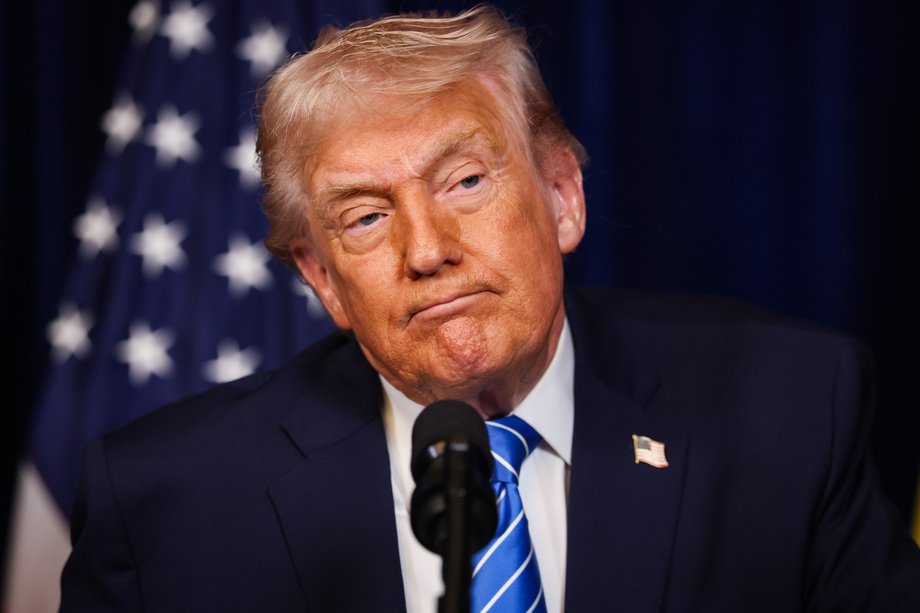
Donald Trump is skeptical about the chances of the former shah's son taking power in Iran
|
Joe Raedle/Getty Images
Beijing did not act chaotically. Chinese investments have undergone an evolution: from energy and mining projects to the construction of infrastructure with clearly military potential. The example of China's megaport in Chile is telling. Officially justified by commercial purposes, it may serve completely different purposes. “This is my theory that China is trying to do around the United States what the United States has around China” – explains Kwiatkowski. “America has bases in South Korea, Japan, the Philippines, and on small islands. China has nothing on the United States. That is why they tried to create and economically link Latin American countries with each other, and then establish themselves there militarily,” he emphasized.
At the same time, he pointed out that solving the Iran issue would mean depriving China of one of the “three gas stations”, i.e. fuel exporters: Venezuela, Russia and Iran.
Cuban Missile Crisis 2.0 as a real threat
Recent talks between Chinese politicians and the Cuban establishment have become a key issue for US national security. This is what led observers to talk about the possibility of a repeat of the Cuban Missile Crisis of the 1960s. If China managed to spread a military base just 150 km away from the border with the United States, Washington would find itself in a situation it “could not afford in the 1960s and cannot afford now.”
The entire program is available here:
The problem is not limited to Cuba. Jamaica, Bahamas, Mexico — these are all countries into which China has poured significant financial resources. Beijing did not act without a plan. Multi-year contracts have provided Chinese companies with access to resources of rare earth metals, copper and other strategic raw materials. For America, this means not only economic dependence on a competitor, but also a direct military threat.
Venezuela as a test
The situation in Venezuela was a turning point. Officially, the USA worked for democracy by supporting the opposition. But the real stakes were more primitive: cutting off Chinese access to Venezuelan oil and restoring the influence of American oil companies. “If they let American oil companies in, if they can rebuild infrastructure that has not been modernized for 20-30 years, that will be enough for Trump. Plus, of course, rejecting the Chinese hand” – says Kwiatkowski.
The strategy also makes sense politically. After the Iraqi experience, America avoids overt military interventions. I prefer to work with a local partner, even if imperfect, to build governments from the ground up. “For them, a model in which someone rejects the Chinese hand and is willing to cooperate with the United States is enough,” explains the Cardinal Stefan Wyszyński University in Warsaw scientist. This person doesn't have to be a saint or fully sympathetic to democracy – he has to be useful.
Colombia and Cuba – next deals?
Will the United States act similarly in Colombia? The situation here is complicated. Colombia has a democratically elected president, it is a large country, and his overthrow would be impossible to explain to the world without worsening America's image, says the expert. “Americans could not explain to anyone why they had to take over the head of this state, why they had to remove the power that existed there” notes Kwiatkowski.
Onet Morning. Financially
“Onet Rano. Finansowo” is a weekly program in which Business Insider journalists talk to invited experts from the world of business and politics about current events and issues related to the Polish economy, public finances and the impact of politics on the wallets of every Pole.
The program can be watched every Wednesday at 10 on the main page of the Onet portal, and from 11 as podcast at Onet Audio.