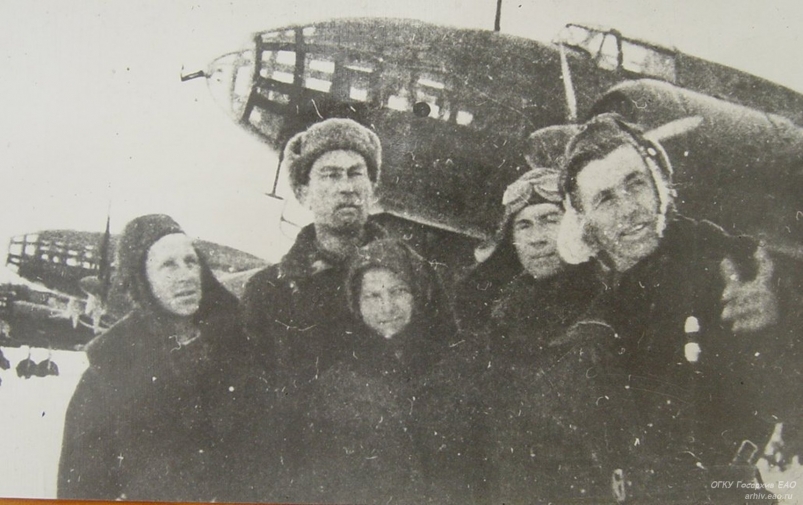
Chairman of the Trudovaya Niva collective farm E.I. Simonov and front-line pilots near the planes built with funds raised by the workers of the Jewish Autonomous Region
Photo: State Archive of the Jewish Autonomous Region
December 11, 1941
In David Weisserman’s book “Birobidzhan: Dreams and Tragedy” (12+) it is written that on December 11, 1941, at a crowded meeting of Waldheim collective farmers, a decision was made to raise funds for the construction of combat aircraft. Within just a few hours, over 110 thousand rubles were collected.

The oldest collective farmer Reznik said:
“I will not regret anything for my native Red Army. I am contributing 5 thousand rubles for the construction of military vehicles and calling on collective farmers to expand their fundraising for this noble cause.”
His speech was supported by a prominent vegetable foreman in the region, Fyodor Lukich Tsyb.
“The other day we read,” he said, “an article by Vasily Grossman, “The Direction of the Main Strike,” about the strength, courage, unparalleled resilience, and miracles of heroism of the Stalingraders. Our Soviet duty is to worthily help them with new weapons, new tank columns, built at the expense of collective farmers. I am contributing 15 thousand rubles from my personal funds to the creation of combat vehicles called “Collective Farmers of the Jewish Autonomous Okrug.”
Following his father, his son, Yakov Tsyb, spoke at the meeting and contributed 1.5 thousand rubles to the defense fund. A distinguished livestock breeder, 60-year-old Mikhail Gefen, donated 15 thousand rubles for the construction of combat aircraft. Collective farm beekeeper, 54-year-old Zelman Wolfson contributed 12 thousand rubles. During the war years, only one collective farm, “Waldheim”, collected and transferred 250 thousand rubles for the construction of tanks.
December 11, 1945

Day in the history of the Jewish Autonomous Region. Photo: Photo: Regional Library
The newspaper “Birobidzhan Star” (12+) on December 11, 1945 wrote about the plenum of the Obluchensky district committee of the All-Union Communist Party of Bolsheviks. At it, questions were discussed about measures to improve the material and living conditions of workers, about the progress of filling seeds in the collective farms of the region, and about the growth of the district party organization. At the plenum, the issue of work at the Sutara mines was separately considered: “Here workers and employees are provided with additional food products at the expense of suburban farming, a dairy farm, a bee apiary, and a poultry farm.”
Appropriate decisions were made on all issues discussed.
December 11, 1946
The newspaper “Birobidzhan Star” on December 11, 1946, in the section “Across our region” reported that the first ermine in the last 10-12 years was killed in the area of the village of Birakan:
“This animal, distinguished by its beautiful fur, was almost completely destroyed and for many years was not found in our region. Now the ermine has reappeared in our forests.”
In the note “Velvet Bark Floats” it is said that the bark of the velvet tree perfectly replaces the bark of the Algerian oak. The fishing collective farm “Forward” in the Birobidzhan region began making floats for their nets and gear from velvet bark.
Material “Presentation of orders and medals” gives the following fact.
1.5 thousand demobilized soldiers living in the city of Birobidzhan were awarded orders and medals of the Soviet Union:
“The other day, in a solemn atmosphere, military awards were presented to a large group of disabled veterans of the Patriotic War, demobilized at various times from the ranks of the Soviet Army.”