Ukrainian drones exposed the Kremlin's problem. Russia is ravaged by a catastrophe


The Black Sea is one of the most frequently used transport corridors in the world. Scientists agree that it is located in the state ecological crisis caused by a combination of chronic and emergency pollution. Russia's war in Ukraine only worsens the situation.
First, in June 2023, after blowing up and destroying the dam of the Kakhiv Hydroelectric Power Plant on the Dnieper, the river flowed into the sea tons of contaminated soil, silt, garbage and dead animals. According to data from the director of the Ukrainian Scientific Center for Marine Ecology (UkrNSTEM), Viktor Komorin, after the disaster, specialists detected high levels of heavy metals such as copper and zinc in sea waters. The presence of arsenic, toxic and carcinogenic chlorine compounds was also found.
After several months, the water quality improved, but the toxins did not dissolve. They settled at the bottom and are a constant source of sea pollution.
Russian specialists had different opinions on this subject. Leading scientist, head of the ecology department of the federal research center Institute of South Sea Biology. AO Kovalevsky RAN Alexei Petrov, believed that the biggest problem was contamination with petroleum products. RAN academic Viktor Danilov-Daniljan, in turn, stated that the ecosystem will recover quickly.
“The main Black Sea current is cyclonic (counterclockwise) and, flowing along the coast, is divided into two large circulation currents: western (covering the water areas from Crimea to the coast of Bulgaria) and eastern (water areas from Crimea towards the Caucasus to the coast of Georgia and Turkey). Therefore, contaminated sewage from the Kakhovka reservoir and the Dnieper-Bug estuary should not be to reach our shores of the Black Sea at all. Even for people vacationing on the western coast of Crimea, there is no threat. Theoretically, after crossing the entire sea circle, the water masses, moving along the coast of Turkey, Abkhazia and Georgia, will reach us in a few years. But by then, the Black Sea will clear itself.
In August 2023, Bulgarian scientists confirmed that the pollutants had not penetrated beyond the borders of the Gulf of Odessa, where the waste was deposited.
The article continues below the video
According to statements by the Russian authorities, after the destruction of the hydroelectric power plant, pollution standards were not exceeded in the Russian waters of the Black Sea (measurements were carried out at stations in Tuapse, Crimea, Sevastopol, Kerch Strait, Sochi), and the water meets sanitary standards. There was allegedly no threat to the population or ecosystems.
However, Russian scientists rarely record pollution – they only do so when oil washes ashore. A situation in which they could not deny the fact that petroleum products entered the sea as a result of a failure occurred in December 2024.
Welcome to polluted beaches
On December 15, 2024, two Russian tankers sank off the coast of the Kerch Strait due to a storm. Experts believe that the tankers were involved in illegal trade in petroleum products under sanctions. According to various estimates, 2,000 leaked from the hold. up to 5 thousand t mazut. A day later, the beaches of the resort in Anapa were covered with a layer of pus. Initially, the governor of Krasnodar Krai, Veniamin Kondratiev, talked about local problems. However, when the region's forces failed to remove the contaminated sand, the authorities announced a federal state of emergency.
Thousands of volunteers arrived at the site to help collect sand and oil and wash the dirty birds. Although the Internet was flooded with photos of the disaster, the authorities still claimed that the beach season on the coast was real, citing monitoring data that (as usual) showed that the water complied with sanitary standards.
However, oil slicks in the water and lumps of mazut continued to wash up on the shore, and the Federal Service for Supervision of Consumer Rights Protection and Human Welfare (Rospotrebnadzor) finally concluded that the coast of Anapa was not ready for the tourist season. The season was ruined and hotels suffered losses.
However, in Russia, data for superiors is prepared by various sources, and each agency tries to present the situation in the most favorable light possible. In October, scientists from the Southern Federal University (JuFU) and the Hydrochemical Institute of the Federal Service for Hydrometeorology and Environmental Monitoring assessed the scale and dynamics of oil pollution in coastal waters on the occasion of the International Black Sea Day.
On October 10, 12 and 24, 2025, the operational headquarters of the Krasnodar Krai announced new leaks mazutu on the beaches of Anapa and the Temrjuk area. It would seem that this fact confirms pollution, but no – Russian waters are being cleansed at an incredible speed: the more polluted they are, the faster they are.
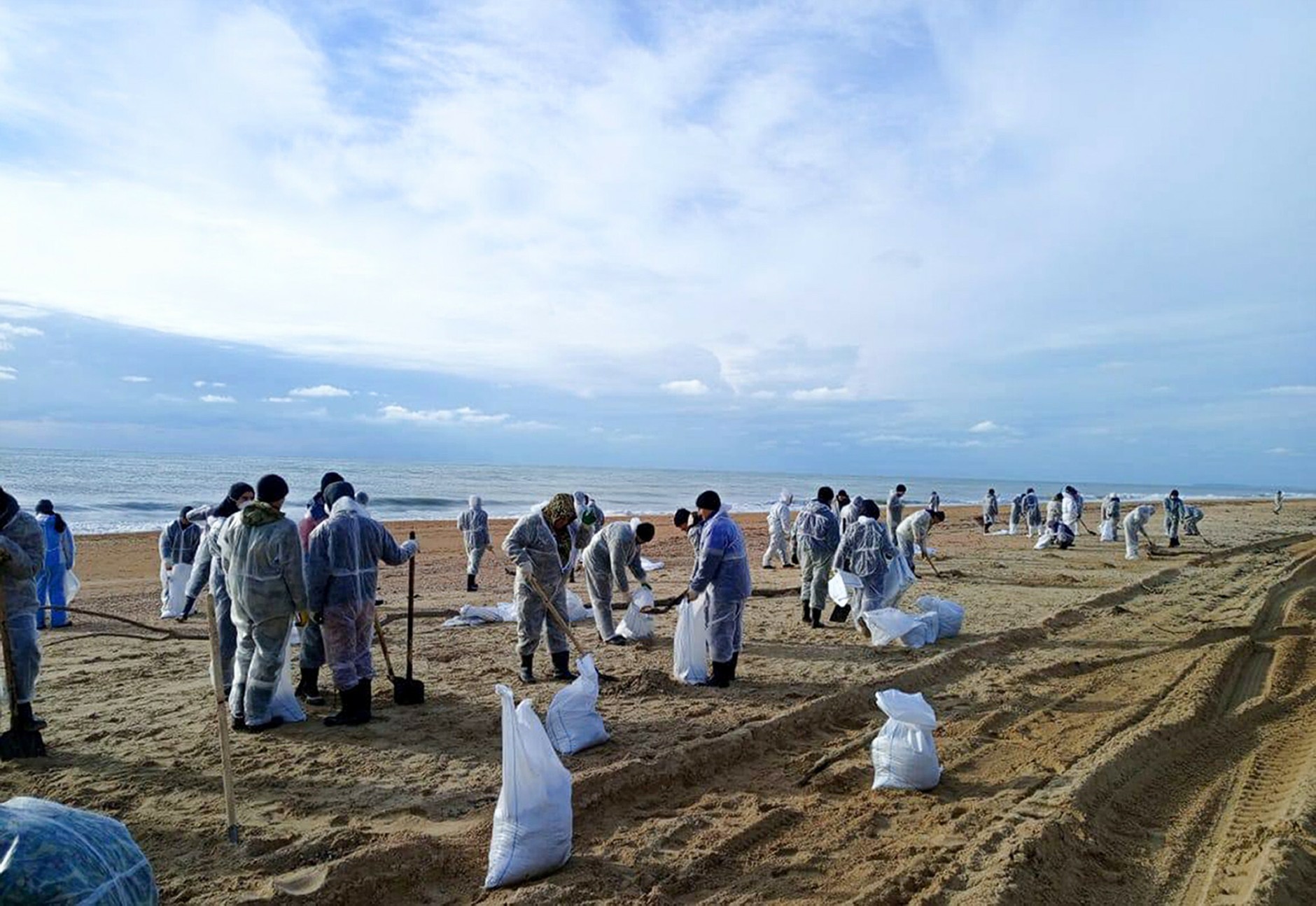
Work on the beach in Anapa, January 2025Associated Press/EastNews
Satisfaction of Russian officials
“The data showed significant fluctuations in the concentration of petroleum hydrocarbons in water. However, peak pollution values, many times exceeding the norm, were expected and were recorded immediately after the tanker disasters. Interestingly, after the 2024 disaster, such a summer increase in pollution was not recorded in 2025. On the contrary, one of the lowest pollution levels was recorded in all 18 years of observations,” reads the scientists' release.
Data satisfactory to officials were included in the draft final report of the Ministry of Environment on the state of the natural environment in Russia in 2024. The authors of the document claimed that the Black Sea had become cleaner than in previous years. “Coastal water measurements show improvements in water quality in the Anapa, Novorossiysk, Gelendzhik and Tuapse regions over the past few years,” the report said.
However, these promising data seemed insufficient to the authors of the document, so they decided to dispel any doubts about their conclusions. The report makes no mention of the Kerch Strait disaster.
Only after the experts of the Public Chamber drew attention to the lack of information, the press service assured that it would add this data, although initially it intended to include information about the pre-New Year's disaster in the report for 2025.
Perhaps the Department of Environmental Protection is hoping for raising sunken tankers with fuel oil, which will put an end to oil pollution. At the end of 2024, state experts promised a super-operation to block leaks on the seabed and then raise the ships. However, no changes have occurred so far. Oil continues to leak from tanks and Anapa residents are demanding progress in the rescue operation.
According to an expert familiar with environmental monitoring in Russia, who wished to remain anonymous, State authorities have not acted on the side of society for a long time: water samples can be taken in such a way and at such a place that they demonstrate the cleanliness of the environment. That is why in 2018–2020, many citizen environmental cleanliness measurement projects appeared in the country. They mainly concerned air cleanliness: for example, activists in Chelyabinsk and Krasnoyarsk raised money for measuring instruments in order to present the measurement results to the authorities and demand changes.
In the case of water, the situation is more complicated: for now, activists most often call on independent laboratories to conduct tests. However, in Anapa it is not that simple. According to our sources people are detained on charges of exporting soil and water samples. Moreover, laboratories refuse to conduct tests for fear of persecution by the authorities.
The impact of war on ecology
Another comical (if not for the context of war) situation took place on November 2. At night in the port of Tuapse, fragments of downed Ukrainian drones fell on a tanker carrying oil. Then, the region's operational staff reported damage to two foreign civilian ships.
Around the same time, a video of it surfaced petroleum products in water in the Tuapse area. Satellites also recorded oil slicks in the port. One of the photos from November 2 shows a stain stretching from the quay for 3.8 km to the southwest. Another photo from November 3 shows that the oil layer most likely spread over an area of approximately 120 square kilometers.
However, Tuapse port workers did not detect any pollution in coastal waters. Apparently it won't even get to analysis. Tuapse leader Sergei Baika quickly declared: the satellites were wrong – there is no pollution.
On October 21, the head of Rosprinadzor, Svetlana Radionova, assured President Vladimir Putin that information from satellites is always confirmed. On this basis, the official proposed the introduction changes in legislationfor satellite images to be accepted as evidence in court. Currently, only eyewitness testimony can confirm contamination. Judging by the public statements of witnesses in Tuapse, they see worse than satellites, even though they have a direct picture of the situation in front of them.
All three cases talk about two things: the negative impact of the war on ecology and biased monitoring of ecology in Russia. It seems that even hostilities may end one day, but the authorities will not stop lying about the state of the natural environment.