The impressive story of the child who died for Romania. How did a 12 -year -old girl manage to contribute to the most important victory of the First World War


The youngest Romanian hero of the First World War was a girl of only 12 years. It was named Maria Zaharia and died during the battle in Mărășești. Her special story inspired historical literature and cinema.
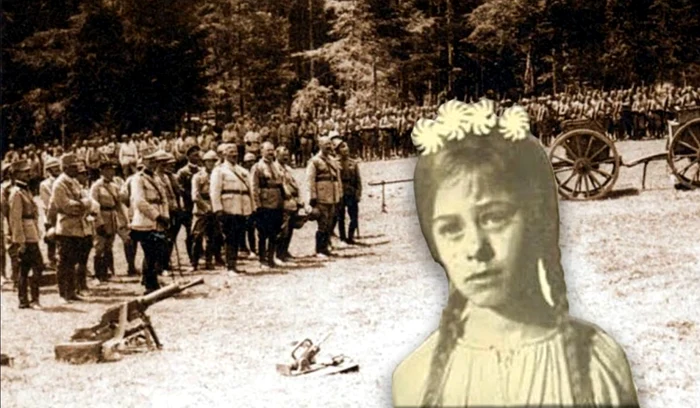
Maria Zaharia Photo Click
The First World War represented for Romanians a lesson of humility and one of heroism. On the one hand, the Romanian army was effectively humiliated in 1916, being shattered by German troops. On the other hand, especially in 1917, the Romanians became famous in the international press through the moments of heroism and the extraordinary victories against the enemy armies. Among these heroes were men and women, but also children. Perhaps the most tragic and excited is the story of Maria Zaharia, a 12-year-old child who has lost her life in the battle of Mărășești. He is the youngest hero of the Romanian army in the First World War, unfairly forgotten, especially in the last decades.
A summer of revenge
Romania entered the First World War in the summer of 1916, after two years of neutrality. Although they had King Neamț, the Romanians preferred to enter the Antante camp and fight against the Austro-Hungarian, German, Bulgarian and Turkish armies. The objective was clear: obtaining Transylvania and Bukovina. The Romanians had to cope, with Russian support, on a 1300 -kilometer front, larger than the west, comparable to the entire Russian front. In addition, the equipment of the army was made in a beating, the armament being an opportunity to spend the public money and the loans contracted in this regard on all kinds of sinecles, arrangements and preferential contracts. This is why the soldiers arrive on the front in 1916 with weapons that do not shoot, boots to which the sole was detached, without appropriate sanitary materials and with a poor food supply.
According to the victorious offensive in Transylvania, the Romanian army is defeated in Turtucaia, in the south and then suffered a strong German counterattack in the western area. In just a few months, the Romanian army is shattered and Bucharest is occupied by German troops. The year 1916 ended with a real disaster for the Romanian army. The government, the king, officials and a large refugee have come to crowd in Moldova. At the beginning of 1917, the German army was preparing to take over Moldova. In order to survive, great efforts to modernize and endow the army, to which General Berthelot's French mission also contributed. This French mission equipped the Romanian army with modern armament, especially machine guns, but also contributed to the better training of the soldiers. In addition, King Ferdinand raised the morale of the Romanian soldiers, most peasants, promising them. Some historians say it was a key moment. With a well-developed plan of General Eremia Grigorescu, the Romanian army started the fight for the survival of Romania, on the line from Mărăşti-Mărăşeşti and Oituz. The purpose was to stop the German offensive and pushing the enemy back.
The most important battle in the summer of 1917 was the one from Mărăşeşti, being preceded by other well -planned military confrontations and maneuvers. The main blow was to be held in the Nămoloasa sector, in the General Directorate of Râmnicu Sărat. It had to be preceded by another secondary blow given to the flank as given by the Romanian Army led by General Alexandru Averescu. In their turn, the central powers make a maneuver in external directions organized in the north and south of Moldova meant to lead to the complete occupation of Romania and the penetration in the cereal regions of the Black Sea, Russia and Ukraine. The first confrontation took place in Mărăşti between July 11 and 19, 1917. The second army of the Romanian commanded by General Averescu managed to shatter for the first time the myth of German invitation and pushed the German commanders by the renowned Mackensen, managing the release of 600 square kilometers. After Mărăşti, the Germans gave up the Nămoloasa sector and decided the general offensive in the Oituz and Mărăşeşti area, north of Focşani. The decisive clash from Mărăşeşti followed, the biggest battle that the Romanians gave in the First World War. The operations from Mărăşeşti took place in three stages, from July 24 to August 21, 1917.
The observation post from the grandfather's orchard. The summer of the heroes
The battles from Mărăști, Mărășești and Oituz were a series of confrontations that defined a true summer of the heroes in the history of Romanians. The Romanian soldiers, most of them recruited from the villages of Moldova and Wallachia, impressed a whole Europe through their heroism. Not infrequently, they have performed almost impossible missions, such as the assault of the “White Shirts”, of the soldiers in Battalion 3 of the 32nd Regiment “Mircea”. They attacked the German positions, equipped with machine guns, only in the shirt, to be able to run easier, and to the bayonet, succeeding a story victory. Heroes like Major Ignat or Ecaterina Teodoroiu are already well known.
“The defense of the front from Mărăşeşti was the brightest act of weapons ever performed by Romanians”titled the newspaper “Time” in the summer of 1917. During this period of heavy and heroism struggles, the story of the youngest Romanian hero of the First World War was written. It is about Maria Zaharia, a child of only 12 years, born in 1905, in the village of Pădureni, near the town of Mărășești. However, her story and the great war begins in the village of Haret, in 1917. Măriuca, as she was encouraged by the acquaintances, stood at her grandfather Ion Zaharia. It had a beautiful orchard that stretched on a nearby hill and offered an impressive panorama. With the beginning of the offensive from Mărășești, Santa Zaharia dug a tranche near the orchard, where he was hiding with Măriuca when the German bombing began.
On August 5, 1917, the battle of Mărășești was in all, entering its decisive phase. At the dawn of the day the German artillery began to hit the trenches of the Romanian army located on the south – east of Mărășești and Modruzeni, at Haret's rateș, near the Răzoare Forest. Under the protection of the artillery dam, the German troops gave a general assault on the Romanian lines. In order to stand this jure, the Romanian artillery batteries, installed on the east bank of Siret opened the fire. The fire of the artillery was coordinated on the basis of the information provided by two Romanian soldiers who made an improvised observer in the walnut, or the oak after other sources, from the orchard of Moș Zaharia. One of the soldiers reported the movements of the German troops, and the second, with a campaign phone, sheltered at the base of the tree, reports targets, troop movements and enemy's position. All day it rained with howitzers on the Haret hills. At one point, the soldier-observatory in the walnut is shot down.
Măriuca, the girl who faced death
At that moment, the observation post was compromised. But Măriuca appeared. Ioan Zaharia's granddaughter stood long near the soldiers. It is said to bring water, mouth and like to hear what communicates to the superiors by phone, even if it was an area of death. After the observer was shot down, with great courage, Măriuca took the binoculars and climbed to the top of the tree. From there he transmitted precisely all the movements of enemy troops.
He knew very quickly everything the telephoneist asked to observe and managed to do a great job. Many precise strokes of the Romanian artillery were due to the information transmitted by Măriuca. But the fateful moment came. A howitzer explodes a few meters from the observation tree. The skis thrown at a dizzying speed took the life of Măriuca and the telephoneist. For his heroism, the body of Maria Zaharia was deposited in the Mausoleum from Mărășești, along with the other Romanian heroes from the First World War.