Russia's desire to create a world after American domination is today being put to the greatest test in the Western Hemisphere.
It is here – far from Moscow's immediate neighborhood – that the United States is using decisive, dynamic power projection to regain its declining and increasingly contested influence, forcing Latin America to choose between the West and the rest of the world.
After losing the competition to Brazil under Lula's leadership, but notable successes in Venezuela, Mexico and Ecuador, US President Donald Trump and Secretary of State Marco Rubio are now planning to take over Cuba.
If they manage to end the Cuban revolutionary experiment, the main burden of consequences will fall on the Moscow-Beijing axis. And then the dominoes can move further than just the Caribbean.
Signals intelligence, military, strategic projection and sugar – this is what Moscow has mainly gained thanks to Havana, since President Vladimir Putin decided that renewing the old Cuban-Soviet friendship should become one of the state's priorities.
This decision was made at the end of 2000, when relations between Russia and the US were still far from tense. It was then that Putin visited the Caribbean, met with Fidel Castro and laid the foundations for a comprehensive partnership that continues to this day.
Cuban President Fidel Castro talks with Russian President Vladimir Putin during a welcome ceremony at the Cuban International Airport. Jose Marti in Havana, Cuba, December 13, 2000.Jorge Rey / Stringer / Getty Images
Cuba and Russia exchanged experiences, supported each other, restored old, beloved mechanisms of cooperation – such as Soviet barter agreements – and prevented the American blockade from leading to regime change.
Over the years, Putin's Russia has become Cuba's most important “lifeline”, regularly supplying food, fuel, basic goods and medical equipment and supplies, as well as providing financial support and helping to circumvent sanctions.
The Kremlin pays, the Kremlin benefits
Since Putin's decision to write off as much as 90 percent. Cuba's debt to Russia in 2014 to massive humanitarian aid during the COVID-19 pandemic — when the Kremlin sent more than 250 tons of food and medical equipment to the island — Cuba clearly benefited from this cooperation with its former ally.
In turn, Russia gained access to exclusive investment agreements in Cuba's traditionally closed economy. Russian energy and mining companies have gained privileged access to some of the world's largest nickel and cobalt deposits. Cuba extracted raw materials, Russia sold them. Together they mitigated the effects of the blockade by planning Russian investments in the country's development at the level of USD 1 billion. (approx. PLN 3,600 million) by 2030
After the events related to the Ukrainian revolution, the importance of Cuba for Russia increased even more.
The Kremlin stopped seeing the island as a relic of the Cold War that should be supported only out of sentiment, and began to treat it as a listening post right at the edge of US influence.
Between 2014 and 2018, Russia re-activated its largest signals intelligence station in the Americas, the 5,000-square-meter Lourdes complex, located near Havana, capable of monitoring much of the Gulf of Mexico region.
Shortly after the invasion of Ukraine in 2022, Cuba supported Russia by providing – according to various estimates – from 5,000 to 25,000. fighters. However, the Cuban authorities emphasized that these people left for financial reasons and were not part of the state's mercenary activities.
From intelligence gathering, to military support, to resource exploitation – Cuba has proven to be a loyal ally, a valuable asset and a good investment for Russia. Therefore, in the face of mounting pressure from Washington, which has already weakened entities such as the government in Venezuela and the Hong Kong-controlled entrances to the Panama Canal, Putin sees an urgent need to prevent a “takeover” of Cuba – to use Trump's own words.
Kuba between a rock and a hard place
After Nicolas Maduro was removed from power in early January, Washington and Moscow began a tug-of-war over Cuba. The United States is trying to stoke civil unrest with an unprecedentedly harsh blockade, while Russia opposes America's ambitions to dominate the Western Hemisphere by sending fuel tankers to a fuel-scarce island.
The stakes are huge. Russia cannot afford to lose another ally – this would be a serious blow to its image as a defender of the Global South, with consequences for its ability to build international support and persuade undecided states. The latest US National Security Strategy clearly indicates that Trump intends to “cleanse” the Western Hemisphere of hostile foreign influence by the late 2020s or early 2030s – meaning that all obstacles are to be removed sooner or later.
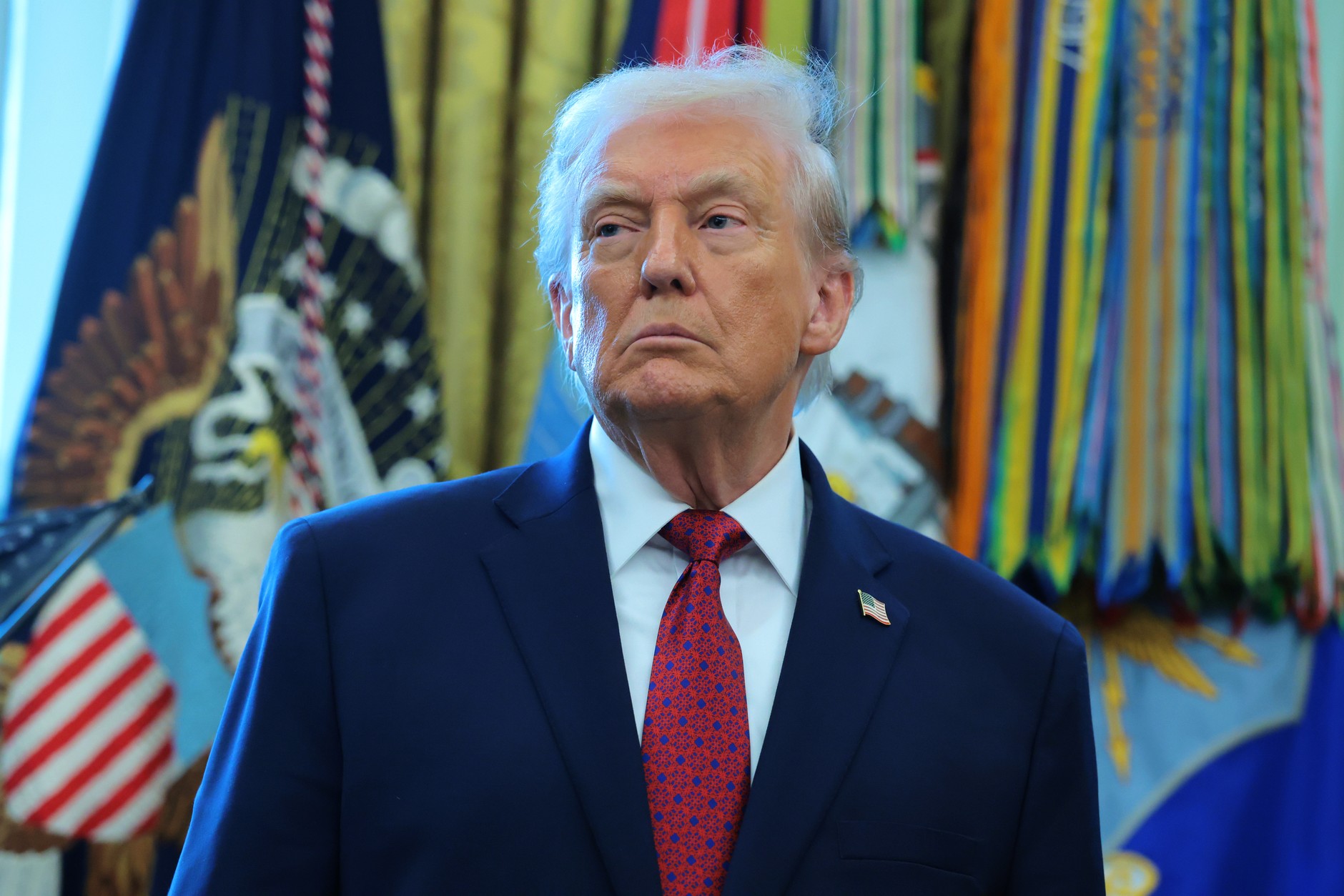
President of the United States Donald TrumpANNA MONEYMAKER / Getty Images
In turn, Russia's goal in the Americas is to create dual-use bridgeheads that will allow it to negotiate with the United States on almost equal terms regarding spheres of influence. Cuba played this role throughout the Cold War, helping the Soviet Union prevent the deployment of key American military installations near its borders.
Putin – mentally shaped by the realities of the Cold War – has most likely always looked at Cuba through the prism of the experiences of his Soviet predecessors, supporting it in the face of the embargo with a view to using its potential at the right moment.
A great test of strength
Trump has already shown that the US naval presence in the Caribbean is not purely symbolic. In early January, he ordered the interception of a Russian-flagged ship carrying Venezuelan oil after it crossed the Atlantic.
He believed that it had thus set a strong precedent and an effective deterrent against future challenges to the “Donroe Doctrine”.
The article continues below the video
However, this did not bring the expected results. Two months later, the Sea Horse tanker managed to deliver fuel to Cuba using a series of stealth maneuvers — from turning off its transponder to unusual routes — demonstrating how to bypass a naval blockade created by Trump to protect “Fortress America.”
However, a few tankers will not solve Cuba's energy crisis or change the fact that this time the White House is serious about changing the political system on the island.
Trump wants to deprive Russia and China of a strategic point located just an hour's flight from Florida; Marco Rubio wants to make history before running for president. Will Russia show as strong determination as the United States? This remains to be seen.
I’m Ashley Davis as an editor, I’m committed to upholding the highest standards of integrity and accuracy in every piece we publish. My work is driven by curiosity, a passion for truth, and a belief that journalism plays a crucial role in shaping public discourse. I strive to tell stories that not only inform but also inspire action and conversation.