Hungarian press: “Ursula von der Leyen makes Romania great – what happened is unprecedented”


The media from Hungary recently reported on Romania's economic evolution, with an emphasis on the accelerated pace of European funds that have arrived in our country in recent months, citing statements by the Minister of Investments and European Projects, Dragoș Pîslaru.
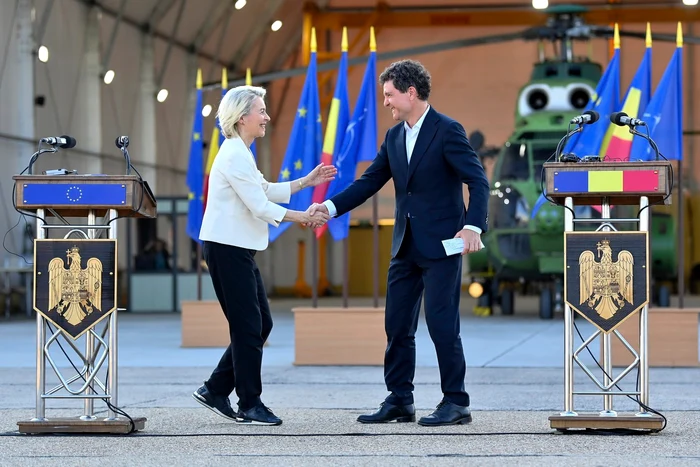
The President of the European Commission, Ursula von der Leyen, with Nicușor Dan PHOTO Profimedia
In an article with a suggestive title – “Something has changed: Ursula von der Leyen and her team are making Romania great, billions of euros have been transferred to them – what happened is unprecedented” – the Hungarian publication vg.hu notes that the flow of European money to Romania has significantly intensified in a short period of time.
Hungarian journalists refer to a post published on Facebook by Minister Pîslaru, in which he shows that the rate of absorption of European funds, calculated on the basis of payment requests sent to the European Commission, increased from 9.9% to 20.4%, which basically represents a doubling of the use of available funds.
According to the minister, the amounts actually reimbursed to Romania also registered a considerable advance. After approximately 2.9 billion euros received in previous years, another 2.3 billion euros entered the state treasury in just six months.
The article also emphasizes the difference in pace: if in the period from 2021 to the middle of 2025 Romania received, on average, 86 million euros per month, in the last six months the average monthly value of reimbursements exceeded 450 million euros, which means an increase of almost seven times.
Dragoș Pîslaru explained that, although the last six months represent only a tenth of the 2021-2027 budget period, in this interval 37% of the total payments and 43% of the reimbursements received so far from the European Commission were made.
The minister emphasized the essential role of European funds in reducing the budget deficit, stating that the objective of the authorities is to attract more than five billion euros from the cohesion funds until 2026. In parallel, preparations have already begun for the next financial year, related to the period 2028-2034.
Regarding the National Recovery and Resilience Plan (PNRR), Pîslaru recalled that, in mid-2025, its implementation was blocked, and the European Commission had suspended several payments. However, the situation has changed in recent months, after the renegotiation of the plan with Brussels and the increase in the level of transparency, which allowed the absorption of about a third of the funds attracted so far through the EU's recovery mechanism.
For the year 2026, the Ministry of Investments and European Projects aims to attract ten billion euros from the European recovery funds. In total, the authorities estimate that at least 15 billion euros of EU funds will be directed to investments in key areas such as health, education, transport infrastructure and increasing economic competitiveness.