According to recent data from the Central Statistical Office (GUS), the average salary in Poland rose by 5.9% in September, reaching 9,300 PLN gross. However, the impact of inflation, which stood at 4.1% year-on-year, means that the purchasing power of these increased salaries has only improved by 1.7%. It’s also worth noting that the average figure includes the higher salaries of managers, skewing the overall average. Not all companies offer such salaries.
This report focuses on the firms that most significantly influence the national average salary and examines which companies face challenges in increasing wages due to their high labor costs. Only Polish companies are considered, meaning calculations for Orlen pertain to its operations within the country.
Orlen Tops Salary Rankings
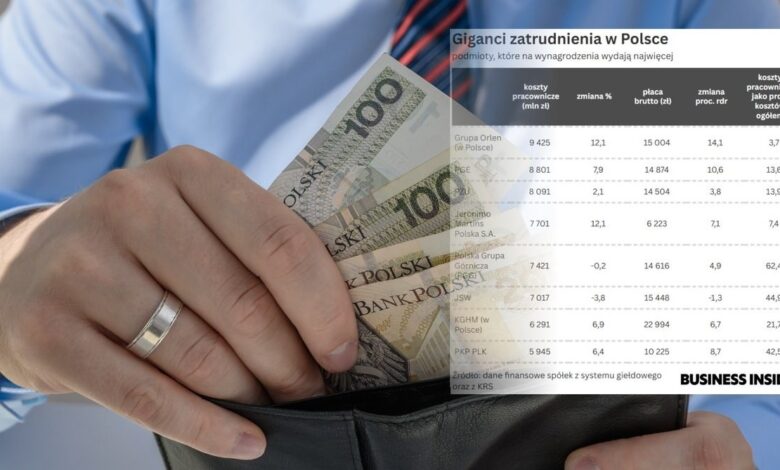
Grupa Orlen stands out as the leading employer regarding employee compensation, having spent 9.4 billion PLN on salaries for its 42,000 employees in Poland last year, which is a 12.1% increase compared to the previous year. Employee costs represent only 3.7% of the group’s total expenses, indicating that the rise in salaries has not significantly affected its profitability. More critical factors for Orlen include crude oil prices, refinery margins, and retail margins.
PGE and PZU follow Orlen as the second and third largest payers, with the first private company, Jeronimo Martins Polska, owner of the Biedronka chain, coming in fourth. Among the top 20 firms, only six are privately owned.
In addition to leading in total salary expenditures, Grupa Orlen has also increased its payroll budget by over a billion PLN (+12.1% year-on-year). Jeronimo Martins follows closely, allocating an additional 833 million PLN for salaries (+12.1%), while PGE has raised its employee expenditure by 643 million PLN year-on-year (+7.9%).
Companies Struggling to Raise Wages
The aforementioned companies find it relatively easier to increase employee salaries due to their low labor costs as a percentage of total expenses. For example, at Orlen, salaries account for only 3.7% of overall costs. In contrast, firms facing greater challenges in raising wages include those where labor costs represent a larger proportion of overall expenses, such as the IT sector and companies like Polska Grupa Górnicza, Poczta Polska, and the hotel group Essendi (formerly Orbis).
Interestingly, some companies report that employee costs consume less than 1% of their total costs, such as trading firms, where profits are made from the difference between purchase and sale prices. For instance, BMW Vertriebs GmbH spends only 0.2% of its costs on employees, despite generating 8.7 billion PLN in revenue last year, yielding a net profit of 263 million PLN.
Similarly, both Toyota Central Europe and Orlen Paliwa allocate 0.3% of their total expenses to salaries, with Mercedes-Benz Polska at 0.4% and Aramco Fuels Poland at 0.6%. These companies tend not to impose strict salary budget limits, resulting in average salaries at Toyota and Aramco significantly exceeding 20,000 PLN gross per month, while Mercedes and BMW employees earn above 15,000 PLN, well above the national average.