The agricultural species that passed the tests of late frosts, heat and flood. “We have almost the same production as last year”


In the place where species, varieties and hybrids of plants resistant to drought and less demanding on soil fertility are researched, a species that could bring great profit was successfully tested. It bore fruit without treatments and has weathered this year's weather well.
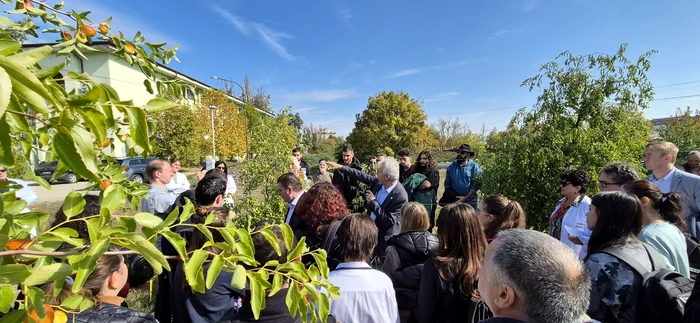
Dozens of students visited the resort and analyzed the cultures PHOTO: Dăbuleni Resort website
At the Plant Culture Research Station on the Dăbuleni Sands, where tens or even hundreds of species, varieties and hybrids of plants that can be adapted to the sandy soil and dry and particularly torrid summers are tested, one species has definitely stood out this year: the Chinese persimmon (ziziphus jujuba).
A clarification must be made at the outset: we are not talking about the dates that we often find in the supermarket, usually dehydrated, which are of the Phoenix dactylifera species, originating from the Middle East and the south-western areas of Asia, but of Ziziphus jujuba, also known in Romania as the Dobrogean olive. The fruits have a sweet, to sweet-sour taste, and the dried fruits can have notes of chocolate. Those who tried them declared themselves delighted with the taste, the Research Station currently offering jujube fruits at the price of 40 lei/kg.
The joy of the researchers is that they were able to present a firm conclusion this year: the species is suitable for the increasingly colder conditions of the “Sahara Oltenia”, this year facing both the late spring frosts and the heat that lasted until the beginning of autumn, followed by heavy rains that have not been recorded in the Dăbuleni area for a very long time.
“It was a more special year, with certain challenges. (…) If the traditional species were affected by the March frost, which destroyed all or most of the flowers, the capacity of this species is that it blooms during two months. And we lost the first round of flowers, but the next rounds found favorable conditions and tied, and we have production almost the same as last year, when we did not have these episodes”explained engineer Aurelia Diaconu, the director of the research station in Dăbuleni, for “Adevărul”.
In October, instead, the flood came, with 180 liters/m2 of rainfall recorded in one week, surprising the jujubes in the fallow, about to ripen. Many of the fruits cracked, but the solution to avoid losses was to dehydrate the fruits.
“It was a weak point, but also a challenge for us, as researchers, to adapt. And we made decisions. Well, what's cracked, we dehydrate them and they are very good, we even tasted them at our demonstration that we had two days ago. Along the way, we will take measures to have a protection over the plants in October, so that it does not rain directly on the fruits and we face their cracking”, Deacon explained.
Resistant to diseases and pests and extreme temperatures
The research station in Dăbuleni has been studying the Chinese persimmon since 2018. In the three years since the trees began to bear fruit, many of the farmers in the area had the opportunity to taste the fruits, to ask the researchers how they behave in the conditions of the area, and the most daring began to cultivate.
“We do not have very large areas, because first of all our role is research, to study feasibility, to disseminate to farmers in the area. The fact that we find a zizipfus jujuba tree in many yards, in many gardens, is a win. This is where the dissemination starts, because they taste them, they are delighted, they ask for more trees and after that the business ideas come to them”Deacon showed.
Investing in such a culture requires some funds, but it is a long-term one. Farmers in the area have a tough decision to make in the coming years anyway, because the species they have cultivated and still cultivate, at least the spring ones in the big crop, bring them more losses. Whether it will be fruit growing or whether they will turn to the vegetable species that the researchers also tested is up to them.
“If for 2-3 years the spring crops are a calamity in the proportion of 70-80% in this area, we could very well rethink the crops, stop planting corn, because anyway it is not the corn area, the corn does not bind anymore, let's plant other crops, such as sweet potato, zizipfus jujuba, peanuts, beans (in which case and under these conditions the pollen survives and bind, compared to beans or peas)”says Eng. Diaconu.
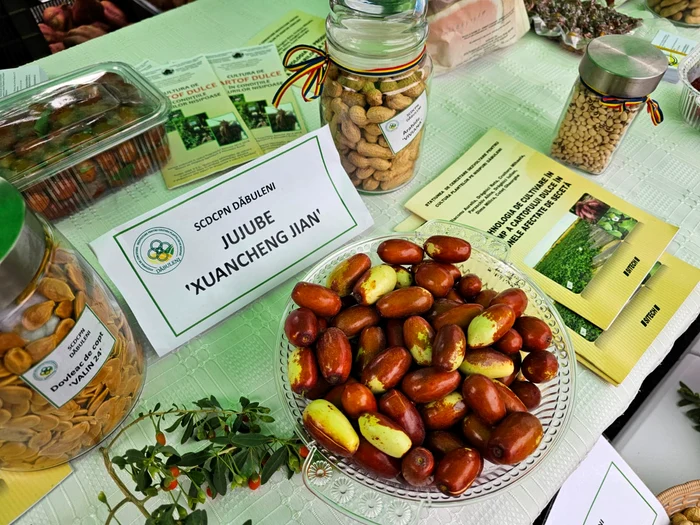
The jujubes sold well at the fair in Bucharest PHOTO: Dăbuleni Resort website
The researchers were able to see that jujubes have profit potential when they presented them at an exhibition for sale in the Capital.
“It was very good, I finished them, if I had any more, I would have sold them, but at that time they were not all ripe. I had only one variety then, now the others are ripe as well. I also had dehydrated and drained ones at the fair and they were also appreciated. They are very good, they are natural. I must mention that I did not spray these jujubes with anything at all because it was not necessary. They behave very well, they have a leaf that exudes health and it is seen that he doesn't have any kind of problem. The stomata do not close even at 40 degrees plus, at 42 degrees the stomata assimilate, photosynthesis does not stop, which is a real gain for the southern area”Aurelia Diaconu brought other arguments in favor of Chinese date cultivation.
Another plus of jujubes, compared to other crops that would also require investment in special storage facilities or processing facilities, is that they are not easily perishable. They can be kept at temperatures of 2-4 degrees, in a fresh state, even for a month, without problems.
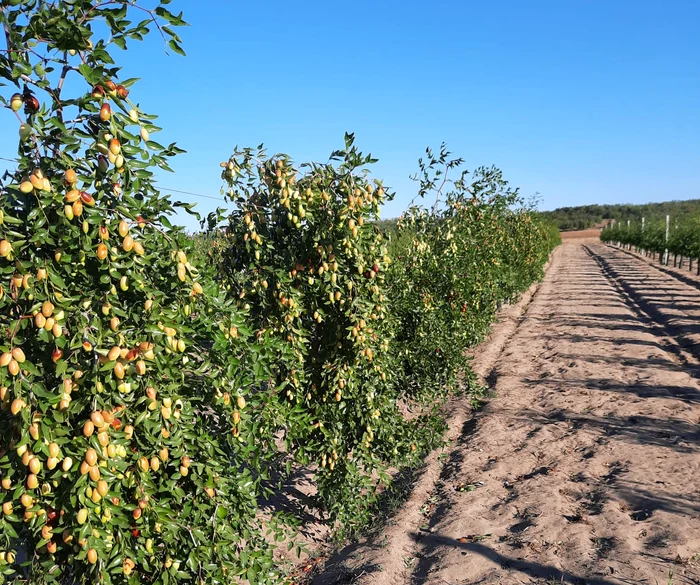
Field culture of Ziziphus jujuba at SCDCPN Dăbuleni, on beach-like sand. PHOTO: A. Diaconu
The production is very good, the quality as well, and the plant withstands frosts of minus 40 degrees Celsius, but also temperatures of 50 degrees, as mentioned in the specialized literature.
The species has a very long life span, its potential being hundreds of years. In addition, it has the advantage of improving the quality of the soil, or for the sandy soils of southern Oltenia this aspect is a godsend.
“It dragonizes a lot, that is, other dragons leave from its root and can become trees and fix the sand. Through the roots that develop a lot around the tree, they help to fix the sand, which is a big deal. It is also a melliferous plant, it blooms for two months, and that means that all is not lost when there is an episode of high temperature during pollination. The pollen is very sensitive to dryness and we have a relatively low humidity, below its bearable average in certain periods, but it has the ability to recover through this quality to bloom. It blooms from June, July and even August, and in August we find even more flowers. And the harvesting is done gradually, they are baked gradually”, Deacon also specified.
“It doesn't like the shade, it's a big heat-loving plant”
Another quality of the Chinese persimmon is that it has great ecological plasticity. It can be grown in sandy soils, but it will also bear fruit in mountainous areas, for example. “It has growth potential even in the mountainous area, provided it benefits from the sun. It doesn't like the shade. It's a plant that loves heat, the sun, a lot of light in particular. It also has the advantage of starting later in vegetation. (…) It has many advantages that make it slip among the disadvantages, and that's a big thing. That's why we focused more on it”added the directorate of the research station.
For those who are thinking of growing jujube for consumption, things are simple. If instead they want to turn it into a business, there are several aspects to consider. Equipment is needed, but also an already identified capitalization market, sales being today the biggest problem of small and medium-sized farmers.
Deliveries of planting material next spring
The research station in Dăbuleni will also prepare this winter for deliveries of planting material, because the interest is quite high. The orchards will be ready for planting next spring.
“People request quickly, or for these permanent plants, for trees, the procedure is not like for seeds. We made sure that in the spring we will deliver. The demand is there, and we, having many fields – and vegetables, and fruit trees, and vines – cannot cope as quickly as we would like. But from next year we will have planting material”, Deacon assured.
For the production of planting material, the efforts of the researchers take place over two years. First, the rootstock is produced from seeds, then grafts are harvested from the varieties available in the area (the resort has a collection of 17 varieties), this graft is prepared according to a certain technology, and finally the graft is combined with the rootstock.
Just a few days ago, approximately 60 students from the University of Agronomic Sciences and Veterinary Medicine (USAMV) Bucharest had the opportunity to participate in a debate with researchers and professors, the species under analysis being Ziziphus Jujuba.