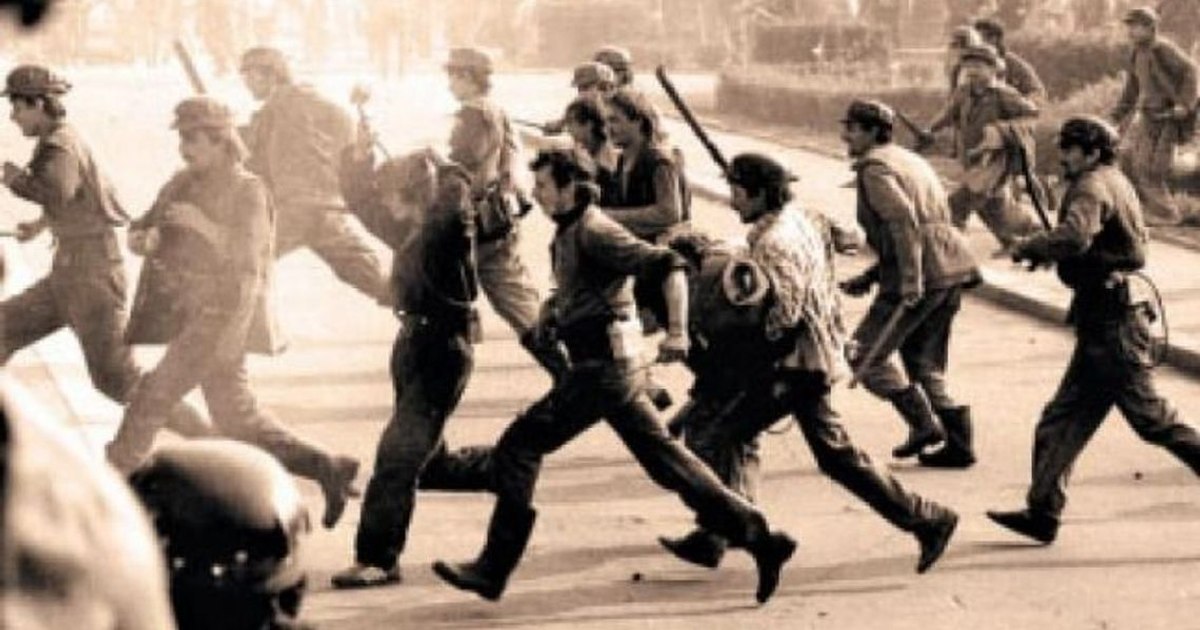
On June 13, 1990, the most violent mining raid in post-December Romania began, when the peaceful protests in University Square were brutally repressed, and the miners were brought to the Capital under the pretext of restoring order. Also on June 13, but in 1878, the debut of the Berlin Congress took place, and in 2019 the Mexican actress Edith Gonzalez died. On the same day, but in the year 2021, the American actor Ned Beatty died.
1641- The relics of Pious Parascheva were brought to Iasi
It is 382 years since the relics of St. Paraschiva were brought to Iasi. After the good-faith Mr. Vasile Lupu of Moldavia paid all the debts of the Patriarchate of Constantinople, its rulers at that time, Patriarch Partenie I, known as the Elder (1639-1644), together with the members of the Synod, decided to offer him, as gratitude, the relics of Pious Parascheva “for the sanctification and blessing of that place of Bogdanie” (Country of Moldova), as stated in “the synodical letter”.
The relics of Pious Parascheva
The casket with the holy relics was transported by ship on the Black Sea, accompanied by three Greek metropolitans (Ioannichius of Heraclea, Parthenius of Adrianople and Theophanes of Paleopatra). Arriving in Galaţi, then in Iaşi, on June 13, they were welcomed by Vasile Vodă Lupu, by Saint Metropolitan Varlaam and by the bishops of Roman and Husi, by clergy and believers
1930 – The government of Maniu II takes over
On June 13, 1930, Iuliu Maniu was appointed Prime Minister of Romania for the second time, in a tense moment, marked by the unexpected return to the country of Prince Carol and his ascension to the throne. This second Maniu government was formed in a complicated political context, in which King Carol II had returned from exile and had been proclaimed king in place of his minor son, Mihai.
The government was a transitional one, with a short duration (June 13 – October 8, 1930), and Maniu tried to maintain the balance between the interests of the king and those of the National-Peasant Party. Constant tensions between the prime minister and Charles II, particularly over the influence of the royal circle, eventually led to his resignation.
1941 – Massive deportations from Bessarabia and Northern Bucovina
On the night of June 12 to 13, 1941, the Soviet authorities launched a mass deportation operation of Romanians from Bessarabia and Northern Bucovina, territories annexed by the USSR in 1940. More than 31,000 people – intellectuals, officials, wealthy peasants or just considered hostile to the communist regime – were torn from their homes and sent to Siberia or Kazakhstan.
Transported in cattle cars, the deportees endured starvation, disease and forced labor under inhumane conditions. Many families were torn apart, and some of those deported never returned. These tragic events are part of the ethnic and social cleansing campaign orchestrated by Stalin in the occupied territories.
1952 – Historic flight without engine in Romania
On June 13, 1952, Gheorghe Cucu made the first long-distance gliding flight in Romania, without an engine, on the Cluj–Siliștea–Buzau route, covering 300 kilometers. The achievement was considered an important technical and human achievement for sports aviation in Romania.
The flight lasted over 6 hours and was made with a Romanian-built glider. Gheorghe Cucu thus became a pioneer of non-motorized flight in the country, contributing to the development of glider piloting schools and the promotion of Romanian sports aviation.
1878: Debut of the Berlin Congress
Held from June 13 to July 13, 1878, the purpose of the Congress of Berlin was to modify the provisions of the Treaty of San Stefano and to diminish Russian influence in the Balkans. The Congress was held following the conflict between the Tsarist and Ottoman Empires (1877-1878)
The Berlin Congress was presided over by the Chancellor of Prussia, Otto von Bismark. The Romanian delegation was led by Prime Minister IC Brătianu and Mihail Kogălniceanu. The Romanians requested recognition of independence and territorial integrity and war reparations.
Later, on July 1, 1878, the Berlin Peace Treaty was signed.
1978: Nicolae Ceaușescu's visit to the United Kingdom
Queen Elizabeth and Nicolae Ceaușescu. Photo: Shutterstock (Archive)
More than four decades ago, the most powerful monarchy in the world rolled out the red carpet to the Romanian dictators Nicolae and Elena Ceauşescu on the occasion of the visit made between June 13-16, 1978.
What's more, the late Queen Elizabeth II took Nicolae Ceauşescu for a carriage ride.
1959: The former president of Romania, Klaus Iohannis, was born
Klaus Iohannis was born in 1959. Photo: Archive
June 7: The day when the athlete Iolanda Balaș set the world record in the high jump
Born in Sibiu, Klaus Werner Iohannis attended the Faculty of Physics at “Babeș Bolyai” University in Cluj-Napoca, according to presidency.ro. The former head of state was a physics teacher and school inspector before being elected mayor of Sibiu in 2000. Later, he was re-elected in 2004, 2008 and 2012.
In February 2013, he became a member of the National Liberal Party, and shortly after was elected first vice-president. Later, on June 28, 2014, he became the president of the political formation.
“President Klaus Iohannis has received numerous prestigious state honors and international awards for his contribution to the promotion of democratic values, transparency, the rule of law and the fight against corruption, such as the German Civic Award, conferred by the Civic Foundation Bad Harzburg (2023), the Franz Werfel Prize for Human Rights, conferred by the Center Against Deportations in Bonn, Germany (2023), the European Charles IV Prize of the German Federation Sudetenland for 2020 (awarded in 2022), “Charlemagne” prize of the city of Aachen (2020), “Otto the Great” prize of the city of Magdeburg (2020), European “Coudenhove – Kalergi” prize (European Coudenhove-Kalergi Society, 2020), “Franz Josef Strauss” prize (Hanns Seidel Foundation, 2018), “Light Unto the Nations” prize (American Jewish Committee, 2017) or the “Martin Buber” plaque (Euriade Foundation, 2016)“, according to presidency.ro.
1990 – Mineriada begins from June 13-15
On June 13, 1990, the authorities unleashed violent repression against the protesters in Bucharest's University Square, who were demonstrating peacefully against the regime led by Ion Iliescu. Law enforcement intervened in force, arresting hundreds of people, destroying the headquarters of independent organizations and newsrooms.
In the following days, thousands of miners from the Jiului Valley were brought to the Capital, under the pretext of restoring order. The June 1990 mine raid was the bloodiest of the three carried out that year, resulting in deaths, injuries and a serious deterioration of Romania's international image in the post-communist context.
2000 – Historic meeting between Korean leaders
On June 13, 2000, the first official meeting between North Korean leader Kim Jong-il and South Korean President Kim Dae-jung took place in Pyongyang. The event represented a historic moment for the Korean Peninsula, being the first summit between the two Koreas since the end of the Korean War (1953).
Discussions focused on reconciliation, economic cooperation and the possibility of reunification. The meeting led to the signing of a joint statement and was followed by several family reunions between relatives separated by the inter-Korean border. For his efforts, Kim Dae-jung received the Nobel Peace Prize that year.
2004 – A meteorite hit a house in New Zealand
On June 13, 2004, a meteorite weighing approximately 4 kilograms pierced the roof of a house in Ellerslie, a suburb of Auckland, New Zealand. The celestial body hit the sofa in the living room, a few meters away from the tenants who were in the house.
The meteorite fragment was about 10 centimeters in diameter and was found to be composed mainly of iron and nickel. Specialists confirmed its authenticity, and the event attracted the attention of the international media, being one of the few documented cases when a meteorite directly hit a house.
2019: Mexican actress Edith Gonzalez died
Edith Gonzalez was born on December 10, 1964. Photo: Archive
June 8: Prince Carol of Hohenzollern-Sigmaringen becomes king of Romania under the name Carol II
Born on December 10, 1964, in Ciudad de Mexico, Edith Gonzalez debuted in telenovelas from a young age, precisely from 4 years old. He met success at the age of 13, with the appearance in “Los ricos tambien lloran/And the rich cry”.
Later, he played in “Aventurera” (1998), “Love Wins”, “Salome” (2001), “Cursed Forest” (2004).
In 2016, the actress was diagnosed with ovarian cancer.
He also played in the movie “Deseo” and in the telenovelas “Dona Barbara” and “Cameleones”.
2021: American actor Ned Beatty died
Ned Beatty was born on July 6, 1937. Photo: Archive
Born on July 6, 1937, Ned Beatty made his screen debut in 1972, in the movie “Deliverance”. In 1977, he was nominated for an Oscar for his role in “Network”
He was nominated for an Emmy Award in 1979 for his role in the 1979 film Friendly Fire. His most acclaimed role on television was that of Detective Stanley Bolander in the drama “Homicide: Life on the Street” in the early 1990s.
From his filmography we mention: “All the President's Men”, “Radioland Murders” and “Shooter”.
2023: American author Cormac McCarthy died
Born on July 20, 1933, in Providence, Rhode Island, Cormac McCarthy's first novel, The Orchard Keeper, was published in 1965.
However, he found late success with his iconic novels such as “All the Pretty Horses” and “The Road”.
The American author has won several prestigious awards in the United States, including a Pulitzer in 2007 for “The Road” (2006), which narrates the wanderings of a father and a son in a country devastated by a cataclysm of unknown origin.
On the other hand, he did not win the Nobel Prize for Literature.
He died of natural causes.