Europe has just gone through one of the most spectacular months from a meteorological point of view. “It's not a momentary sensation.” In Romania, things looked different


At the European level, the spring of 2026 (March–May) was the third warmest in history, according to data from the Copernicus Climate Change Service. Last month started with extreme cold, but after May 20 it was an early heat wave in Central and Western Europe. In Romania, there were maximum temperatures of over 34 degrees Celsius.
“The month of May in Europe shows more and more clearly the effects of global warming: new regional temperature records and heat waves. It is not a momentary sensation. This pattern appears year after year in the observational data and is directly related to the increasing concentration of greenhouse gases. And the trend will be maintained as long as the concentrations of greenhouse gases continue to increase,” notes physicist Bogdan Antonescu, in an Infoclima.ro analysis.
- Antonescu is a researcher in the field of meteorology and climatology, a lecturer at the Faculty of Physics of the University of Bucharest and a researcher at the National Research – Development Institute for Earth Physics, with expertise in the study of severe storms and extreme meteorological phenomena in the context of climate change.
A month of strong contrasts
Last month was the second warmest month ever recorded globally, both on land and at the surface of the oceans, according to data from the Copernicus service, implemented by the European Center for Medium-Range Meteorological Forecasts (ECMWF).
From well below average temperatures to the strongest heat waves
Europe experienced a spectacular climate contrast in May, going in a short space from temperatures well below average for the period to one of the strongest heatwaves ever seen so early in the season, particularly in the west of the continent. France, the UK, Ireland and Portugal recorded record temperatures for May amid an exceptional heatwave, the analysis said.
In the second half of the month, Western Europe was hit by an unusually early and intense heat wave. Numerous temperature records for May were broken in France, the United Kingdom, Ireland and Portugal. The temperatures felt by the population frequently reached between 35°C and 40°C, levels associated with strong or very strong heat stress.
Specialists warn that this extremely rapid transition has amplified the impact on the population, agriculture and ecosystems. The sudden change in weather conditions left very little time for people, crops and vegetation in full growing season to adapt to the much higher temperatures.
Rain in the east, drought in the west and center
May also highlighted strong contrasts in the rainfall regime. While large areas of western, central and eastern Europe, including Italy and Spain, experienced drier than usual conditions, other regions were hit by heavy rainfall and flooding. Turkey, Bulgaria and the Republic of Moldova reported significant flooding episodes, and northwest continental Europe, northern Scandinavia, Finland, Turkey and the Black Sea region recorded rainfall amounts above the seasonal average.
The highest temperatures in Romania in May 2026
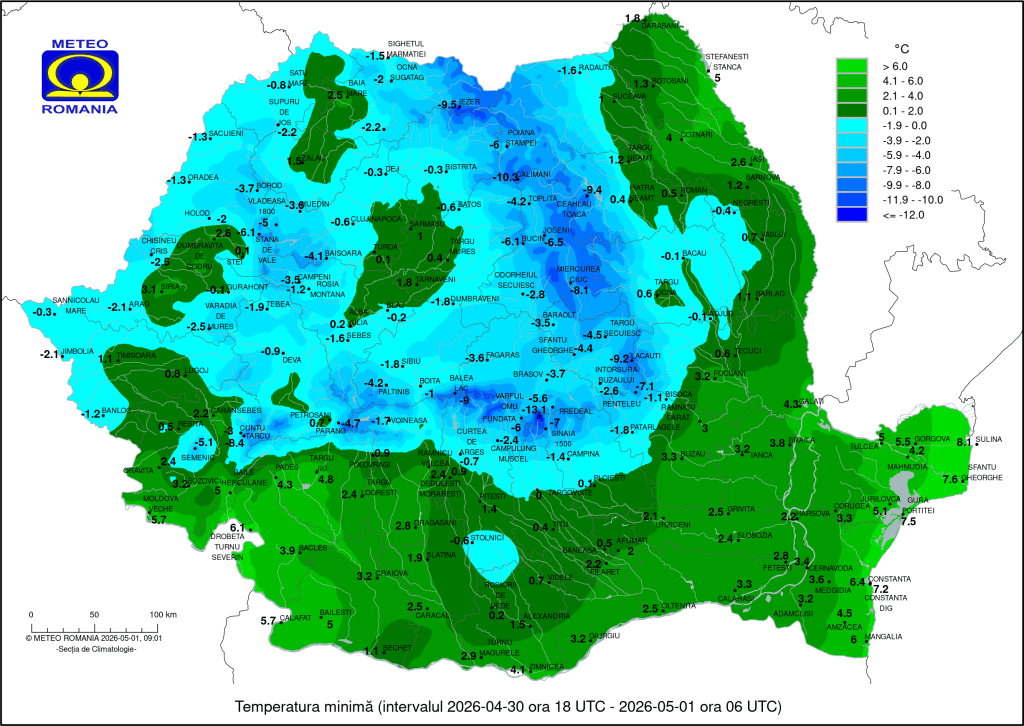
In Romania, the beginning of May was the coldest since weather records exist, with frost in all regions of the country and temperatures dropping to -8 degrees Celsius.
- Jimbolia: +34.1 C
- Caulk: +33.2 C
- Săcuieni: +33 C
(All recorded on May 27, source ANM)
The lowest temperatures in inhabited areas
- Wednesday Ciuc: -8.1 C
- Joseni: -6.5 C
- Stâna de Valea: 6.1 C
The month of May in Romania had an average temperature of 14.7 C at the level of the country, according to ANM data. The difference from the 30-year average was only a tenth of a degree.
The hottest place in the country in May 2026 was the city of Calafat, with an average of +18.5 C.
The warmest May on record was in 2003, with an average of 18C
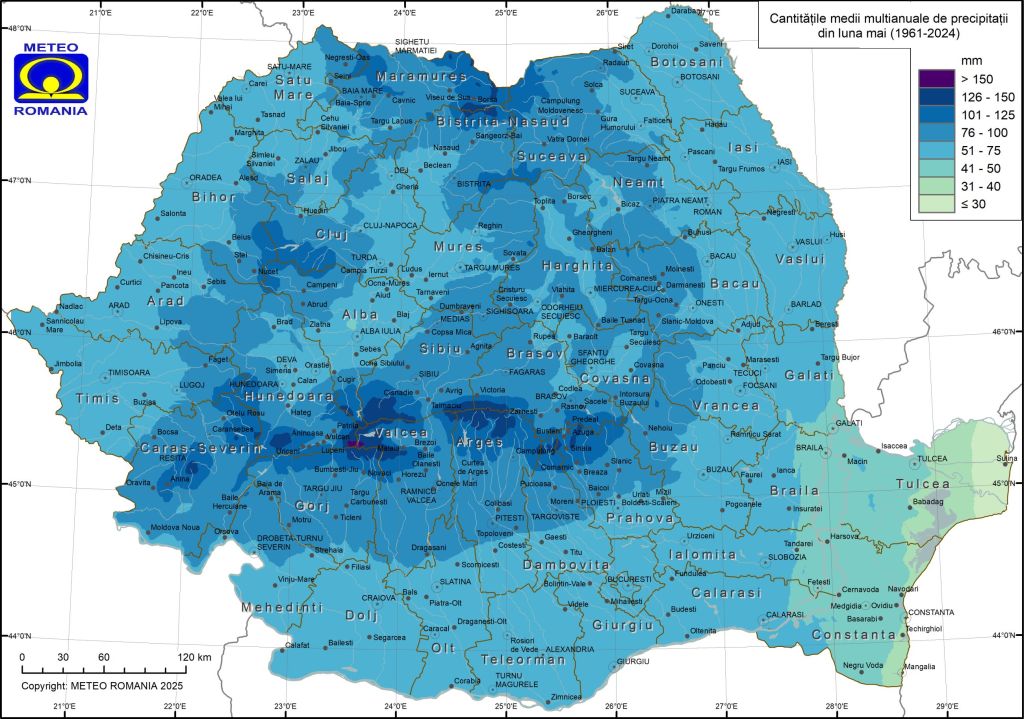
In total, it rained 14% less than the May average throughout the country, and the most rain fell at the Lăcăuți mountain weather station: 183 l/m2.
The oceans remain at exceptionally high temperatures
Infoclima.ro's analysis also shows that ocean surface temperatures have remained at almost record levels. The average sea surface temperature between latitudes 60°S and 60°N reached 20.90°C, the second highest on record for May, very close to the record of 20.93°C set in 2024.
Experts note that tropical Pacific water temperatures remain exceptionally high as the equatorial Pacific Ocean continues its transition to the El Niño phenomenon expected to develop in the coming months. Traditionally, El Niño is associated with an increase in global temperatures and the amplification of extreme weather events in many regions of the world.