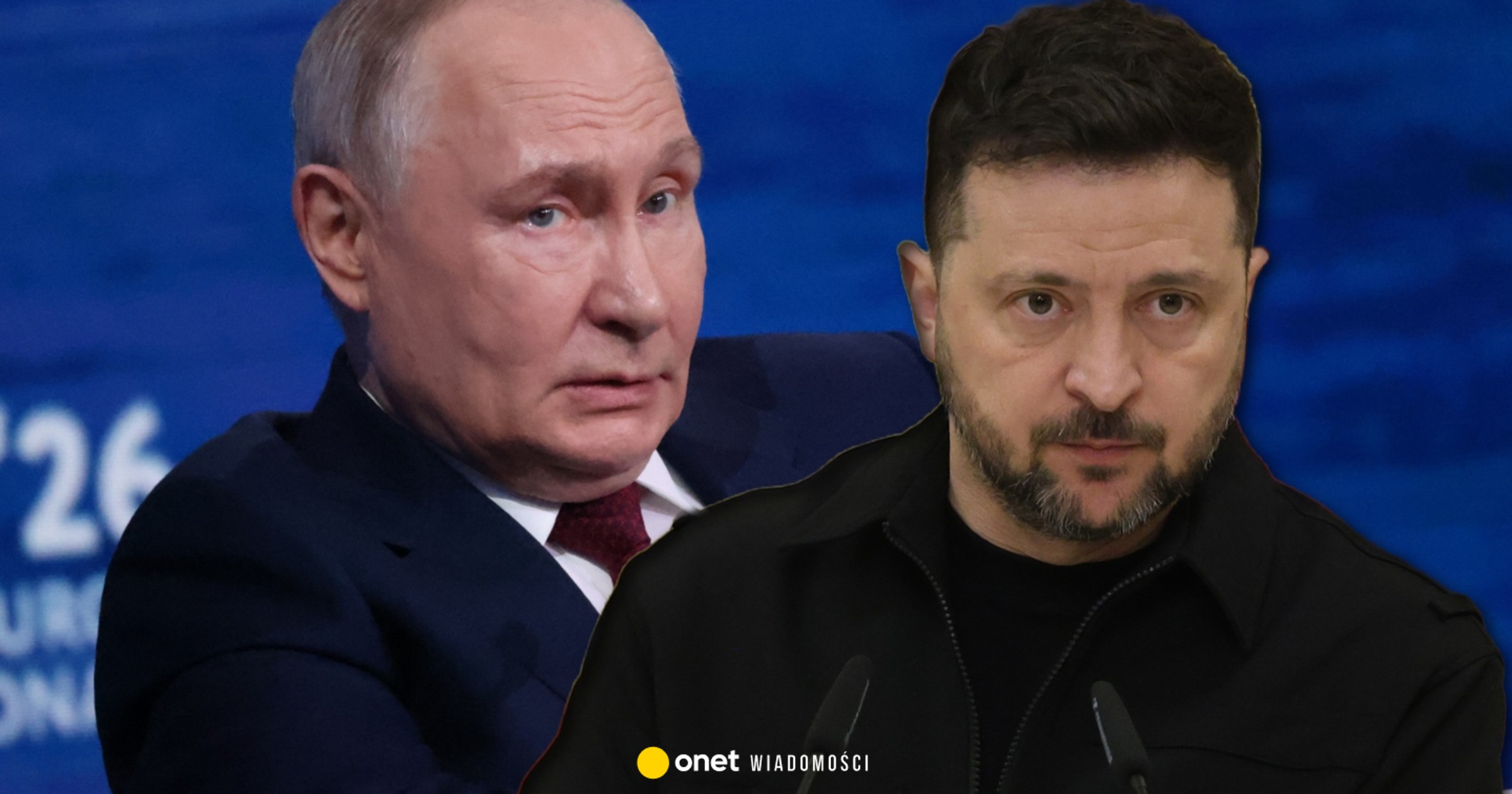
– For now, I don't see the point in it – this is how Vladimir Putin answered the question about whether he would meet with Volodymyr Zelensky. This is a response to the open letter of the President of Ukraine to the President of Russia.
“Now we all see that the Russians are finally starting to feel worse and worse in this reality – in the face of the fact that the war is bringing more and more negative consequences to Russia. They don't like the presence of our drones and missiles. They don't like the shortage of gasoline and constantly rising prices. They don't like the constant introduction of restrictions. They don't like your intention to start a second wave of mobilization in order to expand the war to other areas of Ukraine or use it against other countries neighboring Russia. They don't like the fact that there is no end in sight to this war,” Zelensky wrote in an open letter.
The President of Ukraine adds that his country will do everything to hasten the end of Putin's rule. He also cites data on the losses suffered by the Russians on the front in May. As he writes, over 30,000 people were killed or seriously injured last month. soldiers of the Russian dictator's army.
— President Zelensky's letter should not be interpreted as an attempt to reach an agreement at any cost or as a sign of weakness. The main goal was political and communicative. The message was addressed to several recipients at the same time: the Kremlin, Ukrainian society, the American administration and European partners, says Valerii Vins, senior analyst at the Kiev Institute of European Security Studies, to Onet.
The expert, who has been monitoring the security situation in Central and Eastern Europe for years, believes that Zelensky's letter “also had a symbolic meaning.”
— At a time when the Kremlin was trying to present itself as a symbol of strength and historic victory, Ukraine demonstrated self-confidence and readiness to act not as a supplicant, but as a state capable of co-shaping Europe's security architecture. Therefore, this letter should be seen primarily as an element of strategic communication, and not as a diplomatic attempt to reach a compromise at all costs, adds Vins.
— The signal was as follows: if Russia does not intend to voluntarily end its aggression, Ukraine and its partners will be forced to create conditions in which the Kremlin will lose the ability to continue it, he tells Onet.
The article continues below the video
Putin responded sharply to Zelensky. An expert explains the real role of the letter
Vins also assures that Moscow's reaction was not a surprise.
— It only confirmed the conclusion that the Russian leadership still does not show real readiness to end the war, the expert says.
The Onet interlocutor stipulates that:
— It is still too early to say that the exchange of letters between Zelensky and Putin is a turning point in this war. However, if we were to look for phenomena that resemble turning points, I would point to two. First, the long-running Ukrainian campaign against Russia's refinery infrastructure. Attacks on refineries affect not only military logistics, but also the revenues financing the Russian war effort. These actions create long-term structural problems for the Kremlin that cannot be solved by political rhetoric alone, he enumerates.
The second key point, as explained by an employee of the Institute for European Security Studies (IESS), is the unprecedented way of organizing the Russian May 9 celebrations.
— For years, the Kremlin has used Victory Day as a show of strength and military superiority. Meanwhile, the need to transform the event into a highly protected security operation, implement unprecedented security measures, and continually emphasize the threat posed by Ukrainian long-range assets reflects the changing reality. Russia continues to organize victory parades, but at the same time it is forced to defend its own capital against the consequences of the war it itself started, Vins emphasizes.
Behind the scenes of General Budanow's visit to Poland. “The goal goes beyond the topic of UPA”
The chief IESS analyst also refers to the visit of Zelensky's trusted man to Poland and explains what the purpose of General Budanov's meeting with Polish ministers was.
— This unannounced visit highlighted Budanov's role as one of the key crisis negotiators in the Ukrainian leadership. He is one of the most influential figures in the Ukrainian national security system and is among a small group of people directly involved in making strategic decisions. Although the formal reason was a diplomatic controversy related to naming a Ukrainian military unit after a figure associated with the Ukrainian Insurgent Army (UPA), the actual scope of the talks went far beyond this issue, he explains to Onet.
— Budanow came to Poland when the historical dispute began to go beyond the framework of academic debate and turn into a political challenge between two strategic partners. Its main goal was not only to discuss a specific decision of the Ukrainian side, but to prevent further escalation and refocus the bilateral dialogue on security cooperation issues, he adds.
The expert also emphasizes the fact that Poland is one of the main targets of Russian propaganda. This one is intended to harm Ukraine.
— Political disputes between Kiev and Warsaw, resulting from differences in the assessment of history, primarily benefit Russia. Creating divisions and mutual distrust among Ukraine's allies has long been one of the main goals of Russian foreign policy and information operations. Poland consistently remains one of the main targets of Russian information and psychological campaigns. Each escalation of historical disputes gives Moscow the opportunity to weaken both countries and divert attention from the common threat, he explains.
— In Ukraine, General Budanov's mission will probably be assessed primarily according to one criterion: whether it helped prevent further deterioration of relations with Poland. Taking into account Poland's strategic importance for the security and political interests of Ukraine, even partial de-escalation can be considered a success, he specifies.
Will Zelensky change his mind about naming the UPA? The expert answers
However, our interlocutor believes that changing President Zelensky's decision to name one of the military units named after UPA is unlikely.
— For many years, Kiev and Warsaw have maintained a certain historical balance, which was developed even before the full-scale invasion of Russia. Currently, historical politics is increasingly becoming an element of political competition within the country. As a result, reactions to individual decisions of the Ukrainian side are often motivated not only by historical considerations, but also by electoral calculations, he says.
— Currently, the scenario that President Zelensky will change his mind seems unlikely. Shaping the policy of national memory and defining its own pantheon of heroes is the sovereign right of every country. Ukraine, like Poland, has the right to interpret and evaluate its history independently, he explains.
I’m Ashley Davis as an editor, I’m committed to upholding the highest standards of integrity and accuracy in every piece we publish. My work is driven by curiosity, a passion for truth, and a belief that journalism plays a crucial role in shaping public discourse. I strive to tell stories that not only inform but also inspire action and conversation.