Donald Trump played on the nose of Russia. Expert: The Kremlin warns

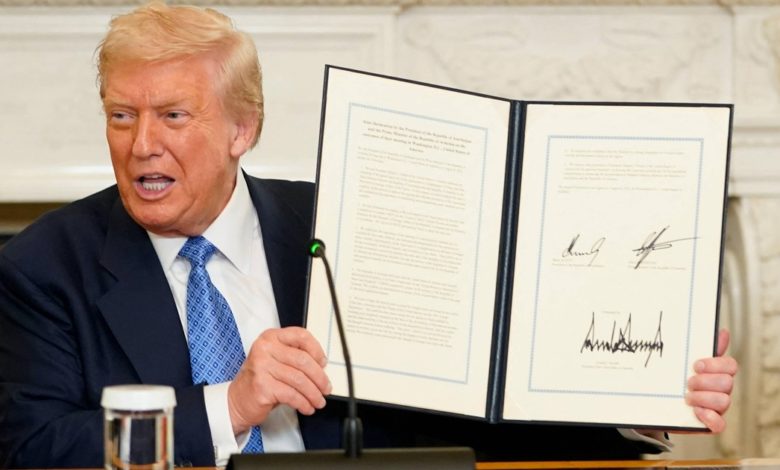
However, the icing on the cake is the announcement of creating a transit corridor, which will take the name: Trump's trail for international peace and prosperity. This corridor is to connect by the so -called The Zangezurski corridor Azerbaijan with its exclava, the Nachichevan autonomous republic, separated from the rest of the country by the 32-kilometer section of the territory of Armenia.
Both Caucasian leaders, present in the White House, agreed that the breakthrough was possible thanks to President Trump and his team. “We put the foundations for a better story than the one we had in the past,” said Prime Minister Armenia Nikol Paszynian, calling the agreement “a significant milestone”. “President Trump performed a miracle in six months,” said President Azerbaijan Ilham Alijew.
Donald Trump pointed out how long the conflict between these two countries lasted. – They fought for thirty -five years, and now they are friends and they will be for a long time – he said.
The conflict between Armenia and Azerbaijan had been growing since the early 1990s, when both countries gained independence after the collapse of the USSR. Its sources are, among others in historical past and in the distribution of the Armenian and Azerbaijani population. The main dispute is Górski Karabach – The region, which, according to international law, belongs to Azerbaijan, but for many years was inhabited mainly by Armenians and there was an unrecognized republic supported by Armenia.
– in the years 1988–1994 the first Karabask War took place, in which Armenia won a formal, though unrecognized international control over the areas of Azerbaijan inhabited by Armenians – First of all over the mountain karabak – explains Wojciech Górecki.
Onet's interlocutor adds that after the Second War of the Karabaka War in 2020 the situation changed: Azerbaijan regained some of the territories previously occupied by Armenians. – In 2023, Azerbaijan took control of the entire area of Górski Karabakh. Armenia was counting on Russia's support then – Both in defense of Karabakh and after the attacks of Azerbaijan on the territory of Armenia itself in 2022, however, help did not come. Armenia's disappointed in Moscow's attitude began to turn to the Westby sending signals about the desire to get closer to the European Union. The EU reacted positively to this – says the expert.
– After Russia's aggression to Ukraine, Moscow lost the possibility of full control over the Caucasus. In 2024, her peace forces, present there since 2020, were withdrawn. Armenia was not satisfied with Russian mediation and began to strive for direct conversations with Azerbaijan – without the participation of Moscow – says OSW analyst.
As life hates a vacuum, a new powerful player – the United States has appeared in the place of Russia.
US offer
The declaration signed last week provides for the pursuit of both Caucasian countries to peacefully resolve the conflict with mountain karabach. Talks between Armenia and Azerbaijan to release regional tensions have been going on for many months.
– Already in March, the erevans and Baku agreed all the disputed issues except one – A reference in the Armenia constitution to the Declaration of Independence, which states that Armenia and Górski Karabach are unity. Azerbaijan considers this to violate his territorial integrity. In addition, the point of the page do not have contradictory interests and are ready to sign a peace treaty, although they still do not maintain diplomatic relations or open borders – explains Onet's interlocutor.
The OSW analyst points out that signing the declaration in Washington shows that the parties do not trust Moscow, who would like to mediate in negotiations. – The US additionally offered participation in the operation of the so -called Zangezurskie corridor – a route connecting Azerbaijan with its excuse Nachiciczan through the territory of Armenia. This is a disputed topic. Azerbaijan was afraid that Armenia would control transit traffic, and Armenia – that the corridor would violate her sovereignty. The solution is to be the American trail management company, which satisfies both sides, but excludes Moscow from the role of a mediator – explains Wojciech Górecki.
What does Trump want to win?
I am asking my interlocutor why the southern Caucasus is so important that the United States decided to get involved there. – The key importance of the region was revealed, among others during a short conflict of June this year with the participation of Israel and Iran. At that time, it turned out that a significant part of the Middle East airspace became inaccessible, and the western airlines bypassed Russia's airspace. As a result, the question arose: which way can you fly from Europe to East Asia – to China or Japan – says the analyst.
– The map analysis shows that the only real corridor is the route through the Caucasus – From the Black Sea to the Caspian Sea, then through Central Asia. It is a trail leading on Georgia, Azerbaijan, partly Armenia, which bypasses both Russia in the north and Iran and an unstable Middle East in the south – adds Górecki.
The expert indicates that the South Caucasus is also an important link in the so -called Central Corridor – a running trail From the Far East through Central Asia, the Caspian Sea, the Caucasus, and then through the Black Sea to Georgia, Turkey or directly to Romania and Bulgaria. – Although the transit of goods through Russia is still functioning, the alternative trail through the Caucasus is becoming more and more important for the safety and diversification of connections between Europe and Asia – he says.
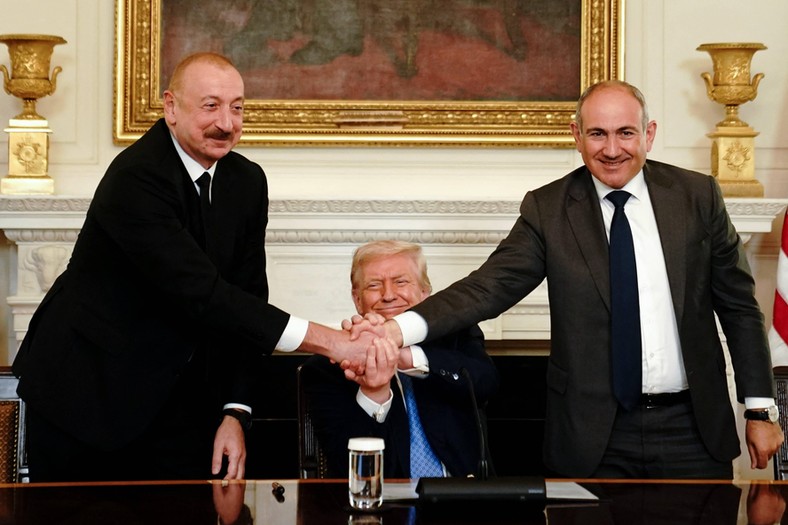
From the left: President Azerbaijan Ilham Alijew, US President Donald Trump and Prime Minister Armenia Nikol Paszynian
“Russia off the beaten track”
The southern Caucasus is a mosaic of sometimes contradictory interests of various countries: Azerbaijan, Armenia, Russia, Turkey, Iran and the United States.
– For many years, political orientation was easily described: Armenia – pro -Russian, and Azerbaijan – neutral. This arrangement persisted around 2020. Then the so -called The Second Karabaska War – says Wojciech Górecki in an interview with Onet.
Washington's provisions were picked up differently by regional powers. – Türkiye is satisfied with the current situation because it is consistent with its interests. Ankara has been supporting Azerbaijan for years and stood behind the change of status quo, which until 2020 consisted in the fact that Armenia controlled a significant part of the territory belonging to Azerbaijan – says Górecki.
The OSW analyst also draws attention to Iran, which from He is reluctant to observe the increased US presence in the region, especially the possibility that the so -called Zangezurski corridor – connecting Azerbaijan with his exclaims by Armenia – will be managed by American companies. “Tehran has recently weakened his position in regional relations, so his impact on the course of events is limited,” he adds.
Ali Akbar Welajati, an adviser to the spiritual and political leader of Iran, Ayatollah Ali Chameneia said that Tehran would not agree to the creation of the “Trump Trail”. He threatened that this corridor would become a cemetery.
Russia, in turn, although omitted by Armenia, Azerbaijan and the USA, still has some tools to influence. – Under the 1992 agreement, he formally guards the borders of Armenia with Iran and Turkey (some of Armenia's records have already spoken). Russia also controls significant economic assets in Armenia, including the local railway lines – says Onet interlocutor.
– Officially Russia declares support for the peace in the Caucasus, but emphasizes that stability will not be possible without the participation of the region's neighbors – including Russia, Turkey and Iran. This position has a warning tone, and the scale of Moscow's future activities remains unknown – adds Wojciech Górecki.
The expert emphasizes that although the declaration signed on Friday is not a peace treaty yet, he brings both sides to its conclusion. – Currently, there is a lack of armed incidents on the border, which is an additional signal that the peace process is heading in the right direction – with Washington as the main intermediary and Russia remaining off the beaten track – he concludes.