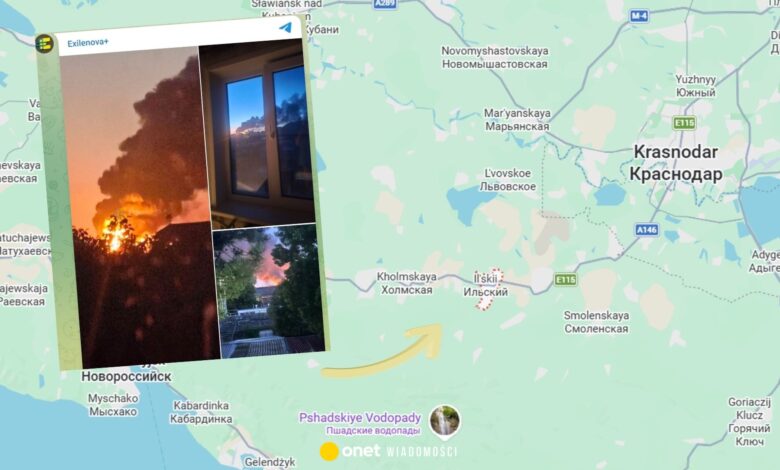
Ukraine carried out an attack on an oil refinery in Ilyskiy in Russia's Krasnodar Oblast. It was the fourth recorded attack on this facility this year. Ukrainian strikes continue to disrupt the Russian oil sector, contributing to declining refinery efficiency, rising fuel prices and fuel rationing, which has already spread from occupied Crimea to the Moscow region.
According to the regional operations headquarters, in the early morning hours of Tuesday, June 2, Ukrainian drones attacked an oil refinery in Ilskiy in Russia's Krasnodar Krai.
“According to preliminary information, there are no victims. Rescue and special services are operating at the scene,” the statement said.
Krasnodar Krai Governor Veniamin Kondratyev did not officially confirm the attack at the time of publication, although local Telegram channels circulated videos showing a large fire at the plant.
The Ilyskiy oil refinery is one of the largest refineries in the Southern Federal District of Russia, with a production capacity of approximately 6.6 million tons of oil per year.
The plant produces natural gasoline, gas condensate distillates, high-sulfur diesel oil and fuel oil. Although it exports gasoline ingredients, it does not produce motor gasoline or diesel fuel for the domestic market.
According to Russian media reports, this was the fourth attack on the refinery since the beginning of 2026. Ukrainian drones allegedly hit the facility twice in February and once in January.
The previous recorded attack occurred on February 17, when a drone strike sparked a fire at a refinery and damaged an oil storage tank. Russian authorities reported that the fire covered an area of approximately 700 square meters.
According to the Astra website, the latest attack is at least the 16th on the refinery since the beginning of Russia's full-scale invasion of Ukraine. Ukraine has not officially commented on its participation.
This attack comes in the context of an intensifying Ukrainian campaign against Russian oil infrastructure. According to Bloomberg, in May alone, Ukrainian forces carried out 15 drone attacks on Russian refineries, as well as seven attacks on oil pipelines, six attacks on ports and one attack on a tanker at sea.
The total number of attacks on Russian oil infrastructure in May was 30, the highest monthly total since the beginning of the full-scale war. The previous record was set in December, when 26 oil-related facilities were hit, including 15 refineries.
In this situation, oil processing volumes in Russian refineries continue to decline. According to OilX data, in May Russian refineries processed 4.58 million barrels of oil per day – 2.3 percent more than last year. less than in April and by 14.4 percent. less than at the beginning of the year.
Refinery capacity utilization rates decreased by 13%. on a year-to-year basis and by approximately 20 percent. compared to pre-war levels in 2021, reaching the lowest level since October 2009.
Oil companies, faced with lower production volumes, have significantly reduced gasoline supplies to commodity exchanges, where fuel is purchased by independent and private gas stations.
In May, supplies of AI-95 gasoline dropped to about 5,000 tons per day, one third less than a year earlier. Wholesale gasoline prices increased by 26%. since the beginning of the year, while retail fuel prices have increased by 4.3%.
In response to growing pressure on domestic fuel supplies, Russia introduced a gasoline export ban in March. In June, restrictions were extended to the export of aviation fuel.
Fuel shortages are already occurring in several regions. In occupied Crimea, authorities introduced fuel rationing and a coupon system due to supply disruptions.
The fuel crisis is now spreading deeper and deeper into Russia, and shortages have already reached the Moscow region.
According to The Moscow Times, gas stations in New Moscow – an area incorporated into the Russian capital in 2012 – have started limiting the sale of gasoline to 60 liters (about 16 gallons) per customer and diesel to 100 liters (about 26 gallons).
Fuel prices in Moscow also continue to rise. Over the past week, the average price of diesel fuel increased by 56 kopecks to 78.49 rubles (about $0.98) per liter (or $3.71 per gallon).
The price of AI-92 gasoline increased by 24 kopecks to 64.67 rubles (about $0.81) per liter (or $3.07 per gallon), while the price of AI-95 gasoline increased by 35 kopecks to 71.46 rubles (about $0.89) per liter ($3.10 per gallon).