The incredible story of the people no one wanted at the front. The Lesson of the “Smoking Serpents”

The Second World War offered everything, cruelty, death, destruction. But also motivational stories. And one of these was given by a detachment of soldiers that no one had bet on. They became true legends of the toughest battles of the war.
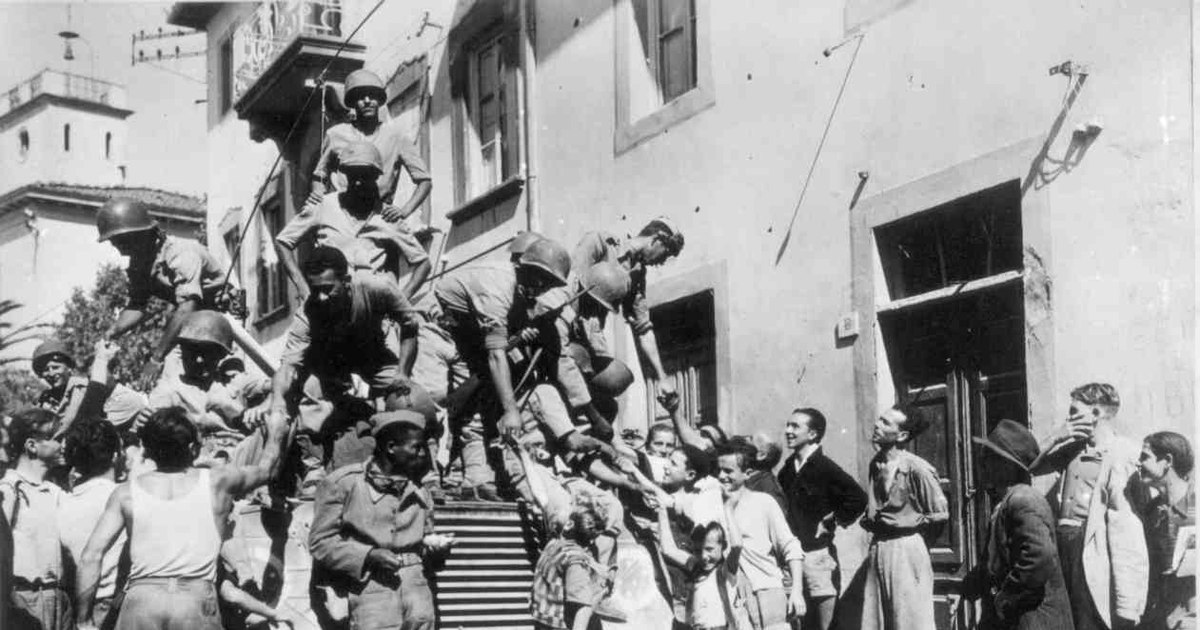
Brazilian soldiers welcomed by Italian locals PHOTO wikipedia
World War II was the most devastating conflict in human history. It meant death, destruction, pain, trauma, and indeed one of the historical events that completely changed the destiny of mankind. In addition to all these atrocities, the Second World War was the perfect proof that humanity does not disappear even in the cruelest moments of its existence. At the same time, he also offered many life lessons. One of these was that of the “Smoking Serpents”.
They were a Brazilian expeditionary regiment that nobody gave a damn about. They were humiliated, underestimated, cast aside, considered unworthy of such a harsh conflict. In just a few months, they became the heroes who saved hundreds of thousands of lives. After September 2, 1945, when the Second World War ended, no one laughed anymore when they heard of the “Smoking Snakes”, and their funny emblem on the right sleeve of the uniform became a symbol of the elite and the soldier who deserved respect.
Laughing at the world….from samba to war
In 1939, when Nazi Germany was invading Poland, and even after that, when Hitler was rampaging through Europe, across the Atlantic no one bothered about European wars. Much less Brazil, a country of paradoxes, vast but sparsely populated, rich in resources but with many people living a poor life.
No one would have imagined that the country famous for its luxury beaches, samba and football would have any role in the Second World War. No one imagined that Brazil would be able to fight in such a conflict, considering that the last war it had participated in was against Paraguay in 1870, that is, seven decades ago.
Not to mention the fact that there was a significant community of supporters of the Axis powers, especially Germany, in Brazil. Besides, Brazil had other worries, especially with its rival, quite aggressive in South American politics, Argentina. And not just on the football field.
However, the Japanese attack at Pearl Harbor came, which managed to completely change the fate of this war and, including, the history of mankind. It is known that, disturbed by the American economic sanctions, but also by the fact that the USA had settled in the Pacific, the Japanese decided to attack first and launched a surprise, devastating attack, without any declaration of war, on the American base at Pearl Harbor. They destroyed part of the American fleet, but only awakened a sleeping giant. Basically, they got the US into the war on the side of the Allies.
Brazil, a country economically linked to the Americans, has declared itself a supporter of the US in this conflict. Brazilian President Getúlio Vargas stated, after US President Franklin D. Roosevelt wanted to ensure that the United States' neighbors were on its side, that “Brazil must now stand or fall with the United States.”
This declaration was made at the Rio Conference in January 1942 and was in no way a declaration of war against the Axis powers. Especially since “breaking relations with Germany, Italy and Japan will lead to war, and the Brazilian army is not prepared for war”, declared the Minister of War Eurico Gaspar Dutra.
But Vargas was determined to transform his country into a regional power, relying on the alliance with the US. Although it did not officially enter the war, Brazil would, from 1942, provide its resources, land for bases to control the South Atlantic, and eventually a fighting force to carry the war into Europe.
Americans were excited about the first two offers, less so about the third. Namely the participation of the Brazilian army in the war. The Americans did not consider it good for anything. For his part, the Brazilian president avoided declaring war on the Axis until he received military equipment from the Americans.
The Brazilian president was determined to make his country a fighter, even if no one gave him a chance. Even the Brazilians had become the subject of banks and it was said that they would go to war “when the snakes smoke”. That is the equivalent of the phrase “when pigs will fly”.
The “Pearl Harbor” of Brazil
Washington had hoped, through the Rio Conference, to induce all eight South American republics to sever relations with the Axis powers. In the end, only Brazil did so, and even if it had the support of its neighbors, the decision was fraught with danger.
The Brazilian army was beyond criticism in terms of equipment and training. Besides his lack of war experience, his last serious training and equipment had been provided by a French mission two decades earlier. And the Brazilian officers had not really impressed the French.
Military equipment was the country's main weakness. The Brazilian military had a motley mix of American, German, Czech, French and Italian weapons and vehicles. Its air force, created in 1941 by combining Navy and Army aviation, operated nearly 500 obsolete biplanes and light transport aircraft.
The tragedy of a family and a house: Candiano-Popescu
Aware of what he has in store, Vargas tried to blackmail the Americans: if they want Brazil's resources and bases, they must provide military equipment. The Americans, with their overstretched war industry, refused to give weapons to an ally they despised or had not yet tested on the battlefield.
But then came the summer of 1942. Kriegsmarine U-boats sank several Brazilian merchant ships off the East Coast of the United States. Then, in June, Adolf Hitler decided that Brazil's pro-American stance constituted an act of war and launched a “submarine blitz” in retaliation.
In August alone, a single long-range submarine, U-507, sank six Brazilian ships in just two days. The country was seething with anger. Suddenly, the Brazilian people were demanding revenge. And Vargas gave him satisfaction: he declared war.
It took a year, however, for the Brazilian army to raise enough troops to fill the ranks of the Brazilian Expeditionary Force (Força Expedicionária Brasileira or FEB). The new force, according to the agreement with the United States, was to be led by General João Batista Mascarenhas de Morais. This was a 61-year-old serviceman, the oldest Allied divisional commander in Europe.
The Brazilian army, however, was organized according to American military standards.
When the snakes start smoking
By November 1944, the Allied campaign to liberate Italy had already entered its second year. What should have been a simple mission, especially since Fascist Italy had fallen, turned into a terrible war of attrition.
The Germans had occupied Italy and had set up the Gothic Line, a defensive network stretching from the Ligurian Sea to the Adriatic Sea. Facing this last obstacle were troops drawn from nearly three dozen Allied nationalities, including Americans, British, Indians, Greeks, South Africans, Canadians, New Zealanders, and Gurkhas from Nepal. No one could break through this desperately defended line. The longer the war went on, the more people died.
The Brazilians wanted to go to the front. The Americans put their hands to their heads. They didn't know where to send them so as not to get confused, in a quiet and mundane area of the front. Brazilian leaders had envisioned sending an army of 100,000 men to participate in Operation Torch. But the North African campaign was over before they could get there, and the force was reduced to one large infantry division, the First Expeditionary Division, and an airborne detachment.
The American generals believed they had finally found a quiet place to hold the small Brazilian military force, the subject of benches for all. More precisely, in Italy. In the meantime, however, the situation has changed completely. The Italian front had become one of the toughest in Europe. A disaster, the Americans thought, especially when they looked at the Brazilians' badge, a snake smoking a pipe. Well, these soldiers with funny badges, underestimated and humiliated by the Allies, caused a huge surprise. The snake actually started smoking. But not anyway, but in a big way, Brazilian.
South American “snakes”, heroes in the Mediterranean
The 25,000 Brazilian soldiers and pilots who arrived in Italy gave a true lesson in courage. But at the same time, they taught everyone that you shouldn't underestimate anyone. The “Smoking Serpents” played a brief but important and fascinating part in the struggles of Europe. After a quick retraining to bring them up to American standards, the “Smoking Serpents”, now finally equipped with American weapons, uniforms, vehicles and radios, were sent to the Gothic Line, the vast Axis defense network stretching across Italy. Once at the front, the newcomers, nicknamed “febianos” or “pracinhas”, proved to be real demons. That is, some extremely brave and efficient soldiers.
The most important politician of the century, crushed by a deep suffering. How the family refused the love of the man who changed history
The Brazilians quickly adapted to the Italian front and impressed in the battles with the much more experienced German troops. One of the great Brazilian victories was at Monte Castello, a large hill on the border between the regions of Tuscany and Emilia-Romagna. After this battle, no one wanted to talk about the Brazilians anymore, and the pipe snake became the symbol of military valor and courage. Brazilian troops attacked the hill at Monte Castello four times in November and December 1944. After the December assault, a German officer told a captured Brazilian lieutenant:
“Honestly, you Brazilians are either crazy or very brave. I have never seen anyone advance against machine guns and well-defended positions with such disregard for life. You are devils.”But it was far from the Brazilians' greatest feat of arms. On February 21, 1945, in Operation Encore, the Brazilians attacked again with great courage. They suffered heavy losses, but covered themselves in glory.
In April 1945, when the First Expeditionary Division was ordered to liberate the town of Montese from the German 148th Division and three fascist Italian divisions, the Brazilians did not hesitate. After four days of hard fighting, the Brazilians suffered heavy losses but managed to impress again. They captured two generals, 800 officers and 14,700 Axis soldiers. The 148th Division was the only intact German division to surrender on the Italian front. And surrendered to the Brazilians.
At home, overseas, the newspapers wrote about the victories of the Brazilian troops. “The young Brazilians who planted the Brazilian flag on the top of Monte Castello will conquer for Brazil the place it deserves in the world of tomorrow”stated the journalists from Correio da Manhã. During the 229 days of combat, the Brazilians proved their worth to Allies and enemies alike.