Specialists agree: space is increasingly becoming a battlefield. This is visible not only in the creation of our own space forces, such as the US Space Force or the formation of special forces for space flights in Russia and China, but also in weapons tests and billion-dollar investments in military space programs.
Now we are dealing with another escalation: the disturbing approach of Russian satellites to a Western space reconnaissance satellite that is tracking and analyzing Russian movements in the war in Ukraine.
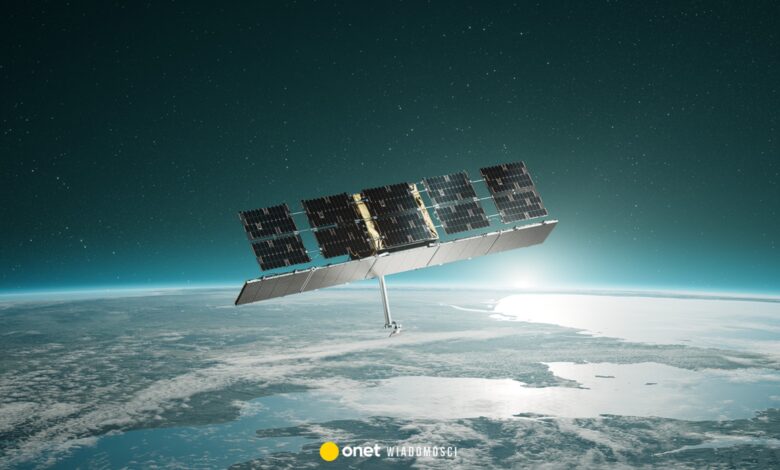
It's about four or five Russian Kosmos satelliteswhich were directed into the immediate vicinity and into an almost identical orbit as the Finnish-American satellite ICEYE-X36. The distances between the eastern and western satellites were to be reduced to as much as 500 m. In an orbit at an altitude of approximately 550 km, this is an extremely close approach. The Russian satellites in question — designated Kosmos 2610 to 2613 — were launched in mid-April aboard a Soyuz rocket in northern Russia.
Space race
The ICEYE satellite provides reconnaissance data for Ukraine. It uses radar technology that allows it to recognize the area it is flying over, even at night and through clouds. The resolution of satellite data is so precise that objects as large as 25 cm can be detected.
The Finnish company ICEYE, founded over 10 years ago, is currently growing rapidly. Since 2018, it has sent over 70 satellites into space. ICEYE is currently recognized as operator of the world's largest fleet of radar satellites (Synthetic Aperture Radar).
At the end of 2024, cooperation between ICEYE and the large German arms company Rheinmetall was initiated. In 2025, this led to the official establishment of the ICEYE Space Solutions joint venture. In December 2025, the alliance received an order from the Bundeswehr worth EUR 1.7 billion (PLN 7.2 billion) for a fleet of radar satellites for the army. Satellite production is scheduled to start by the end of the year in Neuss.
Among military experts, the approach of Russian satellites to the ICEYE X36 satellite is seen as an alarm signal.
Electronic warfare
This is “an alarm signal for Europe,” we read in the specialist publication “Orbital Foresight.” Moscow is probably not testing a literal war campaign of physically hunting down commercial satellites. “It wouldn't make much operational sense,” experts say.
Rather, the picture here is of a more comprehensive method space geopolitical confrontationwhere orbital pressure, ambiguity, intimidation, and constant probing become normal elements of strategic competition. According to experts, Russian satellites may be preparing electronic jamming maneuvers against the ICEYE satellite. Russia tests electronic warfare in orbit. This is more likely than a devastating kinetic attack.
Russian satellites approaching Western satellites is nothing new. European security officials estimate that over the last three years, at least 17 key European satellites have been tracked or compromised by Russian intelligence satellites to intercept signals (SIGINT).
This fuels fears that Moscow may not only steal secret data, but also actively take over satellites to “bring them back to Earth,” reports the industry website satnews.com.
The Achilles heel of the West
These maneuvers are described as “space stalking” or a hybrid attack. The main participants in orbital espionage so far have been the Russian satellites Luch-1 (launched in 2014) and Luch-2 (launched in 2023). According to data from the French space monitoring company Aldoria, Luch-2 carried out risky short-range maneuvers, remaining for weeks at a distance of only 20 to 200 km from sensitive geostationary (GEO) satellites.
Maj. Gen. Michael Traut, who heads the Bundeswehr's Space Command, confirmed that the Russian missiles likely intercept “command links” — those unencrypted communications channels through which older satellites receive commands from ground control.
German Defense Minister Boris Pistorius has warned that satellite networks are the “Achilles heel of modern societies”. He pointed out that an attack on these systems could paralyze entire nationsdisabling GPS, the banking system and secure military communications.